


NEW YORK: A senior UN official has warned that atrocities in Sudan are being repeated “on a cycle” as the country enters its fourth year of war, urging the international community to act decisively to end the conflict and prevent further suffering.
Denise Brown, the UN’s top humanitarian official in Sudan, said the country is witnessing recurring patterns of violence, displacement, and abuse.
Urgent global attention beyond humanitarian aid is needed, she said.
“As we finish the third year of the war, we really are on repeat in Sudan: repeats of sexual violence, repeated displacement, repeated death,” Brown told reporters on Monday.
“It feels like we’re stuck in this cycle, and everything is being repeated.”
Speaking from Khartoum, Brown questioned the lack of stronger international response: “Why isn’t the world outraged enough to do something about it? What more has to happen for everyone to pay attention to find a solution?”
Brown said that while humanitarian agencies remain active on the ground, they cannot resolve the conflict.
“We are here picking up the pieces, we are not the solution,” she said, calling on UN member states to focus on ending the war, including addressing arms flows and the war economy.
The warning comes amid mounting evidence of widespread atrocities, particularly in Darfur, where patterns of sexual violence have been extensively reported.
“Rape and gang rape (are) well documented,” Brown said, citing a recent report by Medecins Sans Frontieres that treated nearly 2,500 survivors of sexual violence in the past year alone. “No safe space (is) left for women and girls in Darfur.”
She added that the consequences extend beyond immediate violence, pointing to cases of forced impregnation and the long-term impact on victims, families, and communities.
Brown also highlighted mass killings in Al-Fasher, where “6,000 people (were) killed in three days (and) that’s only what we could verify,” warning the actual toll is likely much higher.
She highlighted the finding of a UN fact-finding mission that identified “hallmarks of genocide” in the conflict.
On the ground, conditions continue to deteriorate. Brown expressed deep concern about Dilling, a town in South Kordofan that has come under renewed attack after aid convoys briefly reached it earlier this year.
“The people that I met there (are) now trying to flee,” she told Arab News.
“The children who are still there, (there) is no safe passage out. It’s being bombarded every single day,” she said.
Access for humanitarian aid remains severely constrained. “Our convoys are no longer able to get in,” she added.
In Blue Nile state, almost 30,000 people have recently been displaced by escalating violence, with Brown planning a visit to assess the situation.
She warned that without a political solution the crisis would only deepen. “We see no slowing down the systematic, widespread sexual violence, (no) reason at all to believe it will stop,” she said.
“The longer this goes on, the deeper that hole becomes for the people of Sudan.”
Brown also raised alarm over critical funding shortages for humanitarian operations. The UN’s response plan for Sudan is currently only 16 percent funded, far below the $2.9 billion required this year.
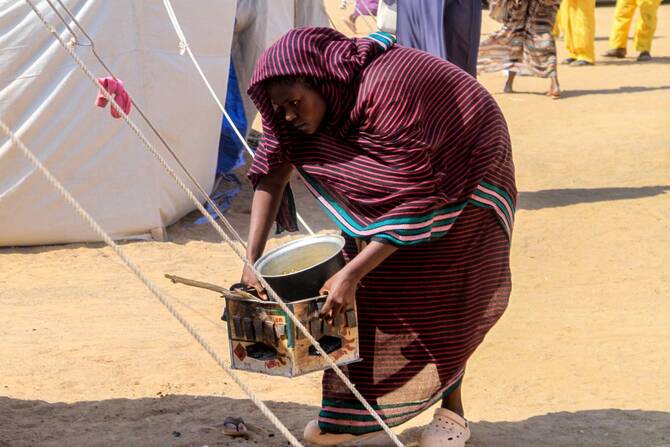
“When we get a tent (that) tent doesn’t become six tents. That tent is one tent,” she said. “Imagine what we are able to do with 16 percent of what we need.”
While expressing gratitude to donors, she said that far greater support is required to meet basic needs.
She also pushed back against describing Sudan as a “forgotten crisis.”
“Please don’t call this a forgotten crisis,” Brown said. “I’m referring to this as an abandoned crisis.”
Despite the bleak outlook, she pointed to local peace efforts as a source of hope, highlighting community-led initiatives aimed at preventing further divisions.
“These communities … are determined not to get caught up in hatred,” she said, adding that grassroots efforts may offer the most realistic path toward progress while broader diplomatic efforts continue.


