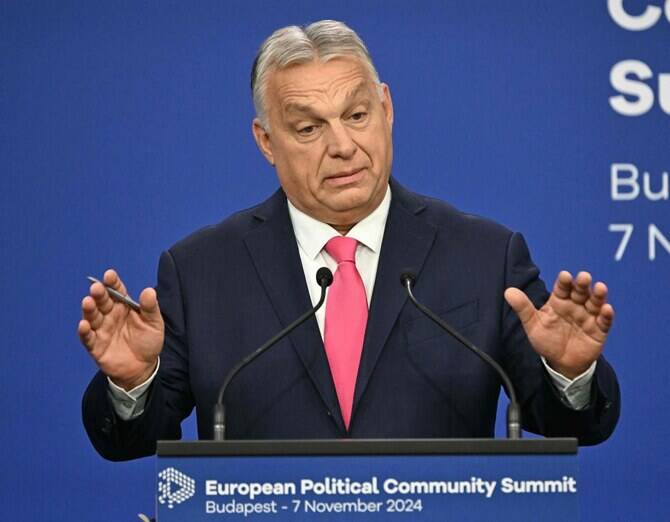
PRAGUE: Czech and Slovak leaders backed Prime Minister Viktor Orban on Saturday on the eve of Hungary’s parliamentary election, saying he was the best choice for the country’s interests.
Opinion polls indicate Orban, a nationalist who has clashed repeatedly with Brussels and has friendly ties with Russia, could be ousted in Sunday’s vote after 16 years in power.
“I have never met such a warrior for sovereignty and national interests of one’s country as Hungarian Prime Minister Viktor Orban,” said Slovak Prime Minister Robert Fico.
Under Fico, who is in power for a fourth time since 2023, Slovakia has been key ally for its neighbor Hungary, with both keeping warm relations with Moscow, opposing European Union sanctions and continuing to buy Russian oil and gas.
Both have clashed with EU institutions over the rule of law.
Czech populist Prime Minister Andrej Babis, a billionaire businessman who has turned from a liberal pro-EU politician into a close Orban ally in their Patriots for Europe faction in the European Parliament, also voiced his support.
“He (Orban) has always fought for a stronger Europe, one built on peace, sovereign nations, sovereign member states, competitiveness,” Babis said on X.
“In turbulent times, choosing stability and proven leadership matters more than ever,” Babis added.
Since Babis returned to government last year after a stint in opposition, the Czech Republic has slashed aid to Ukraine and, following Hungary and Slovakia, refused to participate in EU’s 90 billion euro ($105.47 billion) loan for Kyiv.
The Czech position on Russia has, however, remained more mainstream than those of Hungary and Slovakia.
Babis’s cabinet, which includes a far-right anti-NATO party, is trying to reverse EU decarbonization policies, and is preparing legislation to revamp public media and bring non-governmental organizations under closer scrutiny.
His opponents say the plans are modelled on Hungarian and Slovak reforms that undermine democratic standards.


![]()

Czech, Slovak leaders back ally Orban ahead of Hungary vote
Short Url
https://arab.news/8eh4z
Czech, Slovak leaders back ally Orban ahead of Hungary vote
- “I have never met such a warrior for sovereignty and national interests,” said Fico
- “He (Orban) has always fought for a stronger Europe,” Babis said


Latest updates


© 2026 SAUDI RESEARCH & PUBLISHING COMPANY, All Rights Reserved And subject to Terms of Use Agreement.