

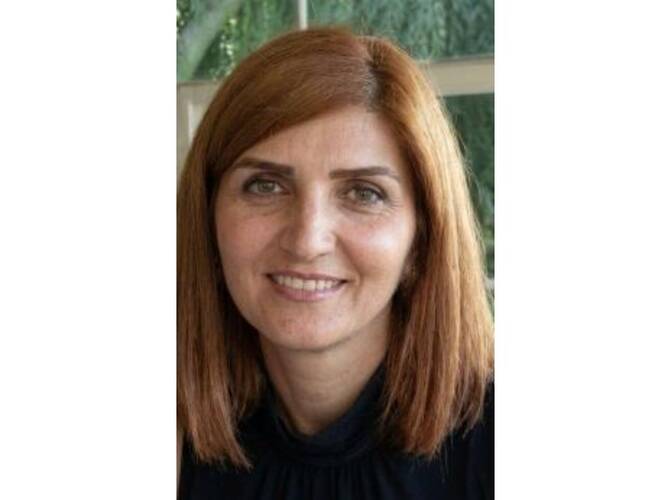

BEIRUT: Rana Shaya Malaeb was shopping for medicines, baby formula and diapers for displaced families when an Israeli airstrike hit the pharmacy.
The mother of two had spent weeks volunteering to help people forced from their homes by the war. On Wednesday, she was killed inside the store in the town of Kayfoun, one of dozens of locations hit in a furious wave of Israeli strikes across Lebanon.
“She was always smiling as she collected donations and bought medicine for displaced people who had moved to Mount Lebanon,” her friend Farah Abi Murshed told Arab News. “She was doing everything she could to ease their suffering.”
Recalling the final encounter, Abi Murshed said: “She told me she was heading back to Baisour, where she lived, after picking up supplies but she never arrived. I learned of her death through a local social media group. It was devastating.”
Malaeb had fully committed herself to humanitarian work since the start of the current war a little over a month ago, which has displaced more than a million people.
“She hailed from a family that rejects political divisions and was not affiliated with any political faction. She raised her sons to love their country,” she added.
The strike on the pharmacy was particularly deadly. At least 25 people were killed in the building, according to Mohammed Al-Hakim, head of the Kayfoun Charity Association, which had relied on the facility to provide affordable medicines for residents and thousands of displaced persons.
Other victims included an oncologist, Dr. Nabil Shamseddine, his wife and their five children, as well as relatives who had sought refuge with them after fleeing the southern city of Tyre.
Also among the dead were Suzanne Khalil, a journalist who had accompanied Malaeb on her aid rounds; pharmacist Said Khansa; pharmacy worker Fatima Amhaz; a 15-year-old volunteer; and two sisters, one of them a social activist and the other an academic who had recently returned from the US.
Some of those who died were at the pharmacy seeking treatment for chronic illnesses. Others were there simply because it had become a lifeline for a community overwhelmed by displacement and war.
“Nothing can justify what happened,” Al-Hakim said. “This pharmacy served locals and around 25,000 displaced people who fled Beirut’s southern suburbs and the south.”
Malaeb’s husband, Suhail, described the loss of his wife as immeasurable.
“I lost my partner,” he told Arab News. “She was devoted to helping others and did everything in her power to meet their needs. I will try to continue on the same path with our two children despite losing my life partner.”
Malaeb’s body was identifiable only by a distinguishing mark due to the extent of the damage caused by the blast, Abi Murshed said.
She was among more than 300 victims of Wednesday’s strikes whose identities have been confirmed so far, according to Lebanon’s Ministry of Health. Authorities say they are awaiting the results of DNA testing on the remains of many more people, underscoring the scale of destruction.
About 100 strikes hit several locations across Lebanon in the space of just 10 minutes on Wednesday, killing civilians in their homes, workplaces and shelters.
Obituaries and tributes to the victims appeared across social media. Among them was Ali Zaiter, an academic specializing in economics and development and a senior figure at the Lebanese University’s Institute of Social Sciences, and Khatoun Salma, a poet killed alongside her husband in a strike on a residential building in Beirut. Ola Attar, who lost her husband in the August 2020 Beirut port explosion, also died in the capital, leaving behind two children.
For many relatives and friends of the dead, the grief is compounding.
“Israel killed our brother a month ago, and now my sister,” one man said as he mourned the loss of his siblings. “We will pass on the pain we feel to our children.”


