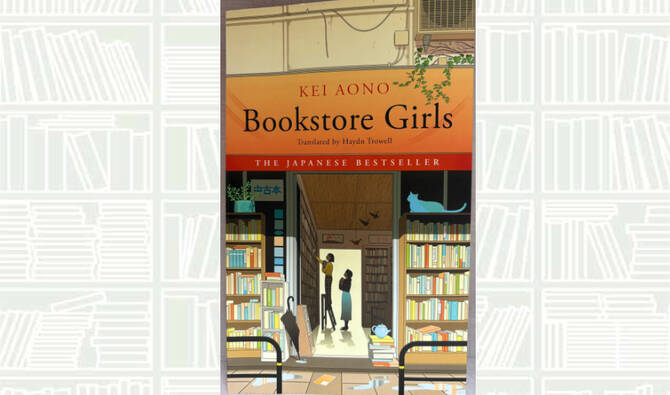

Author: Kei Aono
The Japanese bestseller “Bookstore Girls” is one for the shelf.
Originally published in Japanese in 2012 and translated into English in 2025 by Haydn Trowell, it is the first of this successful series of books to be translated into English.
Although not usually a fan of fiction, I find that contemporary translated Japanese titles do pique my interest. And this was one that was both minimalistic and packed with emotion.
In this narrative you meet two women in Tokyo: 40-year-old Riko Nishioka, hard-working assistant manager of the flagship Pegasus bookstore in Kichijoji, and her nemesis, 27-year-old Aki Kitamura, whose family connections landed her a job at the same bookshop.
These women could not be more opposite. Yet they are also somehow exactly the same.
The opening scene takes us to Aki’s lavish wedding as Riko reluctantly sits as a guest.
While Aki, donned in her perfect wedding dress, actively tries to avoid tossing the bouquet to the wrong hands, it lands — literally — on a surprised Riko.
Both women are bitter about it. Aki claims it ruined a perfectly good moment on the wrong person, and Riko — feeling mocked for still being single while her much younger colleague found love and marriage — has her confidence and mood ruined.
Neither of them handled the incident gracefully — exchanging angry words and making an already tense relationship at work even more awkward.
One chapter comes from the perspective of Riko, the next from Aki’s. We are able to delve into their psyches and how they contemplate and compartmentalize their inner thoughts about the same incidents.
Like books on a shelf, they are hard to read without cracking them open. This alternate chapter structure helps guide us into their inner monologues.
When the bookshop is at risk of shutting forever, they have a decision to make: either push their differences aside and work together to save the store or maintain their tangled emotions and pride.
My opinion of the women changed page by page.
The author, Aono, is well known and celebrated for her work crafting friction in fiction, and this book has received the stamp of approval from swarms of avid readers, who are already spoiled for choice. There is no shortage of Japanese books about bookshops, but this one made the charts.
Over 200,000 copies were sold in Japan upon its release and it was adapted into a TV show after the third book in the series scored the grand prize at the Shizuoka Bookstore Awards.
To his credit, Trowell, an Australian translator of Japanese literature, seems to have captured the eccentric mannerisms of these women. He also seems to have nailed the perhaps intrusive thoughts accurately and in such an animated way that made me both relate to and perhaps detest one — or maybe even both — of these women.
In the end, books and what they represent were the real winners in this story and this one fits nicely on my shelf.