
CHICAGO: Following the ceasefire announced on Tuesday between the US and Iran, significant uncertainty remains around its terms and whether it will hold.
With officials from both countries expected to begin negotiations on Friday in Islamabad, the ceasefire is widely seen as a narrow and fragile window for diplomacy.
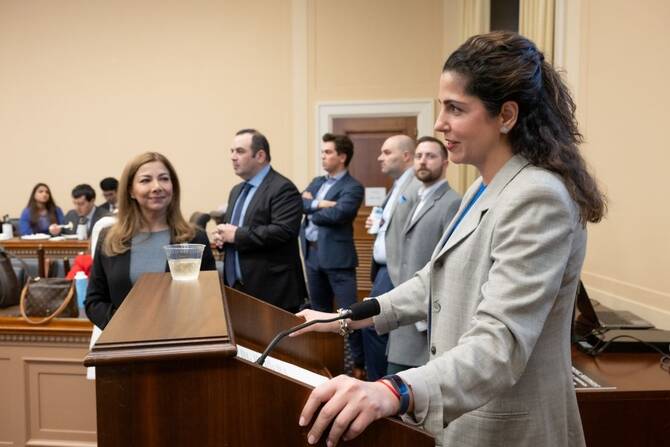
It is “a critical opportunity to reassess strategy and avoid renewed escalation, particularly tactics that could harm civilians or destabilize the region,” Dr. Neda Bolourchi, executive director of the Public Affairs Alliance of Iranian Americans, told Arab News.
“While the ceasefire is a welcome pause, it’s clearly not a resolution. The underlying risks remain, and if military objectives expand beyond limited, targeted actions, we could very quickly see a return to escalation.”
Bolourchi emphasized that while many Iranian Americans initially supported targeted military action and regime change, there has been growing concern about the expansion of tactics to include civilian infrastructure.
Those concerns have intensified as rhetoric has shifted toward bombing bridges, health organizations, power stations, transit systems, and sending Iran “to the stone age” — language that is undermining support, including among the more than 1 million Iranian Americans in the US, she said.
Many of them are particularly concerned about the safety of family and friends in Iran, she added.
In a PAAIA survey, “a significant portion of respondents identified civilian casualties and broader instability as top concerns,” she said. “That concern has been consistent throughout.”
Drawing on her background as an academic and former advisor to the departments of defense and state, Bolourchi cautioned against direct comparisons to US operations and wars in Venezuela, Iraq and Afghanistan.
“Those regimes, especially Venezuela and Iraq, were more vertically structured, meaning leadership removal had more immediate systemic effects,” she said.
“The Islamic Republic, by contrast, is more horizontally structured and has greater capacity to regenerate leadership, which significantly and substantively complicates any regime-change strategy.”
She said historical experience in Iraq, Afghanistan, Syria and elsewhere raises serious doubts about the feasibility of externally driven regime change.
“There are over two decades of US involvement in the Middle East where attempts at regime change haven’t succeeded in producing stable outcomes,” she added.
“Instead, these countries have struggled to achieve stable post-conflict governance, often resulting in fragmentation or state breakdown.
“On top of the devastation to those countries and their populations, these efforts have come at enormous cost — trillions of dollars and tens of thousands of American lives.”
She said: “When we talk about regime change, we need a clear definition. Historically, the data doesn’t support its success as a full transformation of government, particularly in cases like the Islamic Republic … Even with a massive deployment of US troops, which I don’t recommend, the costs would be extraordinary, and the outcome would still be highly uncertain and potentially catastrophic.”
Bolourchi added that while many Iranian Americans support regime change, there is divergence in how far individuals are willing to go to achieve it.
“There’s a spectrum within the community,” she said. “Many support regime change as an outcome, but not necessarily the full range of military actions required to achieve it.
“Some are more willing to accept extensive force, but many others aren’t, particularly when it raises the risk of mass civilian harm, further entrenching the regime or triggering broader instability.”
She added: “More limited, targeted objectives tend to retain strong support, but broader escalation fractures the consensus and makes the already difficult prospect of meaningful regime change even more uncertain.”
When asked what she would advise US President Donald Trump to do, Bolourchi urged a return to clearly defined objectives and “focus on what’s actually doable. If these operations continue, they should remain narrowly focused on degrading missile capabilities and limiting the regime’s ability to project power.
“Rhetoric needs to be curtailed. There shouldn’t be confusion as to whether the president is talking about the Islamic Republic or the people of Iran and their culture and civilization that dates back 5,000 years.”
She also warned against actions that could escalate regional and humanitarian risks. “You can target facilities involved in missile production — those are achievable objectives,” she said.
“But targeting nuclear plants would be extraordinarily dangerous, and that’s not a decision that the IAEA (International Atomic Energy Agency) or regional actors would support as they’d also bear the consequences of the fallout.”
She said there appears to be some strategic restraint in avoiding broader targeting of Iran’s conventional military.
“One potentially positive development is that the regular army has largely not been targeted,” she added. “If true, that suggests some lessons may have been learned from Iraq — namely, not dismantling entire state structures.
“There appears to be a focus on the more ideological Revolutionary Guards, and moving down the ranks eliminating them, while leaving the more ‘professional military’ intact.”