

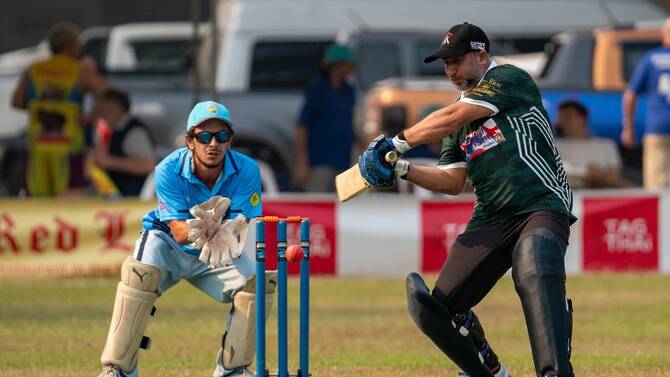

Since 1997, except for the years impacted by the COVID-19 pandemic, I have traveled at this time of year to play in the Chiang Mai International Cricket Sixes, or CMS, in northern Thailand.
This year, my flights were canceled and I could not find suitable alternatives. My team is the Drifters, named during a tour of the West Indies back in the 1970s. The composition of the team has changed over the years, but it has always been an eclectic bunch of cricketers. A number of them played high-level club cricket, several have played county cricket, while two played for England, five for Scotland, two for the Netherlands, one for France, one for Papua and New Guinea and several for Sri Lanka.
The Drifters team is one of only three teams to have played in every CMS since the first one in 1988. Then, all of the team traveled from the UK, a situation that continued until circa 2000. In two years prior to that, two teams of Drifters took part. After 2000, when I took over the task of organizing the team, the number traveling from the UK dwindled, owing to retirements and rising costs. Australian and local Thai friends were recruited. Other teams from England have been similarly affected to the point where their percentage representation has dropped to 15 percent.
In comparison, the representation of teams from Australia has held firm, as has the number of teams based in Thailand, although their composition has changed. Once made up mainly of ex-patriots, there has been an increase in the number of young Thai players and teams. This is the result of a concerted effort by people associated with the Chiang Mai Sixes to develop young Thai talent in northern Thailand. The international reach of the Sixes varies from year to year. This year a team from the Maldives participated, while regular participants from the UAE, New Zealand, Vietnam and Japan were present. In previous years there have been teams from Bahrain, Malaysia, Hong Kong, Bangladesh, Pakistan, Singapore, Zimbabwe and South Africa.
In 2026, 32 men’s teams and four women’s teams participated, compared with 16 in 1988. This number increased gradually year on year until 2002 saw the participation of 30 men’s teams and two women’s teams. A capacity limit was reached in 2008, with 36 men’s and four women’s teams, a number also achieved in 2018. This number places great pressure on time and space.
A number of initiatives have been introduced over the years to address this. These have included bowling all overs from one end, the next batter in standing at square leg, while the need to bowl another delivery if wide ball is called has been removed, unless it is bowled off the last ball of the last over of an innings. One year a bowler in the Drifters team had an attack of the “yips,” whereby he was unable to bowl straight, leading to wides accounting for 70 percent of the opposition’s total score and using up valuable time in embarrassing circumstances.
The Sixes competition rules that define a wide delivery are extremely stringent and the margins for error are very low. The Drifters bowlers still generate their fair share. However, in the past two years the quality of batting has overridden any such problem, to the extent that the Sixes Cup was won in 2025 for the first time since 1996 — as reported in this column a year ago — and retained in 2026. In a sign of changing times, the 2025 contained team two players who had traveled from England. This year the players were drawn entirely from Thailand, mainly Pattaya Cricket Club. This was formed in 2010 by a group of ex-patriot enthusiasts, one of whom is a long-standing Drifter. He has been instrumental in building the club into a major force in Thai club cricket, winning the Division A of the Bangkok Cricket League in three of the past four seasons. This success has now spilled over to benefit the Drifters, as the team enters a new phase of its evolution.
Given that I was unable to travel to Chiang Mai, it was necessary to decide how to fill this unwanted and unexpected void. The English County cricket season opened on April 3, thought to be the earliest date in its current format, pushed to the extremities of the season by the need to accommodate The Hundred in August. It felt too cold to watch at this time of year. Instead, I visited the National Maritime Museum in Greenwich, southeast London, which holds a collection of historical images of cricket matches.
There was a photograph of passengers playing cricket on the cruise ship Iberia in 1954 while at sea. Another photograph shows a match being played on asphalt in an urban setting. The nearby Royal Observatory, famous as the place that defines zero degrees longitude for the world, once had a cricket team, which played locally. The guide informed me that a match had taken place between a team of men with one leg and a team of men with one arm. They were Royal Navy sailors who had been pensioned off and housed in Greenwich Hospital, which operated between 1692 and 1869.
Further research revealed that the earliest match on record between a team of Greenwich Pensioners with one leg and a team with one arm was played on nearby Blackheath in 1766. There is reference to this match in “The Recreative Review,” a book published in 1822, in a chapter called “Wagers.” Although the initial purpose of the match was to raise money for the wounded sailors, it was also an opportunity to use cricket as a mechanism for gambling that became popular from the mid-18th century. The match was accompanied by sideshows and family entertainment.
A match between one-legged Greenwich Pensioners and one-armed Chelsea Pensioners was reported in August 1796. This was played in Montpellier Gardens near to the Beehive Public House in Walworth, also in southeast London, but nearer the center. Details are misty, but it is thought that members of the Beehive/Montpellier Club, including aristocracy, were among those who formed Surrey County Cricket Club in 1845, based nearby at Kennington Oval. A thousand guineas were at stake for the match, suggesting the involvement of aristocracy. The match began at 10 a.m., with the one-legged team scoring 93 runs. During the first innings of the one-armed team, a crowd of people stormed the gates in an attempt to enter the packed ground. Three hours later the game resumed, the one-armed team totalling only 42 runs. The second innings of the one-legged team was curtailed by fading light and resumed on the second day, totalling 104. A target of 157 was too much for the one-armed, who scored only 57. In a re-match the following week, the one-legged team won again.
It is uncertain how many matches have been played between teams of one-limbed players. The Sporting Magazine of August 1811 describes a match at Walworth, also with a 1,000 guineas stake. Evidence exists of another five matches between 1841 and 1868, after which the Greenwich Hospital closed. There is reference to an annual match between the Greenwich Pensioners, suggesting that this was a more regular event than first thought. There is also evidence of matches being played outside of London. Some of the featured places were Tunbridge Wells, St. Albans, Brighton and Old Trafford, Manchester, in 1863.
The matches appear to have been great money-spinners, ranging from gambling profits to gate-money and entertainment revenues. One newspaper article suggests that each player received 10 shillings, which compared well with the one-shilling Greenwich Hospital pocket money. They also received refreshments during the match and dinner in the evening. Match reports suggest that the one-legged team won more than they lost. Understandably, their batting was stronger, but they were slow in the field, while the one-armed players had difficulties when trying to catch the ball. Charles Dickens was sufficiently intrigued to attend a match in 1862. In his magazine, All the Year Round, in a column entitled “The pursuit of cricket under difficult circumstances,” he described the fielding as “something painfully wonderful and ludicrously horrible.” A report in an Australian paper suggested a reason why spectators were attracted: “Novelty was the ruling passion, nine-tenths went merely for the say of the thing.”
We cannot know if this was true, but we do know that disability cricket is becoming part of cricket’s landscape at both domestic and international level. Last year, for example, England hosted India in an inaugural Mixed Disability Series comprising seven T20 internationals. An increase in international cooperation was discussed at a conference at Lords. Cricket has displayed the capability for at least four centuries to provide playing opportunities for a diverse variety of people and places. A team of Drifters in Thailand or teams of one-limbed pensioned sailors are but two manifestations.


