


PARIS: Amid the turmoil of the Israeli-American war against Iran, the Palestinian issue appears to have been overshadowed. Yet on the ground, both in Gaza and the West Bank, Israel is continuing its campaign of destruction and dehumanization of the Palestinian people, free from any constraints.
Taking advantage of the global upheaval, the Israeli government recently adopted a law introducing the death penalty by hanging for Palestinians held in its prisons. What does this law mean in practice for Palestinians, and what is Israel seeking through its implementation?
The secretary-general of the Palestinian National Initiative, Mustafa Barghouti, told Arab News en français that this law “marks a turning point of historic gravity.”
Speaking in a calm voice, yet one filled with conviction and firmness, the Palestinian doctor and political leader does not mince his words: “This law is not merely an additional legal instrument in Israel’s arsenal, but the expression of a profound political shift that openly authorizes the elimination of Palestinians.”
“What is happening is not simply the adoption of a law,” he insisted. “What we are witnessing today is a fascist drift in Israel.”
At the head of the Palestinian National Initiative, which has no armed wing, Barghouti has over time established himself as a spokesperson for the Palestinian cause, marked by a tone that is both soft and incisive, often unsettling for his opponents.
Barghouti attributes the initiative for this bill to Israel’s Minister of National Security, Itamar Ben Gvir, a figure of the radical far right, but he stressed that “the problem goes far beyond a single man.”
According to this skilled communicator, who is also a politician with deep knowledge of the inner workings of Israeli politics, the real alarm lies in the broad support the law received in the Israeli parliament.
“Nearly two-thirds of Knesset members voted in favor, including some opposition representatives such as Avigdor Lieberman,” a consensus that, in his view, reveals “a deeper transformation of Israeli society.”
“The law is only a symptom, because the fascist drift of Israeli society is now very advanced,” he said.
This evolution is reflected through several simultaneous developments: the war being waged in Gaza, the intensification of settlement activity in the West Bank, and now the adoption of legislation specifically targeting Palestinian prisoners.
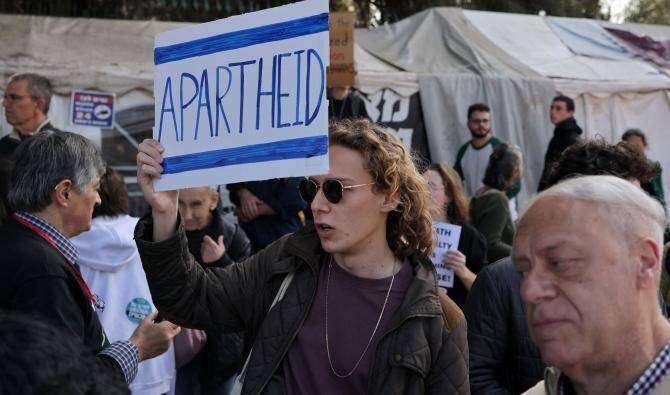
For Barghouti, the real impact of the law goes beyond the issue of the death penalty itself, as in practice it establishes “a fundamentally discriminatory system of justice.” “This law deepens the apartheid system,” he stated.
According to this logic, a Palestinian accused of killing an Israeli could be sentenced to death, but when an Israeli kills a Palestinian, Barghouti said, “impunity is often the rule.”
For him, the law functions as “a license to kill Palestinians” and also legitimizes, in his view, “the extrajudicial executions already observed on the ground.”
Barghouti estimates that between one and two thousand Palestinians in Gaza have already been victims of extrajudicial executions. The same applies in the West Bank, where he refers to numerous cases of fatal shootings without legal proceedings, including the recent killing of a civilian family in the Tubas area.
Asked about the detainees concerned by the law, Barghouti is unequivocal: “All Palestinian prisoners are at risk,” he said. Even those who have already been tried could see their cases reopened if “the Israeli authorities decide to re-examine certain cases.”
Around 10,000 Palestinians are currently held in Israeli prisons, including 300 children and 75 women. A large number of them are held under administrative detention, which allows a person to be imprisoned without charge or trial, for renewable periods.
Detention conditions are particularly harsh: “They are deprived of medical care, subjected to hunger, abuse, and extremely difficult conditions,” Barghouti explained.
Since October 7, he said, 90 Palestinian prisoners have reportedly died in detention. Since 1967, the total number of detainees who have died in Israeli prisons is said to have reached 322.
The situation in the Gaza Strip remains catastrophic, according to Mustafa Barghouti. He claims that Israel has never truly respected the announced ceasefire.
Since it came into force, 720 Palestinians have reportedly been killed and more than 2,000 injured, while bombardments continue daily, including in the heart of Gaza City.
But the most dramatic aspect, according to him, concerns the humanitarian situation. The ceasefire agreement provided for the entry of 600 humanitarian aid trucks per day; however, according to Barghouti, deliveries remain far below that figure, with some days seeing barely 56 trucks allowed in.
Even more serious, no medical supplies have reportedly been allowed in since the start of the ceasefire: “Entire hospitals risk ceasing to function,” he warns. Even dentists, he said, have recently issued an appeal stating that they no longer have basic equipment to treat their patients.
In the West Bank, the situation is hardly more encouraging. Barghouti describes a state of constant escalation: military raids and arrests continue daily, and attacks by armed settlers are increasing.
He asserts that these groups act with the protection of the Israeli army and said that 71 Palestinian communities have already been expelled from their land.
These expulsions, he stresses, are part of a strategy aimed at gradually taking over the West Bank, of which “Israel now controls more than 40 percent.”
Faced with this situation, Mustafa Barghouti dismisses the idea of internal change in Israel: “This society has turned toward fascism,” he said.
For him, two factors will be decisive for the future. The first is the resilience of the Palestinian people on their land, as “the Zionist project can only succeed if it manages to expel Palestinians from their land, as in 1948.”
The second factor is international pressure. Barghouti believes that statements and condemnations are no longer enough: “Israel will not be deterred by speeches.”
The only solution, in his view, would be the imposition of international sanctions and a global boycott of Israel.
Despite the severity of the situation, Barghouti says he does not feel alone: “My relationship is not with governments,” he concludes, “my relationship is with the people, and I know that people understand what is happening.”
* This article originally appeared in French on Arab News en français. Click here to read it.


