


ISLAMABAD: As the US-Israel war on Iran have disrupted global crude oil shipping routes, Pakistani refineries adjusted procurement strategies and managed their crude oil inventories to prevent energy shortages, according to refinery officials and data seen by Arab News.
Global oil prices have increased ever since the US and Israel attacked Iran in February and Tehran responded with attacks on economic targets in Gulf countries. Iran has effectively blocked the Strait of Hormuz, a key route through which roughly 20 percent of the world’s oil and gas supplies pass through, leading to reduced maritime traffic, increased shipping costs and delayed shipments of oil and gas to several countries around the world.
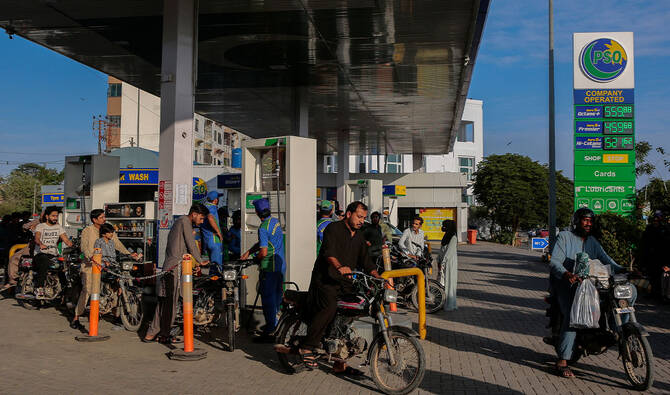
Pakistan raised prices of petrol and diesel last week to historic highs amid the global oil supply shock. However, Pakistan’s finance ministry said on Monday that the country’s refineries continue to operate at optimal levels, and the overall supply of petrol, diesel and crude oil in the country remains stable.
Pakistani oil refinery officials credited several factors to Pakistan’s stable supply of fuel products. These included a rise in domestic refining capacity, moving away from single-source crude oil suppliers, and coordination with the state to ensure adequate stock of petroleum products.
“The recent period has shown that a coordinated approach, combined with strong domestic refining capacity, can effectively shield the country from external supply shocks,” Usama Qureshi, vice chairman of Cnergyico Pk Limited., a leading Pakistani refinery, told Arab News on Monday.
Pakistan’s increased reliance on domestic oil refining comes amid a sharp spike in domestic fuel demand. According to research from Arif Habib Limited, demand for Motor Spirit (MS) jumped 25.1 percent year-on-year in March 2026, while the demand for High-Speed Diesel (HSD) rose 26.8 percent during the same period.
Industry stakeholders attribute this surge in demand to increased transport and logistics activity, seasonal agricultural requirements for diesel and an increased in industrial output.
To meet this demand amid the ongoing regional instability, Qureshi said Pakistani refineries moved away from their reliance on single-source suppliers.
“Diversification played a critical role,” Qureshi told Arab News. “Refineries avoided over-reliance on any single crude source and instead explored multiple supply origins, ensuring that disruptions in one region did not halt operations.”
Cnergyico Pk Limited official noted that Pakistani refineries processed US crude oil in March, which was already in transit when the Iran war intensified. He added that Pakistan’s diplomatic efforts also ensured further energy shipments.
“Some of the cargoes which were stuck due to the Strait of Hormuz closure made it to the destinations with the efforts of government involvement by using diplomatic channels,” Qureshi said.
Deputy Prime Minister Ishaq Dar announced last month that Tehran had allowed 20 Pakistani-flagged vessels to pass through the Strait of Hormuz amid the war.
Disruptions at the strait have historically triggered a surge in crude premiums, freight and insurance costs. While Pakistan’s supply of crude oil remained stable during the crisis, Qureshi warned that such risks “contributed to a more uncertain pricing outlook, particularly for diesel and other middle distillates.”
To mitigate these risks, Pakistani refineries strengthened local inventory levels. According to Qureshi, “some refineries maintaining higher-than regulated crude on the government’s directive and product stock levels as a presumption.” This, he said, created a buffer that allowed production to continue even when shipments faced delays.
According to data seen by Arab News, the total output of oil refineries in Pakistan rose 13 percent year-on-year in March 2026 to 972,000 metric tons. Cnergyico reported the sector’s most aggressive growth, with MS and HSD volumes surging by 123.1 percent and 104.3 percent, respectively, compared to the previous year.


