


DUBAI: In a regional context marked by geopolitical tensions and water scarcity, desalination emerges as a strategic tool. Gulf countries, where it plays a central role, face growing challenges related to infrastructure protection, population growth, and industrial demand.
To address these challenges, the Gulf is investing heavily in desalination infrastructure, in line with national strategies, growth objectives, and long-term development visions. These projects form an integral part of plans to strengthen water security and support the region’s economic expansion.
Veolia CEO Estelle Brachlianoff emphasized the sector’s resilience amid these challenges. “Today, all of Veolia’s desalination activities are continuing and service is being maintained,” she said in an interview with Arab News en français.
In a region where access to water constitutes a priority for economies and populations, these facilities are “considered to be of national interest.” She stressed that the safety of teams, the integrity of infrastructure, and the continuity of operations are subject to constant monitoring to ensure a stable supply despite risks.
To limit risks, desalination networks are designed to be robust and interconnected, allowing plants to substitute for one another if necessary and to incorporate storage capacity to ensure service continuity, Brachlianoff explained.
This multi-site configuration and coordination with local authorities are essential to protect a critical resource in an environment where infrastructure security is strategic.

According to Veolia CEO Estelle Brachlianoff, the market is expected to grow at an accelerated pace over the next five years, in the Middle East, Asia-Pacific, and certain European countries. (Supplied - Veolia Media Library – Nicolas Fagot)
Desalination accounts for a significant share of drinking water in Gulf countries: 42 percent in the UAE, 70 percent in Saudi Arabia, 86 percent in Oman, and 90 percent in Kuwait, according to the French Institute of International Relations in 2022. “Desalination is now essential for water supply in Gulf countries,” Brachlianoff noted, highlighting the central role of this technology in response to demographic and industrial pressure.
To address energy constraints, the sector has significantly reduced its electricity consumption. “Over the past 10 years, we have managed to divide by three the energy consumption required to produce one cubic meter of desalinated water,” she added.
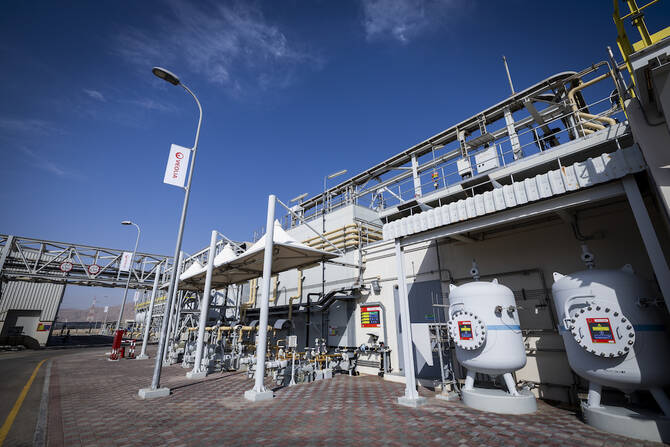
The transition to renewable energy is also progressing. In Sur, Oman, a solar field now powers the desalination plant 100 percent during daytime, making it the first plant in the world to operate this way. This initiative could be replicated in other countries in the region, in compliance with local regulations.

In Sur, Oman, a solar field now powers the desalination plant 100% during daytime. (Supplied)
These improvements make the process more efficient, flexible, and environmentally friendly, while enabling countries to better align their infrastructure with their national development and growth visions.
The desalination market is expanding rapidly. “The market is expected to grow at an accelerated pace over the next five years, mainly in the Middle East, Asia-Pacific, and in some European countries, with an expected capacity of around 40 million m³ per day,” Brachlianoff noted. Demand varies by territory: Certain countries favor large, centralized facilities, such as the Mirfa 2 and Hassyan plants in the UAE, while others opt for more compact or modular solutions.
With nearly 19 percent of installed capacity in the region, Veolia is a key player in the sector. However, desalination does not constitute a standalone solution. The group’s CEO emphasized that it must be complemented by water reuse and network optimization to ensure a reliable and sustainable supply.
The sustainability of desalination depends on its ability to remain affordable and environmentally friendly. In regions exposed to water stress, such as the Middle East and North Africa, this technology remains a pillar of water security.


