
RIYADH: AI in engineering might sound like a futuristic promise. In reality, it is already transforming the field in practical ways: pairing simulation with real-time data so engineers can stress-test designs before construction, and spot early warning signs before a failure becomes an outage, a leak, or a safety incident.
Alia Bahanshal, Ph.D., AI expert and CEO of Aurora AI in Riyadh, told Arab News: “AI in engineering is the use of intelligent algorithms to act as a ‘digital brain’ that analyzes vast amounts of data to predict failures before they happen, optimize complex designs in seconds, and automate the precision tasks that once took humans weeks to calculate.”
FASTFACT
DID YOU KNOW?
- Saudi Aramco reported $1.8 billion in AI-driven Technology Realized Value in 2024.
- Engineers can simulate extreme conditions like sandstorms and heat before anything is built.
- Many AI systems can ‘fail silently’ when real-world conditions differ from training data.
Engineers now use AI to scan patterns across sensors, inspection records, weather conditions, and operational history, flagging what looks risky or inefficient. The technology is most effective when tied to real operating data and engineering constraints.
In Saudi Arabia, this shift is tangible. Aramco reports that AI is embedded in daily operations to improve performance, cut costs, and support emissions reductions. The company recorded $1.8 billion in AI-driven Technology Realized Value in 2024. It has mapped 442 AI use cases, with over 200 solutions already deployed and more than 100 under development as of late 2025.
A digital twin, Bahanshal explained, is “a living, breathing ‘virtual clone’ of a physical object —like a bridge, a wind turbine, or even an entire city like Riyadh — that stays perfectly synced with its real-world counterpart in real-time.”
The concept matters because engineering decisions often have to be made before all evidence is available. With a live model that mirrors the asset, teams can run scenarios too costly, slow, or dangerous to test on real equipment.

On-site engineers can use AI insights to keep industrial equipment running reliably. (Image by Pvproductions Freepik)
Bahanshal added that the point is to test the future by simulating harsh conditions such as sandstorms and extreme heat, so weak points appear earlier and repairs can be planned when they are safest and most cost-effective.
The same approach applies to everyday infrastructure. Water loss is one example, especially in a country where desalination and distribution carry major energy costs.
“In our desert climate, AI serves as the ultimate conservationist by acting as a digital guardian for our infrastructure, using advanced algorithms to detect underground leaks smaller than a pinhole and saving millions of gallons of desalinated water before a single drop is wasted,” Bahanshal said.
Abdulelah Al‑Shehri, an assistant professor in AI for Engineering at King Saud University, told Arab News that earlier automation relied on “rigid, deterministic ‘if-then’ rules.”
He described the current shift as “a transition from prescriptive execution to probabilistic and autonomous exploration.”
In practice, that change is evident in design optimization. Instead of drafting a component, calculating stress, revising, and repeating over weeks, engineers can now specify requirements such as material, thermal load, and volume. AI can then generate candidate geometries for testing and adjustment. Al‑Shehri said it is “an evolutionary leap from software being a calculator to collaborator.”
The harder challenge is trust. Al‑Shehri noted that performance on historical data is insufficient because systems operate in “the dynamic volatile physical world.”
When conditions deviate from a model’s training, failures can be easy to miss. “Because neural networks lack innate physical intuition, they fail silently and confidently when real-world conditions diverge from historical training baselines,” he said.

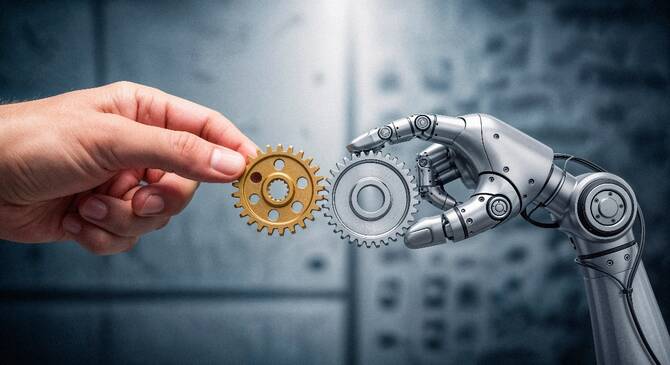
Digital twins use live sensor data to test scenarios and improve performance safely. (Image by DC Studio Freepik)
Shifts don’t always need to be dramatic — they may stem from an uncalibrated sensor, changing load profiles, or material variations across suppliers. Al‑Shehri also cautioned against automation complacency, where high reliability reduces human vigilance. Continuous observability and testing, including simulated anomalies, can catch drift and keep operators engaged.
Bahanshal said a related barrier inside companies is trust. “The biggest challenge companies face isn’t just messy data, but the ‘trust and transparency gap’— the difficulty of moving AI from a mysterious ‘black box’ to a reliable engineering tool,” she said.
Aurora AI focuses on systems that provide “a traceable, ‘human-centric’ reason for its decisions.”
All of this raises a key question: where to draw the line between AI “assisting” and AI “deciding.” Al‑Shehri explained that the boundary is “dictated by the speed of required intervention and the societal and monetary cost of failure.” Strict domain guardrails can keep autonomous systems aligned with physical constraints and safe boundaries.
Al‑Shehri described a collaboration between King Saud University and University College London that developed a domain-enforced AI platform for turbine set-points. A “deciding AI” outperformed traditional approaches in a small power plant, cutting carbon dioxide emissions by kilotonnes per year and saving about $1 million annually.
For engineers, the immediate impact is less about replacement than shifting where expertise is applied. Bahanshal said AI can automate tedious calculations and data processing, freeing engineers to focus on higher-level decisions.
Al‑Shehri emphasized that education should not aim to turn every engineer into a computer scientist. “We cannot (and should not) attempt to turn every mechanical or chemical engineer into a computer scientist.” Graduates should instead learn to frame problems, structure data, and connect AI to hardware, safety protocols, and regulations.
Looking ahead, Al‑Shehri stressed separating practical gains from hype: “Over the next two to three years, the industry should separate applied value from the speculative hype of Artificial General Intelligence.”
He cited reports showing 62 percent of employees view AI as overhyped, and an estimated 95 percent of enterprise generative AI pilots fail to deliver measurable business impact.
“To capture AI’s projected $3 trillion economic potential, we cannot rely on predictive AI models or Large Language Models like ChatGPT to ‘do it’.”
Al‑Shehri concluded that the real priority is connecting AI to the on-the-ground realities of engineering — moving beyond purely data-driven approaches and embedding domain principles and uncertainty estimation directly into AI models.
Done well, digital twins and predictive systems are not magic — they are engineering workflows enhanced by tools that learn from data at scale and are monitored closely enough to earn trust.