

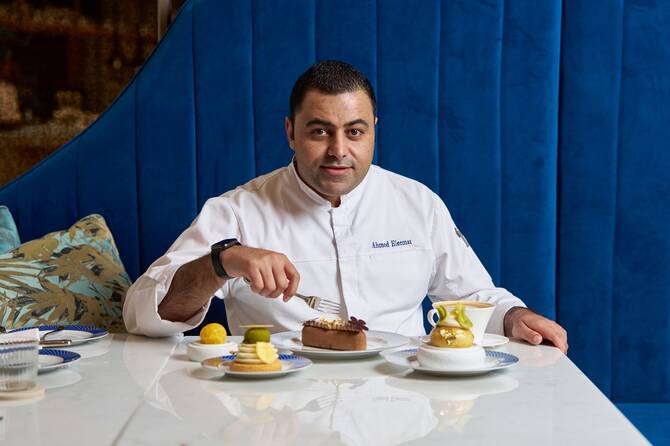

DUBAI: At one of Riyadh’s most prestigious hotels, The St. Regis Riyadh, executive pastry chef Ahmad Eleemat leads a team responsible for everything from refined afternoon teas to VIP amenities and large-scale banqueting. The Jordanian chef, who has worked in some of the region’s leading luxury hotels, is especially well known for his chocolate creations.
Since taking on his current role in December 2023, Eleemat has helped secure the title of Best Afternoon Tea in Riyadh for two consecutive years. His desserts often draw inspiration from Saudi heritage, translating memory and culture into carefully balanced, technically refined creations.
When you started out, what was the most common mistake you made?
Rushing the process. I didn’t always respect exact measurements, temperatures, or timing as much as I should have. Coming from a creative mindset, I believed intuition alone would carry me through. Very quickly, pastry taught me a hard but valuable lesson: precision is everything. One gram too much, a few seconds too long, or a temperature slightly off can completely change the final result. Over time, I learned that discipline and patience are just as important as creativity. That lesson shaped not only my cooking, but also my professional mindset.
What’s your top tip for amateur bakers?
It’s simple: don’t rush and don’t stress. It should be enjoyable, not intimidating.
Before starting, read the recipe fully, from beginning to end. Measure your ingredients carefully, prepare everything in advance, and give yourself time. In pastry especially, calm hands create better results. Mistakes happen, and that’s part of learning but when you cook with patience and focus, the outcome is always better. Most importantly, enjoy the process. Food carries energy, and when you cook calmly, it shows on the plate.
What's one ingredient that can instantly improve any dish? And why?
For me, it’s dark chocolate. It has incredible depth — bitterness, sweetness, richness and complexity all in one ingredient. When used correctly, it can elevate a dish instantly, even a savory preparation. It adds structure, elegance and emotional comfort at the same time. Dark chocolate also reflects craftsmanship. It requires balance, respect and understanding and, when handled well, it leaves a lasting impression.
When you go out to eat, do you find yourself critiquing the food?
I try not to judge. I go as a guest, not as a critic. I want to enjoy the moment, the atmosphere and the effort behind the dish. Instead of critiquing, I observe and learn. I taste, I feel, and I appreciate the work that went into the experience. Every kitchen operates under different pressures, and I respect that. If anything, I believe dining out should inspire chefs, not turn them into constant judges.
What’s your favorite cuisine or dish to order?
My favorite cuisine is Mediterranean, and I’ll often order a simple burrata salad. I’m drawn to its simplicity and honesty. Fresh ingredients, clean flavors, and perfect balance — creamy burrata, ripe tomatoes, good olive oil. There’s nowhere to hide in a dish like that. When it’s done well, it shows true respect for ingredients. It reminds me that great food doesn’t need to be complicated, it just needs to be done right.
What’s your go-to dish if you have to cook something quickly at home?
Muhallabia (milk pudding). It’s fast, comforting and deeply personal to me. It was the first recipe I ever learned from my mother. Even today, when I prepare it, it brings back memories of home, family and simplicity. Despite its simplicity, though, muhallabia requires balance and attention just like any good dish. It proves that even the simplest recipes can carry strong emotion and meaning.
What customer request most frustrates you?
When a guest heavily modifies a dish without understanding its concept, and then judges the final result. Every dish is designed with balance, structure and intention. When too many changes are made, that balance is lost. I truly believe food should be experienced as the chef intended — that’s where the story and craftsmanship live. Of course, dietary needs are always respected, but understanding the dish before changing it creates a better experience for everyone.
What’s your favorite dish to cook and why?
Desserts that tell a story. Especially chocolate-based creation. Pastry allows me to combine precision with emotion. Through desserts, I can translate memories, culture, heritage and moments into something tangible and edible. Chocolate, in particular, is powerful: it’s emotional, nostalgic, and elegant at the same time. For me, dessert isn’t just the end of a meal; it’s the final memory the guest takes with them.
What’s the most difficult dish for you to get right?
Baklava. Not because it’s technically impossible, but because it uses ingredients I personally don’t enjoy working with — ghee and heavy sugar syrup. They are essential to baklava’s identity, and that makes it challenging for me creatively. That said, I respect the dish deeply. It requires discipline, layering and precision. Even when a dish isn’t aligned with your personal preferences, mastering it is part of being a professional chef.
What have you learned from working as a chef?
It’s taught me discipline, trust and communication. A kitchen only succeeds when everyone works together with respect and clarity. No matter how talented one individual is, the result depends on teamwork. So, I’ve learned to listen, to support, and to lead by example. When the team feels valued and aligned, the kitchen runs smoother, pressure is managed better, and the food improves naturally. Strong teams create strong kitchens.
Chef Ahmad Eleemat’s orange, ginger and vanilla mousse cake
Orange Jelly
Ingredients
• 100g orange juice
• 15g sugar
• 1g agar agar
Method
Mix the sugar and agar agar in a bowl.
Warm the orange juice, then whisk in the sugar and agar mixture.
Bring to a boil and let it cook for about one minute.
Pour into a mold and refrigerate until completely set.
Vanilla sablé
Ingredients
• 100g butter, soft
• 60g icing sugar
• 20g egg yolk
• 200g flour
• Vanilla to taste
• 1g salt
Method
Beat the butter and icing sugar together until light and smooth.
Mix in the egg yolk and vanilla until combined.
Add the flour and salt, stirring gently to form a dough.
Wrap and chill the dough in the refrigerator for 30 minutes.
Roll out to 3–4 mm thickness, cut into shapes, and bake at 170°C for 12–15 minutes.
Orange vanilla and ginger mousse
Ingredients
• 150g milk
• 40g egg yolk
• 40g sugar
• 6g gelatin, bloomed
• 120g white chocolate
Orange zest, to taste
3g ginger powder
• 250g whipping cream, semi-whipped
Method
Heat the milk, egg yolk, ginger and sugar together, stirring until the mixture reaches 82°C.
Remove from the heat and stir in the gelatin until dissolved.
Pour the mixture over the white chocolate and blend until smooth and emulsified.
Add the orange zest and allow it to cool to 30°C.
Gently fold in the semi-whipped cream until fully incorporated.
Orange chocolate for dipping
Ingredients
200g white chocolate
200g cocoa butter
2g orange color
Method
Melt the chocolate and cocoa butter together until smooth.
Stir in the color until fully combined.
Use at 35–38°C to dip frozen cakes.
Final assembly
Place the orange jelly insert in the center of the mousse.
Fill the mold halfway with mousse, add the jelly insert, then cover with more mousse.
Freeze until completely firm.
Unmold and dip the frozen cake into the orange chocolate (35–38°C).
Let the excess chocolate drip off.
Set the coated mousse cake on a vanilla sablé base and allow it to firm up.


