

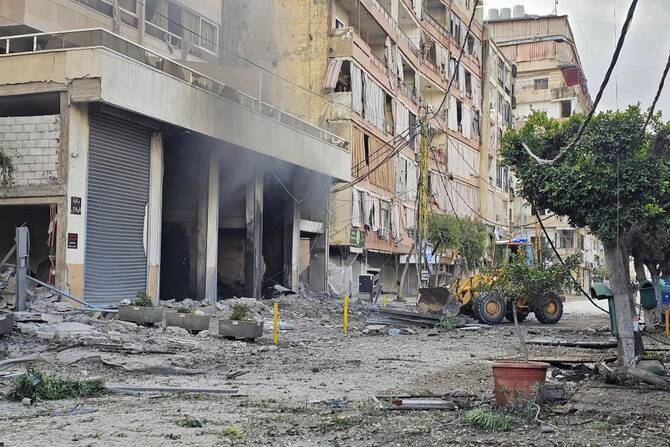

BEIRUT: As war returns to Lebanon, mental health specialists warned the country is facing a rapidly deepening psychological crisis in a population already traumatized by years of conflict, economic collapse, and displacement.
The last war, which broke out between Israel and Hezbollah in 2024, had already pushed millions to the brink. Renewed violence and mass displacement this month are reopening old wounds, turning psychological trauma into one of the country’s most urgent emergencies.
Psychiatrist Dr. George Karam, head of the Alzheimer’s Association in Lebanon and executive director of the Institute for Development, Research, Advocacy and Applied Care, said 63 percent of Lebanese experienced mental health problems between 2020 and 2023, following the Beirut port explosion and the first Hezbollah-Israel conflict.
“Today, the renewed war and the large-scale displacement it has triggered are exacerbating these challenges to a dangerous degree,” he told Arab News, stressing that the need for psychological support is critical.
In less than a month, the war has killed more than 1,120 people, wounded 3,235 people, and displaced around 1.3 million.
Driven out of their homes by Israeli airstrikes and urgent evacuation warnings, many civilians have had no time to gather their belongings, fleeing instead into the streets.
UN estimates indicate that approximately 20 percent of Lebanon’s population is now displaced.
Lebanon’s National Mental Health Programme is providing psychological support, in an effort “to alleviate the burden a little” on the Lebanese people.
The program’s website offers guidance, specifically directed at women as pillars of strength for their families.
“In these tough times, mothers carry a heavy burden, so don’t hesitate to seek psychological support and available services when needed,” the program’s website read.
Other advice focused on children’s mental health. “Try speaking in a calm voice, stay close to the child, and breathe slowly,” the website instructed parents.
On Friday, the International Rescue Committee said prior to the current escalation, Lebanon was already grappling with one of the highest rates of mental health conditions in the region with nearly half the population screening positive for depression, anxiety, and post-traumatic stress disorder.
“Today, ongoing exposure to violence, fear, and uncertainty is driving rising levels of psychological distress,” the IRC said in a statement.
It reported numerous cases of severe anxiety, disrupted sleep, emotional strain, and difficulty managing daily life. “The lack of safe spaces, combined with the unpredictability of the crisis, is intensifying feelings of fear, helplessness, and exhaustion, leaving many communities in a constant state of survival,” it added.
The UNHCR also warned on Friday that Lebanon is facing a “humanitarian catastrophe,” while UNICEF reported that more than 370,000 children in Lebanon have been forced to leave their homes in just three weeks, describing it as one of the largest waves of internal displacement affecting children in the country in decades.
UN Women reported that a quarter of women and girls in Lebanon have been forced to flee their homes, meaning that hundreds of thousands of women now face compounded risks, including loss of income, interruption of healthcare, and an increased likelihood of gender-based violence within overcrowded and unstable displacement environments.
Insecurity is no longer limited to areas people fled; it has reached Beirut, where tens of thousands sought refuge, only to find it under pressure as well, deepening the humanitarian strain on residents.
Magda Rossmann, IRC country director for Lebanon, said: “Lebanon’s crisis is no longer only visible in destroyed buildings; it is also in people’s shattered sense of safety.
“People are living under constant threat, with no clear sense of safety or what comes next,” she added.
Rossmann reported witnessing deep psychological distress across all segments of the population, including among people with no prior history of mental health conditions.
“At the same time, insecurity is cutting off access to care just as needs are surging,” she said, calling for an immediate end to the hostilities and urgent flexible, sustained funding for mental healthcare.
The number of calls to the hotlines set up by the NMHP doubled in the first 10 days of the escalating crisis.
Of those seeking support, 55 percent reported acute psychological distress, 30 percent expressed suicidal thoughts, and 40 percent requested urgent referrals to emergency or community services.
The IRC said it is scaling up support for the hotline’s Mobile Crisis Team, which is dispatched to deliver urgent psychological care across Beirut, Mount Lebanon, and North Lebanon for people affected by trauma and displacement and cannot access health facilities.
The organization warned that displaced children, refugees, migrant workers, and people with disabilities were facing heightened risks due to disrupted support systems and limited access to care.
Dr. Rabih Chammay, the head of the NMHP, told Arab News: “We used to speak of invisible wounds, but that no longer captures the devastation we see. Since 2019, crisis after crisis and now this war has torn through people’s minds and hearts, pushing mental health to the very front line.”
He said as children wake in fear and parents carry unbearable worry, “the hurt will echo for years, if not generations, after the bombs fall silent.”
Chammay urged real investment in mental health as an “act of protection, of dignity, and of hope for true healing and recovery.”
Karam noted a growing number of people seeking psychological help at his clinic, describing the situation as dire.
He added that people are deeply exhausted and that their psychological struggles are worsening.
Karam said he uses his social media platforms to advise those struggling to focus on what they can control, channel their energy into productive activities, postpone worrying thoughts to a later time, and dedicate part of the day to rest and relaxation to maintain a sense of control.
He warned that growing internal tensions in Lebanon could turn into anger and animosity that may be exploited by political groups for incitement and mobilization, with potentially serious consequences.
The IRC is among the largest NGO partners for the Lebanese government’s mental health system.
Supporting three of the country’s four national mental health and psychosocial support services, the IRC said it is helping maintain continuity of care despite mounting operational constraints.
“As the crisis persists, demand for sustained and specialized mental health support is expected to increase in the coming weeks,” the organization said.
It called on donors and the international community to urgently scale up investment in mental health and psychosocial support in Lebanon.
“Funding must be flexible and sustained to address immediate needs while strengthening national systems for long-term recovery. Without swift action, the psychological impact of this crisis risks becoming a long-lasting and deeply entrenched public health emergency,” it warned.


