

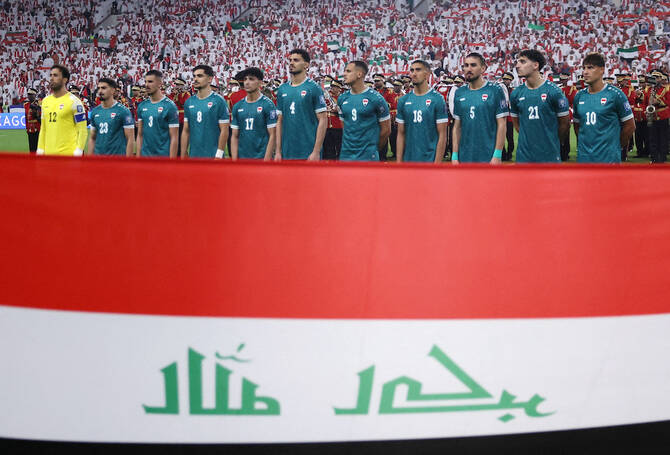

RIYADH: It has been more than 850 days since Iraq’s journey to North America began. A crowd of 64,447 at Basra International Stadium witnessed a decisive 5-1 victory over Indonesia in the second round of Asian qualifiers — setting the tone for what would become a memorable, yet turbulent, campaign.
Twenty games, a managerial change, a regional war and a FIFA private jet later, Iraq have made it to Monterrey.
With an intercontinental play-off against Bolivia looming on Wednesday, Iraq will overtake Indonesia as the most active nation in the 2026 FIFA World Cup qualifiers, with 21 matches played. Only Australia have played more in a single campaign, with the Socceroos enduring a 22-game journey to reach Russia 2018.
Yet just 30 days ago, Iraq faced a major scare as war engulfed the Middle East. Airspaces and embassies closed — complicating visa arrangements — while head coach Graham Arnold was unable to leave the UAE.
Arnold requested a postponement. Alternative travel routes were discussed. Rumours spread over Iran’s participation at the World Cup and whether a potential withdrawal could open a direct path for Iraq.
At one stage, the only viable option appeared to be a 25-hour overland journey to Istanbul to catch an international flight.
Instead, as tensions eased in neighbouring Jordan, FIFA opted against postponement and provided a private jet departing from Amman.
While closer than Istanbul, Amman was still more than a 10-hour drive from Baghdad.
Setting off for the Jordanian capital at 1 p.m. on March 19, the squad arrived nearly 15 hours later at Queen Alia International Airport. Nine hours on, the FIFA jet took off, with Lisbon the only stop en route to Monterrey.
The journey itself offered little relief: eight hours to Lisbon, a two-hour transit, then another 12 hours in the air.
After weeks of uncertainty, 12,500 kilometres and a 43-hour trip, the Iraqi national team finally arrived in Mexico in the early hours of March 21.
What followed embodied the spirit of the World Cup. Mexican fans turned out in droves to support Iraq during training sessions. Children in Monterrey chanted for the team, while the national side’s official social media accounts were flooded with messages of welcome.
In response, Iraq’s English-language accounts began posting in Spanish, reflecting the surge in local support. The team thanked the people of Monterrey — backing that could prove crucial ahead of the match.
On paper, Bolivia might appear more at home, given the shared language with Mexico and Iraq’s long journey. Yet the play-offs — and the reception Iraq have received — suggest otherwise.
Mexican fans have embraced the Lions of Mesopotamia, drawn to the romance of the underdog and the joy of welcoming nations from across the globe. It could tilt the balance in Iraq’s favour.
For older fans, however, Mexico carries deeper significance. It is not only the site of Iraq’s next play-off, but also where they played their first-ever World Cup match.
After progressing through three rounds — overcoming Qatar, Jordan, the UAE and Syria — Iraq secured qualification for the 1986 tournament at the third attempt.
At Mexico 1986, Iraq left beaten but proud. Narrow defeats to Paraguay, Belgium and Mexico meant they finished bottom of their group, each loss by a single goal. Yet for Iraq, the tournament was as much about representation as results.
The late Ahmed Radhi’s goal against Belgium remains a defining moment. Despite Belgium racing into a two-goal lead, Radhi’s 59th-minute strike sparked a thunderous roar inside Estadio Nemesio Diez, as fans urged Iraq forward in search of an equaliser.
It was not to be, but Iraq left with a lasting memory — unaware of the challenges that would follow. Twenty-one years of disappointment passed before their historic 2007 AFC Asian Cup triumph, followed by another 19-year wait leading up to this play-off against Bolivia.
There is a chance Iraq’s World Cup journey could end before it truly begins. A potential group featuring France, Norway and Senegal presents a daunting return after four decades. But for a country that has grown as a footballing force, stepping onto the global stage feels essential — and the World Cup is the perfect platform.
That leap could come from Ali Jasim. In 2023, he scored an injury-time winner against Iran at the U-20 Asian Cup to send Iraq to the FIFA U-20 World Cup. A year later, his extra-time goal against Indonesia secured Olympic qualification. Now, he has the chance to deliver on the senior stage.
Iraq’s path to this final hurdle has been extraordinary. Should the Lions of Mesopotamia overcome Bolivia and script an unlikely underdog story, it would inspire Iraqi football for years to come.


