

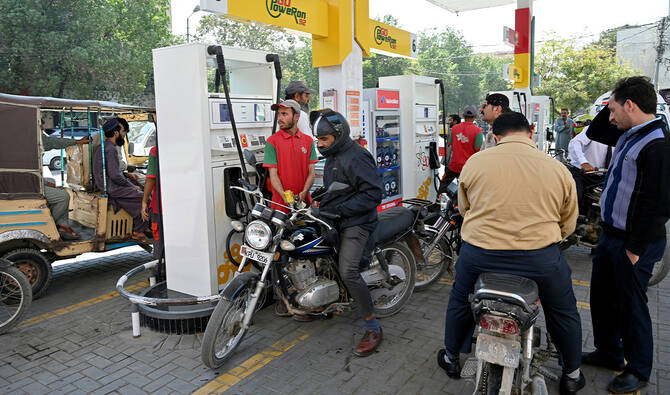

ISLAMABAD: Pakistan’s government is considering new rationing measures that could include providing fuel on quotas for motorcycles and rickshaws, as well as allowing vehicles with license plates ending in odd and even numbers to operate on designated days, a senior official said on Wednesday.
Pakistan is among several countries that have suffered adverse economic impacts due to the US-Israel war against Iran that began on Feb. 28. Iran says it has closed the Strait of Hormuz for “enemy” ships and vessels, through which roughly 20 percent of the world’s oil and gas supplies are shipped. The disruption has rattled global oil markets, pushing countries such as Pakistan to raise the price of petrol and diesel by Rs55 per liter this month.
Pakistan’s government has undertaken several fuel conservation measures since the war began. These include closing schools, shifting higher education institutions’ classes online, imposing a four-day working week and slashing the fuel quota for government vehicles. Prime Minister Shehbaz Sharif formed a government committee this month to monitor the country’s stock of petroleum products amid ongoing hostilities between the US and Israel against Iran.
“Government is considering a number of measures for fuel rationing through the use of technology,” a senior government official with direct knowledge of the development, told Arab News on condition of anonymity as he was not allowed to speak to media.
“These include allowing cars bearing number plates ending with odd and even numbers [on the roads] on alternative days.”
The official stressed that the government has not taken any final decision on the matter. He added that fuel consumption measures would only be considered if the crisis drags on in the coming weeks.
Pakistani government officials and the Oil and Gas Regulatory Authority have said the country’s stock of petroleum products remains adequate.
The official said such fuel conservation measures were not unprecedented and that other countries have implemented them as well.
“Fuel rationing is being practiced in many countries, including Iran and Sri Lanka,” he said. The official added that the goal would be to curb the consumption of fuel if the conflict worsens.
Sri Lanka’s Ceylon Petroleum Corporation said last week that vehicles with number plates ending in an even number or zero can buy fuel on even-numbered days, while those with number plates ending in an odd number can obtain fuel on odd-numbered days.
The Pakistani official said another proposal that authorities are considering is allowing motorcycles and rickshaws to consume a fixed quota of fuel, which could be managed through a mobile application, the official said.
However, the official acknowledged that implementation challenges exist, especially in rural areas where only a limited number of people use smartphones.
In a parallel move, the Oil and Gas Regulatory Authority (OGRA) recently conducted a training for industry stakeholders on a digital track-and-trace system. The system aims to strengthen oil supply chain oversight and prevent hoarding or smuggling of petroleum products during the crisis.
Local media reports suggest the government is planning a broader digital rationing system for all vehicles. However, a senior finance ministry official dismissed the reports.
“Nothing like this has been decided yet,” the official said. “Since the beginning of the crisis, the government is discussing various proposals to mitigate the situation, but no decision has been taken.”
However, he said the government’s contingency planning is in place.
“When the situation deteriorates into a serious crisis, we can implement any of these rationing measures immediately,” the finance official said.
An official of the petroleum ministry told Arab News that the government is mulling providing subsidized petrol to motorcycle and rickshaw drivers. However, the same would not be offered to all motorists.
“A proposal to provide petrol to motorcycle and rikshaw drivers on subsidize rate through a quota system is under consideration but fixing quota for motorists is not under serious consideration,” the petroleum ministry official said on condition of anonymity as he was not authorized to speak to the media.
The official also noted that fuel consumption in Pakistan has continued to rise despite higher prices in March, underscoring the urgency of preparing for potential supply shocks.


