

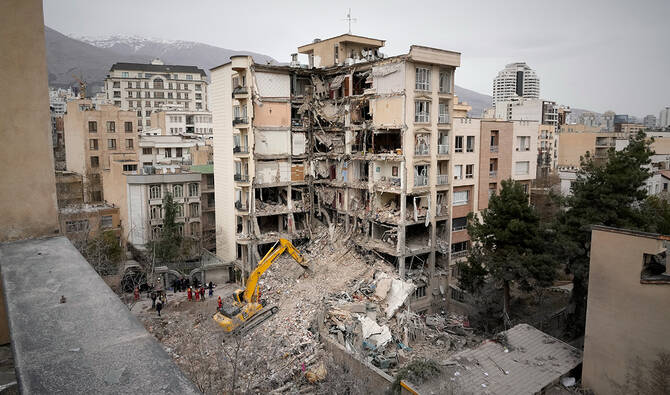

ISLAMABAD: Prime Minister Shehbaz Sharif stressed the importance of dialogue and diplomacy between Iran and its Gulf states, his office said on Monday, as Tehran continues attacks against neighboring states as the Middle East war intensifies.
Iran has fired a barrage of missiles and carried out drone attacks against Gulf countries such as Saudi Arabia, UAE, Oman, Kuwait, Bahrain and others. Iran has said it will target US interests in the Middle East region after Washington and Israel launched coordinated strikes against Iran on Feb. 28.
Iran also threatened this week to attack energy and water systems in Gulf countries if the US follows through with its threat to hit Iranian power plants amid the ongoing war. Washington said it would hit Iran’s power plants if Tehran doesn’t fully open the strategic Strait of Hormuz waterway.
Sharif spoke to Iranian President Masoud Pezeshkian via telephone on Monday to convey Eid Al-Fitr and Nowruz greetings to him and the people of Iran, the Pakistani Prime Minister’s Office (PMO) said.
“In view of this grave situation, the prime minister underscored the urgent need to work collectively for de-escalation and a return to dialogue and diplomacy among all the neighboring countries to settle their differences,” the PMO said.
Sharif also stressed the “critical importance” of unity within the Muslim Ummah, saying it was needed now more than ever.
“While sharing with the Iranian president the diplomatic outreach efforts of Pakistan’s leadership, the prime minister assured the Iranian leadership that Pakistan would continue to play a constructive role in facilitating peace in the region,” the PMO added.
Sharif also expressed condolences over the loss of lives in Iran and prayed for the early recovery of all those injured in the ongoing conflict, expressing solidarity with the people of Iran.
Pakistan, which maintains close ties with Gulf states, Iran and other regional actors, has increasingly positioned itself as advocating restraint and dialogue, particularly as the conflict begins to ripple across diplomatic and economic spheres.
On Thursday, Pakistan joined several Arab and Islamic nations to call on Iran to halt its attacks against Gulf nations.
In a joint statement issued after a meeting in Riyadh of the foreign ministers of Pakistan, Azerbaijan, Egypt, Jordan, Qatar, Saudi Arabia, Türkiye and others, the nations warned that their future relations with Iran would depend on Tehran not using military capabilities to threaten regional countries.


