

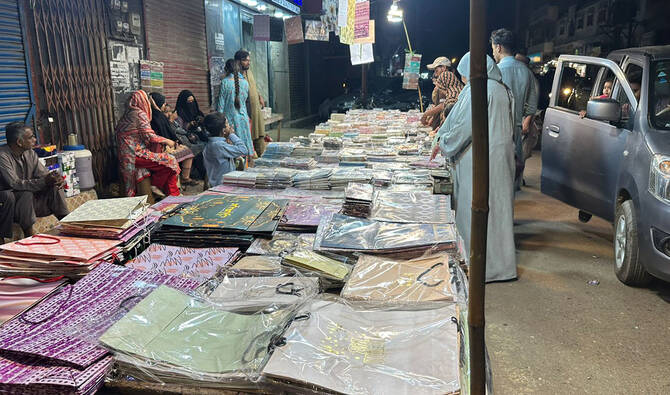

KARACHI: In the narrow lanes of Karachi’s old printing market, machines that once stood idle are running again, churning out brightly colored envelopes as Eid approaches.
The renewed activity is being driven by a growing demand for customized “Eidi” envelopes, decorative packets used to give cash gifts during Eid Al-Fitr, offering a lifeline to a trade that had steadily declined with the rise of digital communication.
For years, printers saw business dry up during Ramadan as traditional Eid greeting cards gave way to instant messages on mobile phones. Now, shop owners say the shift toward personalized envelopes is bringing customers back.
While the practice of giving Eidi, or cash gifts typically given to children and relatives during Eid, remains unchanged, its presentation has evolved. Plain currency notes are increasingly replaced by designed envelopes that echo the aesthetics of traditional greeting cards.
Many are printed with names of recipients, from extended family members to children, with designs ranging from floral patterns for elders to colorful cartoons and popular characters for younger recipients.
“People now send messages on WhatsApp, but it doesn’t have the same charm or enjoyment,” said Muhammad Sikandar, a 38-year-old manager at a local printing press.
“Now Eidi envelopes have taken the place of Eid cards.”
RETURN OF PRINT
Printers say demand has surged in the days leading up to Eid, with orders arriving not just from Karachi but from cities across Pakistan, including Rawalpindi and Peshawar.
At “Famous Card,” a long-running shop near Pakistan Chowk, the change is both welcome and reflective of a broader shift in how people mark the holiday.
Mukhtar Ahmed, 55, who works at the shop, recalls a time when Ramadan meant decorating storefronts with mercury lights and displaying elaborate three-fold greeting cards with intricate calligraphy.
“Today, those things have almost disappeared, and those forms of connection have faded from our Eid celebrations,” he said.
“Now a new trend has emerged: Eidi envelopes. These come in different designs with ‘Eid Mubarak’ inscribed on them.”
TANGIBLE MEMORY
For customers, the appeal lies in something digital messages cannot replicate: a physical object that can be kept, revisited and remembered.
“Paper has its own importance,” said Safdar Raza, a 54-year-old trader.
He believes it’s so because whatever is written on it becomes a memory.
“Today’s messages can be read and ignored, and they just get stored away digitally,” he said.
“But these envelopes, look at their beauty, their designs, they remind you of that era when there were such beautiful Eid cards.”
For some families, the envelopes have become part of Eid preparations themselves.
Bushra Adnan, who manages Eidi for an extended family of about 40 people, plans weeks in advance.
“Our children have not seen the times when we used to give Eid cards,” she said while putting cash into envelopes.
“The system of Eid cards has ended,” she said.
“But when they receive new notes in nice new envelopes, they don’t just take out the Eidi and feel happy, they also keep the envelope carefully.”
OLD FORM, NEW EXPRESSION
As printers work late into the night to meet demand, many say the shift reflects not a disappearance of older practices but their transformation.
Whether it was an Eid card sent by post in the past or a customized envelope handed over in person today, the act of giving remains central to how people celebrate the holiday.
“The traditions of that time reflected its circumstances,” said Raza.
“These envelopes actually remind you of that time and show that traditions remain the same, only the way of expressing them has changed.”


