

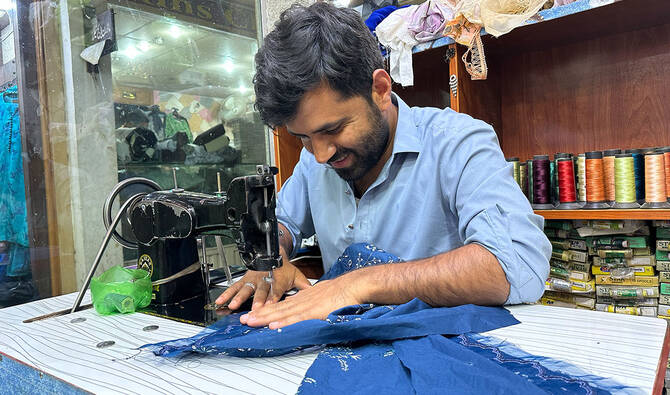

ISLAMABAD: The whir of sewing machines at Melody Tailors in Islamabad’s Melody Market was unusually faint this week.
Days before Eid Al-Fitr, the shop should be overflowing with customers rushing to finalize festive outfits, tailors hunched over sewing machines, measuring tapes draped around their necks as orders pile up before the holiday.
Instead, owner Faisal Ismail sat quietly beside his cutting table, flipping through an order book that is far thinner than it used to be.
Across Pakistan’s capital, a long-standing Eid tradition of commissioning custom-stitched clothes is fading as soaring inflation and the rise of ready-to-wear fashion reshape how people shop for the Muslim festival that marks the end of Ramadan.
“Even though there are three, four, or five days left, the situation isn’t the same as the rush we used to have,” Ismail told Arab News. “People don’t come saying, ‘Make this for me.’ No such hustle or bustle is there anymore.”
For decades, Eid preparations meant selecting bolts of fabric, discussing collar styles with neighborhood tailors and returning for multiple fittings before the holiday. But rising costs have made bespoke clothing harder to justify for many families.
Ismail said his stitching charges have risen from Rs2,500 ($8.95) last year to Rs3,500 ($12.53) this season as inflation pushes up both labor and material costs.
“The rates of materials have almost doubled,” he said. “The bolt of buckram fabric that we use cost around Rs18,000 [$64] last year, but now the same bolt costs Rs55,000 [$197].”
“With the cost of everything going up like this, it’s natural that labor rates also rise,” he added. “When all costs increase, the rates automatically have to be raised.”
The higher prices are forcing customers to cut back.
“Regular customers who used to order three, four suits are now mostly asking for just one suit,” the tailor said.
CONVENIENCE VS. LOYALTY
While custom garments offer a perfect fit, they often require weeks of waiting. Ready-to-wear outlets allow shoppers to walk in and leave with a finished outfit in minutes, making them an increasingly attractive alternative.
“It’s obvious people don’t have much time these days, and they say, ‘We’ll just get it at the last moment, ready-made and done,’” Ismail said.
Maryam Shah, a university student shopping in Islamabad’s F-10 commercial district, said convenience was a major factor behind her choice.
“When you go to a tailor, they take a lot of time for stitching, and in the end, they sometimes don’t even deliver the clothes on time,” she said.
She added that once tailoring and embellishment costs are included, the price difference is often minimal.
“If you buy unstitched and then get a lot of work done on it, it ends up costing you almost the same,” Shah said. “So, it’s better to buy stitched clothes. It makes things easier and also saves your time.”
At a nearby ready-to-wear outlet, store manager Farhatullah Khan said he had watched the shift accelerate in recent years.
“This trend has been growing over time and has increased significantly,” he said. “If we look at the past five or six years, I think the biggest factor is that nowadays people have a major issue with time. Especially these days, during Eid, people don’t have much time.”
Despite the growing dominance of ready-made fashion, some shoppers remain committed to custom tailoring.
Muhammad Arbaz, a 29-year-old engineer who works in the Middle East, said off-the-rack clothing often failed to accommodate individual body types.
“I basically prefer customized stitching,” he said. “I have also used clothes of brands, but everyone’s size is not available.”
For him, the appeal of tailoring lies in its precision.
“Personally, I prefer that a person gets clothes stitched according to their own size and measurements.”


