


LONDON: It began with a satirical open letter addressed to US Secretary of War Pete Hegseth, posted on Sunday on ChinaTalk, a Substack focused on US-China relations.
Instead of fighting over the Strait of Hormuz bottleneck, it suggested, America should use nuclear weapons to “cut a new channel through friendly territory.
“A dozen thermonuclear detonations and you’ve got a waterway wider than the Panama Canal, deeper than the Suez, and safe from Iranian attacks.”
The writer made clear the suggestion was satirical with this signoff: “The views expressed above do not necessarily represent those of anyone with brain cells.”
And, to ram home the point, there was an artificial intelligence-generated image of Fox News coverage of President Donald Trump cutting a tape to open the “Trump Canal.”
That did not, however, stop Newt Gingrich, former speaker of the US House of Representatives, from taking the idea at face value and re-posting it on X, complete with a screengrab of a game in which users can bomb their own canal between the Gulf and the Gulf of Oman.
By Monday, Gingrich’s post had attracted well over 3 million views and thousands of comments — most of which, it has to be said, were not overly kind.
But as ludicrous as the proposed “Operation Thermonuclear Landscaping” was, it isn’t the first time that tensions with Iran in the Gulf have prompted the idea of building a shipping canal to bypass the Hormuz bottleneck — albeit by more conventional means.
On Sept. 9, 2008, The Times of London ran a short article under the headline “Dubai plans $200 billion canal to bypass Strait of Hormuz.”
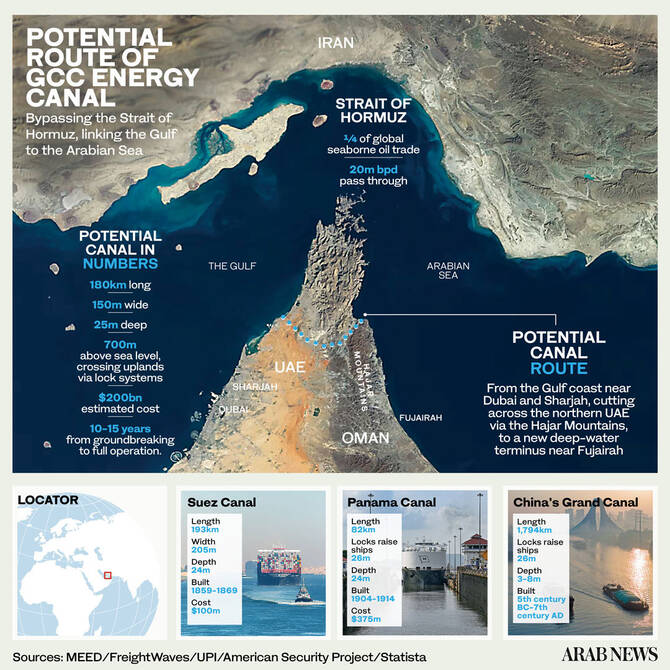
The emirate, it was reported, was considering building a 180-km “mega-canal … as a means of reducing Iran’s influence on the flow of oil from the region.”
The Times carried the story without a hint of skepticism. After all, Dubai was already well known for its ambition — the Burj Khalifa, the world’s tallest building, was nearing completion, and there was no reason to doubt it was capable of at least considering such an audacious scheme.
In fact, as a short statement to the Dow Jones wire service from “a senior official of the Dubai Government” implied, it appeared to be considering more than one such project.
“Many studies on this have been presented, but nothing is solid,” the official said.

Infographic with a globe showing the daily volume of crude oil or liquid petroleum products passing through the various chokepoints of global maritime transport, particularly through the Strait of Hormuz in the Middle East, according to the US Energy Information Administration for the first half of 2025. (AFP)
Then the economic tidal wave of the global financial crisis hit the Middle East, sweeping away many of Dubai’s schemes with it — including a plan to build an altogether more modest canal.
Just 4 km south of the main runway at Dubai’s Al Maktoum International Airport are the remains of what at first glance could easily be mistaken for archaeological earthworks from another era.
In fact, the excavations, which are slowly being reabsorbed by the desert sands, are the remains of what was once billed, with some hyperbole, as “the largest, most complex civil engineering project ever undertaken in the Middle East.”
The Arabian Canal, conceived in the early 2000s, was to be a 75-km waterway, cutting inland in a wide semi-circle from the base of the Palm Jebel Ali and rejoining the Gulf at Dubai Marina.
At $11 billion, its proposed budget was enormous and, said the developers, it would “without question, be one of the wonders of the engineering world.”
The diggers and earthmovers moved in, but work had barely started when the crash arrived, and in 2009, it ground to a halt. Today, the Arabian Canal exists only as a handful of faint scars on the landscape and as a footnote on the developer’s website.
Shelved at about the same time were the plans for what really could have laid claim to being the largest and most complex civil engineering project ever undertaken — not only in the Middle East, but pretty much anywhere else.
For 17 years, those plans, never seen in public, have been gathering dust in a Dubai government office. It is intriguing, said Shahryar Pasandideh, a military and technology analyst at SPAS Consulting, to speculate that someone might now be dusting them off.
But, he said, quite apart from the obvious engineering challenges such a scheme would present, it would be a strategic non-starter.
“If you think the Strait of Hormuz is a vulnerable choke point and that a canal that bypasses it is a better option, you haven’t spent much time thinking about how vulnerable a canal would be,” he said.

All along its length, the canal would be “well within the reach of Iran’s strike capabilities.
“Every pumping station, canal lock, and similarly essential logistical node amounts to a point of failure and vulnerability.
“The greater the number of such points of failure, the greater the investment required toward air defense and ballistic missile defense capabilities to secure all such sites.”
Moreover, he said, “one should not underestimate the consequences of a slow-moving ship with little or no ability to maneuver being immobilized, if not sunk, in a narrow canal.”
These consequences were demonstrated in 2021 when the Suez Canal was blocked for six days, at an estimated cost of almost $10 billion a day, by the Ever Given, a 400-meter-long container ship that became wedged between the two banks.
“My comments are, of course, those of a military analyst,” said Pasandideh, a fellow at the Bill Graham Centre for Contemporary International History.

This satellite imagery released by Maxar Technologies shows an overview of the MV Ever Given container ship and tugboats in the Suez Canal on March 29, 2021. (AFP/File)

A handout picture released by the Suez Canal Authority on March 29, 2021 shows tugboats pulling the Panama-flagged MV 'Ever Given' from where it got stock along Egypt's Suez Canal waterway. (AFP)
“But there are also financial and economic factors to consider, including projected demand for oil and gas, and engineering and geological considerations. All things considered, a canal bypassing the Strait of Hormuz is not a practical solution.”
In 2008, the original plan envisaged a 180-km canal linking the Gulf coast near Dubai with the port of Fujairah on the Indian Ocean, crossing the Hajar Mountains via a series of enormous locks.
As Dow Jones reported at the time: “The massive cost and complexity of the project is thought to have stalled a decision on the canal.”
The cost today would be many multiples north of the predicted bill of $200 billion in 2008. As one of the kinder comments of Gingrich’s X post noted: “It would be cheaper and easier just to make peace with Iran.”
And constructing such a canal would be a fantastically more complex proposition than either the Suez Canal or the Panama Canal, both of which have been cited on social media as examples of why a Grand Arabian Canal ought to be possible.
For a start, running a canal from the Gulf to the Indian Ocean would involve crossing the Hajar mountain range, which runs between the UAE and Oman and, in places, rises to 3,000 meters.
That would mean building multiple locks capable of carrying vast tankers, to say nothing of the pumping infrastructure necessary to move the vast amounts of water involved.
The 82-km Panama Canal has just six pairs of locks; the 193.3-km Suez Canal has none. The proposed canal would require hundreds.

Map of Panama showing the Gatun and Alhajuela lakes and locks. (AFP)

A car carrier ship sails through the Pedro Miguel Locks during maintenance work at the Panama Canal, on the outskirts of Panama City on May 30, 2025. (AFP)
It is possible that the engineers who consulted on the original scheme in 2008 concluded it was impractical — or that, as Pasandideh suggests: “If you need a bypass, a pipeline makes more sense.”
At about the same time that Dubai was thinking about a canal, Abu Dhabi began work on a 360-km crude-oil pipeline connecting its onshore Habshan oil field and the port of Fujairah on the Gulf of Oman.
Saudi Arabia already had its 1,200-km east-west pipeline, which had been built amid earlier fears for the security of the Strait of Hormuz during the Gulf “tanker wars” of the 1980s.
Linking oil fields in the Eastern Province with refineries at Yanbu on the Red Sea, the Petroline has been regularly upgraded.
But neither pipeline, as they stand today, is capable of replacing the volume of tanker traffic that passes through the Strait of Hormuz.
The current capacity of Saudi Arabia’s Petroline is about 7 million barrels per day. The Abu Dhabi Crude Oil Pipeline can carry only 1.5 million, and both were already running at capacity before the war began.
On Friday, S&P Global reported that the current disruption at Hormuz was removing 17 million barrels a day from the global oil market.
As Reuters reported last week, although oil shipments from the Red Sea port at Yanbu, fed by Saudi Arabia’s trans-Arabian pipeline, “are on course to hit record highs in March … they are still far below the levels needed to compensate for the drop in flows from the Strait of Hormuz.”

Map showing Saudi Arabia's major oil infrastructure and pipeline linking oil fields in the Eastern Province with refineries at Yanbu on the Red Sea. (AFP)
Nevertheless, building additional east-west pipe capacity alongside the current route of the Petroline would be a quicker, easier and far cheaper option than running a canal up and over the Hajar Mountains.
And, according to an assessment by AI platform Claude, even drilling a vast tunnel through the 3,000-meter-high, 100-km-wide Hajar mountain range would also be a cheaper, easier alternative to a canal.
The canal, Claude calculated, would require “240 locks with 25 meter lift, or 400 with 15 meter lift — each one roughly 520 meters long, 80 meters wide, and 30 meters deep, making each individual lock structure larger than many of the world’s biggest dams.”
Another engineering constraint would be water. “The larger the lock and the greater the lift, the more water is consumed per cycle. Each locking operation drains an enormous volume of water, equal to 520 meters x 80 meters x lift height.”
At a modest 15-meter lift, “that’s 624,000 cubic meters per cycle — roughly a quarter of the volume of Loch Ness, every time a single ship passes through a single lock.”
Finally, Claude concluded, carving a channel through 100 km of mountain range wide enough for two-way traffic of Ultra Large Crude Carriers would require the movement of “more rock than all human construction projects in history combined.”


