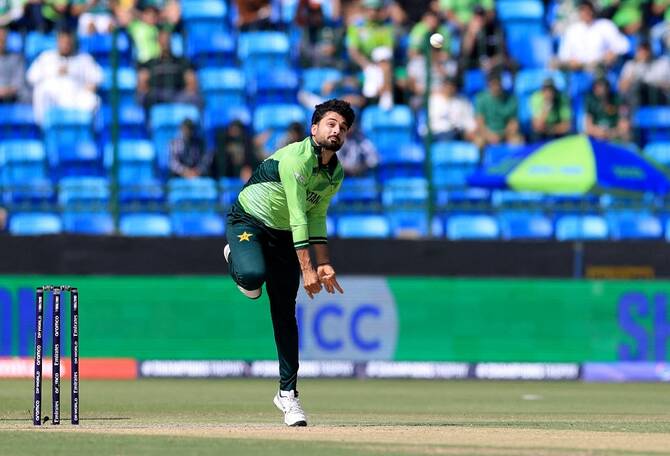
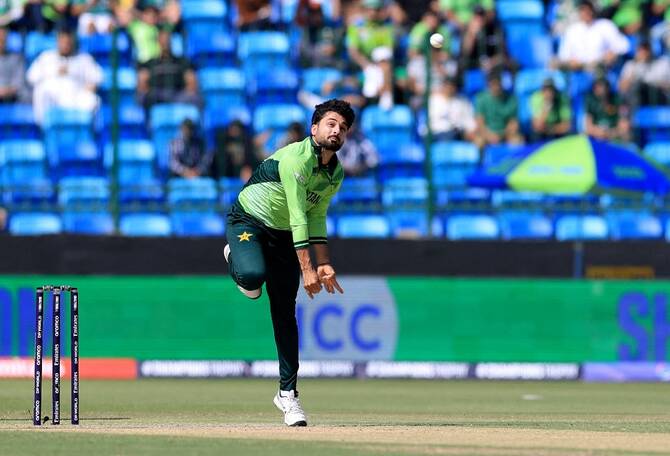
It did not take long for the simmering antipathy on the Indian sub-continent to erupt after the auction of players for the men’s franchises in The Hundred.
This centered on the purchase of Pakistani spinner Abrar Ahmed by Sunrisers Leeds. The franchise is owned by Indian media conglomerate Sun TV Network, which acquired the former Northern Superchargers franchise in two stages. First, it bought a 49 per cent stake from the England and Wales Cricket Board and then the 51 per cent balance from Yorkshire County Cricket Club in a deal worth around $32m (£100m). Sun TV also owns Sunrisers Hyderabad in the Indian Premier League and Sunrisers Eastern Cape in the SA20.
Abrar entered the auction with a base price of $100,000 and was subject to a bidding contest between Trent Rockets and the Sunrisers, who secured his signing with a bid of $252,000. This made him the first Pakistani international to be signed by an Indian-owned franchise in The Hundred.
Present and active at the bidding table was Kavya Maran, executive director of Sun TV Network and the CEO of the group's sports interests. She is the daughter of Kalanithi Maran, the founder of the Sun Group. The apparent determination to secure Abrar’s signing put her under the spotlight, to the extent that the Sunrisers’ X account was suspended within six hours of the signing in reaction to provocative posts. Two comments illustrate the strength of feeling: “This shows the power of Indian people. Now Kavya Maran will understand what people’s emotions mean,” and “They earn money from India and spend it on Pakistani players. Keep boycotting the anti-national Sunrisers.” It ought to be recorded, for balance, that the Sunrisers also acquired players from Australia and South Africa.
Sunrisers coach Daniel Vettori explained the motivation behind Abrar’s acquisition. He said: “After we missed out on Adil Rashid, the priority was going to get a spin bowler and we did not think that quality was in the local market, so we had to jump overseas. Rishad Hossain, Usman Tariq and Abrar Ahmed were all guys that were on our radar.”
Abrar is currently the third ranked T20 bowler and the Sunrisers’ decision should be seen as a cricketing one. However, there are other layers to this story. Yorkshire cricket has previous form on racial matters, notably Azeem Rafiq, so care may be needed.
On March 1, 2025, after Pakistan’s exit from the 2025 Champions trophy at the group stage, Abrar posted a photo on Instagram of himself sipping hot tea, with the caption: “Last cup of fantastic evening tea before the start of Ramadan fasting.”
This seemingly innocuous post quickly became controversial because of its assumed reference to the shooting down of an Indian fighter jet by a Pakistani jet in February 2019. The Indian Air Force pilot, Abhinandan Varthaman, was captured by Pakistani forces. A video was released showing him responding to questions, in which he said: “The tea is fantastic”. It went viral. On March 1, 2019, he was released. Prior to the 2026 T20 World Cup, Abrar posted another video of himself sharing a cup of tea with two teammates with apparent references to a political agenda. It is hardly a surprise that this has restoked feelings against him.
Of the 67 Pakistani players who registered for The Hundred, all but four of whom were men, 16 were selected for the auction pool. Ony Abrar and Usman Tariq were bought. Each franchise is allowed four overseas players. The distribution of the 32 male players by nationality was nine South Africans, eight each for Australia and New Zealand, two each for Pakistan, Afghanistan and the West Indies, plus one from Bangladesh. There are no Indian male players because those with central contracts are not allowed to play in franchise cricket other than the IPL. In the women’s competition, Australians were in greatest demand, taking 17 places, followed by South Africa with six, India with four, West Indies with three and New Zealand with two. Only five players from associate countries were acquired, four of them Scottish women and one from the USA.
A month before the auction of players for The Hundred another, longer established, franchise league also switched from the draft system of player selection to an auction. This was the Pakistan Super League which, after 10 years, entered a transitional phase. Two new franchises were added — Sialkot Stallionz and Hyderabad Houston Kingsmen — thereby expanding the league from six to eight. In the old draft-based system, players were divided into fixed categories — Platinum, Diamond, Gold, Silver, and Emerging. Teams selected players in a predetermined order which limited bidding flexibility. The move to auction seeks to provide franchises with greater autonomy in squad building.
A base purse of 450 million Pakistan rupees was set for each franchise. This could be extended to PKR505 million in special circumstances to allow the direct signing of one foreign player who did not feature in the previous PSL season. Players entered the auction under four base price categories: PKR42 million, PKR22 million, PKR11 million and PKR 6 million.
Franchises must select squads comprising 16-20 players, including at least two uncapped under-23 players, one of whom must feature in the playing XI. The number of overseas players who could be acquired ranged between five and seven depending on the final squad size. Two-year contracts with franchises were awarded to players bought at auction.
Prior to the auction, each of the six existing franchises were allowed to retain up to four players from their 2025 squads, one player per category. In previous seasons, eight players could be retained. The two new franchises were permitted to pre-select and retain up to four players.
Thirty of the possible 36 retained player slots were taken, with all but three being Pakistani. Sam Billings of England, Andries Gous of the USA and Sikandar Raza of Zimbabwe were the exceptions. Also prior to the auction, seven of the eight franchises opted to exercise their chance to acquire, outside of the team purse, one foreign player who had not played in the previous PSL season.
As a result, some familiar names were recruited, such as Steve Smith (for $500, 000), Moeen Ali and Mustafizur Rahman. The latter was at the center of the storm that saw his IPL contract with the Kolkata Knight Riders rescinded as Indo-Bangladesh political tensions reached boiling point. In turn, this led to the withdrawal of Bangladesh from the 2026 T20 World Cup and Pakistani angst about its participation.
Almost 900 players registered for the auction, which was held on March 11. When it ended, 103 players had been bought, 40 of whom were foreign. Australians led the way with nine, the most expensive being David Warner, acquired by the Karachi Kings for $280,000. Five South Africans, New Zealand and English players were acquired, along with three from Sri Lanka, Bangladesh and the West Indies. The majority of these players are now familiar and well-established names on the franchise circuit. There were places also for seven players from associate countries, including the UAE, the USA, Oman and Nepal. The most expensive player was Naseem Shah, who was bought by Rawalpindi for $310,000, a new PSL record. A feature of the auction was that fast bowlers and aggressive opening batters received premium bids from all franchises, all-rounders maintained strong market value, whilst spinners were selected carefully and strategically.
Sometimes, strategic planning can unravel. Rahmanullah Gurbaz had joined Peshawar Zalmi on Jan. 5 but announced two days later that he had withdrawn for personal reasons, citing the need to work on his charitable foundation in Afghanistan. Subsequently, rumors circulated concerning social media abuse on him that focused on Afghan-Pakistan political issues. After the auction, England’s Tymal Mills withdrew from Peshawar Zalmi, citing family commitments. West Indian spinner Gudakesh Motie, signed by Lahore Qalandars, also withdrew, claiming fatigue after being stuck in India after the World Cup. There are rumors he may play in the IPL. If so, this will vex the PSL even more than Zimbabwe’s Blessing Muzarabani, who had agreed to join Islamabad United as a replacement for West Indian fast bowler Shamar Joseph. In a sudden volte-face, Muzarabani agreed to join KKR, as replacement for none other than Mustafizur Rahman!
It is a tangled web that has been woven since KKR was directed by the Board of Control for Cricket in India to release Rahman. Understandably, the PSL is thought to be exploring legal options against Muzarabani.
Last year, Corbin Bosch withdrew from the PSL to join Mumbai Indians as an injury replacement, citing financial security and long-term career opportunities. The PSL banned him for one year. Issues of this nature are likely to surface whenever the PSL and the IPL run simultaneously, serving more opportunities for the simmering tensions between nations and their citizens to be played out publicly and on social media. Both leagues are scheduled to open in two weeks.