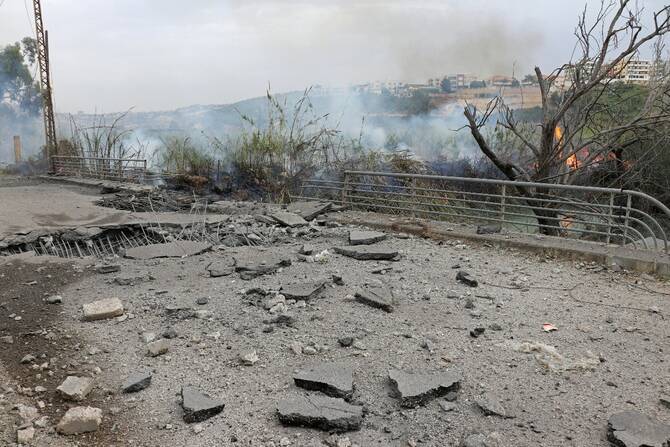

BEIRUT: Israeli airstrikes targeting bridges over the Litani River that link southern Lebanon to the rest of the country signal a new phase in the conflict, a military source said on Thursday.
The source warned that dividing areas north and south of the river would impede relief operations, isolate civilians and ensure the Israeli army’s freedom of movement.
“The current destruction operation aims to isolate the three southern sectors, western, central, and eastern, from one another, as a prelude to entering areas deemed dangerous, in preparation for searching and destroying Hezbollah’s warehouses, positions, and missile launch sites,” the source told Arab News.
The strikes followed residents south of the Litani being forced to move north, with those choosing to remain later targeted.
The first bridge struck on Wednesday was the Al-Kinayat Bridge in the Qasmiyeh area. Later, another strike hit the coastal road linking Sidon and Tyre, close to the Qasmiyeh Bridge.
In warnings to residents of southern Lebanon, the Israeli army claimed its attacks were intended to “prevent the transfer of reinforcements and weapons to Hezbollah and included strikes on all bridges and crossings over the Litani River.” The warning included 15 bridges and culverts across the Bekaa Valley and southern Lebanon.
The bridge strikes coincided with an Israeli tank column moving from the border heights of Kfar Shouba toward the outskirts of Halta via Shannouh, amid artillery shelling of Kfar Shouba and Kfar Hamam.
On the eve of the move, the Israeli army struck positions south of the Litani River where Lebanese army personnel were deployed, as well as sites belonging to the UN Interim Force in Lebanon.
However, the source added that based on monitoring of the Israeli army’s actions, it appeared to be moving slowly to avoid casualties and said: “Therefore, a deep incursion does not seem imminent; rather, the aim is to cut off Hezbollah’s supply lines.”
The Litani River is Lebanon’s longest river, stretching about 170 km. It rises in the Bekaa Valley in eastern Lebanon, flows south, then turns west and empties into the Mediterranean Sea north of Tyre.
It has figured prominently in Israeli military campaigns in Lebanon, notably during Operation Litani in 1978, aimed at dismantling Palestinian armed groups based in the South, and again during the 2006 war with Hezbollah. More recently, it served as a reference line in the Nov. 2024 ceasefire arrangements, which called for Hezbollah’s disarmament in southern Lebanon.
The military source confirmed that Lebanese army units remain deployed south of the river, along with UNIFIL forces.
“The attacks the army suffered 24 hours ago may have been intended to force a withdrawal, but the army is determined to stay,” they told Arab News, declining to disclose the number of soldiers currently in the area.
The Legal Agenda in Lebanon, a non-profit research and advocacy organization, said Israel’s claim that Hezbollah uses bridges and roads does not change their civilian nature: “They remain civilian objects protected under international humanitarian law, and that protection is not lost due to alleged use by a party to the conflict.”
The organization described such acts as a war crime, saying that linking attacks to messages directed at the Lebanese state suggested civilian infrastructure was being targeted as a “means of political pressure” on both the state and the population.
“This violates the core principles of international humanitarian law, which prohibits targeting civilian objects or using civilian suffering to achieve military or political aims,” the organization added.
Media reports in Beirut suggest the negotiations Lebanon is holding onto with Israel may only take place under fire.
“Lebanon now appears orphaned. No one is responding to its initiative, and no one is pressing for de-escalation. A French envoy is due to arrive in Beirut on Thursday, but this remains within the realm of attempts and nothing more,” an official Lebanese source told Arab News.
The source also expressed concern about escalating internal sectarian incitement, alluded to by President Joseph Aoun in a statement issued after he chaired a security meeting on Wednesday.
During the meeting, Aoun stressed “the full readiness of the military and security forces.” He urged for political rhetoric to be grounded in national unity, urging the Lebanese to stand together in solidarity while rejecting divisiveness, sectarian incitement, and strife.
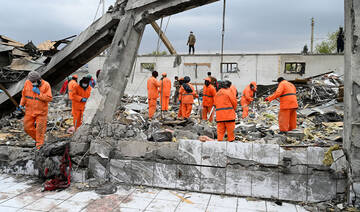
Israeli airstrikes struck the heart of the capital, Beirut, as well as areas in Mount Lebanon, resulting in the death and injury of dozens of residents and displaced individuals. This triggered sectarian responses, given Hezbollah’s interference in the war in support of Iran, sentiments that were amplified on social media platforms.
Two weeks into the expanded war between Israel and Hezbollah, former minister Nasser Yassin, director of the Arab Center for Research and Policy Studies in Beirut, said he feels the data indicates that both sides have entered a phase of attempting to impose realities on the ground, each according to its own objectives and capabilities, before moving toward any potential political path which for now, appears to be “far from feasible.”
Based on the on-ground assessment of Israeli military operations, Yassin said they fall into a complex Israeli strategy that extends beyond intensifying military pressure.
“It aims to destroy Hezbollah’s military and logistical infrastructure, targeting weapons depots, command-and-control centers and supply lines, while pressuring and punishing the supporting community, and exerting additional pressure on the Lebanese state,” Yassin told Arab News.
He added that through limited ground incursions, Israel is attempting to probe Hezbollah’s defenses, erode its combat capabilities, and assess its response speed and operational flexibility, in preparation for a possible expansion of the operation.
Meanwhile, the death toll from these Israeli attacks has surpassed 968, including 100 children and 47 women, with 2,105 wounded. The number of displaced individuals has climbed to 816,700, including approximately 130,000 currently in collective shelters.
Yassin further fears that the worsening humanitarian situation might place additional strain on the Lebanese state and its institutions in managing displacement and emergency response.
“This could deepen the exhaustion in Hezbollah’s supporting community and heighten internal tensions among Lebanese communities, as the fighting intensifies and the scale of human and service-related losses continues to grow,” he said.