
ISLAMABAD: The foreign ministers of Pakistan and several Arab and Islamic nations this week urged Iran to halt its attacks on neighboring Gulf countries in the region, warning Tehran that the future of relations between these countries and Iran depends on its respect for sovereignty and non-interference in the internal affairs of others.
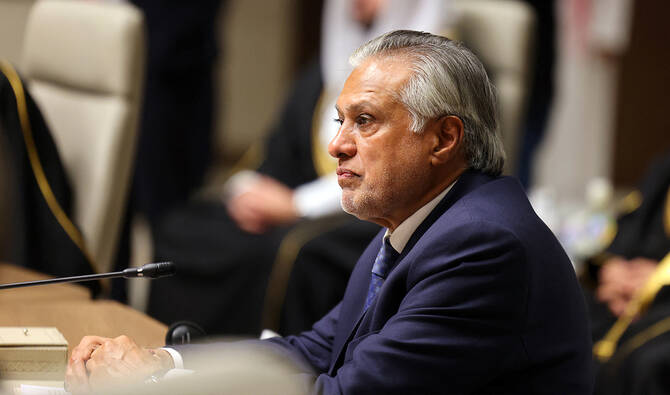
Pakistan’s Deputy Prime Minister and Foreign Minister Ishaq Dar attended a consultative meeting of the foreign ministers of several Arab and Islamic nations meeting in Riyadh on Wednesday. The meeting took place as the conflict in the Middle East continues to intensify, with
Iran attacking US interests in neighboring Gulf states with missiles and drones. Iran says its onslaught is in response to joint US-Israel air strikes against Tehran that triggered a deadly conflict in the Middle East since Feb. 28.
The meeting brought together foreign ministers from Azerbaijan, Bahrain, Egypt, Jordan, Kuwait, Lebanon, Pakistan, Qatar, Saudi Arabia, Syria, Türkiye, and the UAE.
“The ministers called on Iran to immediately cease its attacks, respect international law and international humanitarian law, and adhere to the principles of good neighborliness as a first step toward de-escalation, enhancing regional security and stability and advancing diplomatic solutions,” a copy of the joint statement, shared by the UAE’s official WAM news agency, stated on Wednesday.
“They stressed that the future of relations with Iran depends on respecting state sovereignty, non-interference in internal affairs, refraining from aggression against territories, and not using military capabilities to threaten regional countries.”
The foreign ministers said Iran’s attacks “cannot be justified under any pretext,” affirming the right of affected states to defend themselves in line with Article 51 of the United Nations Charter.
The statement also urged Iran to stop supporting, financing and arming affiliated militias in Arab states. The foreign ministers urged Iran to refrain from actions that could obstruct international navigation in the Strait of Hormuz or threaten maritime security in the Strait of
Mandeb, another strategic waterway between Yemen on the Arabian Peninsula and Djibouti and Eritrea in the Horn of Africa.
The group also condemned Israel’s aggression against Lebanon and its “expansionist policies” in the region.
Separately, Pakistan’s foreign office said in a statement that Dar informed participants of the meeting about Islamabad’s efforts to resolve the diplomatic crisis.
Underscoring the importance of preserving the unity of the Muslim Ummah, the DPM/FM called for a swift end to the ongoing conflict and reiterated Pakistan’s call for dialogue and diplomacy.
“The DPM/FM stressed the need to address the root causes of the ongoing crisis affecting the wider region and, in this regard, condemned in the strongest possible terms Israel’s continued aggression and provocations against regional countries,” the Pakistani foreign office said.
He also condemned the “unwarranted attacks” on civilians, energy and critical infrastructure in the region, calling for an end to all such attacks.
“He urged refraining from any actions that may undermine the energy security of the region and beyond, thereby exacerbating global economic challenge,” the Pakistani foreign office said.
The US and Israel launched coordinated strikes against Iran last month after months of negotiations between Washington and Tehran over Iran’s nuclear program.
The US accuses Iran of building nuclear missiles that could target Israel and Washington, charges Tehran has dismissed.