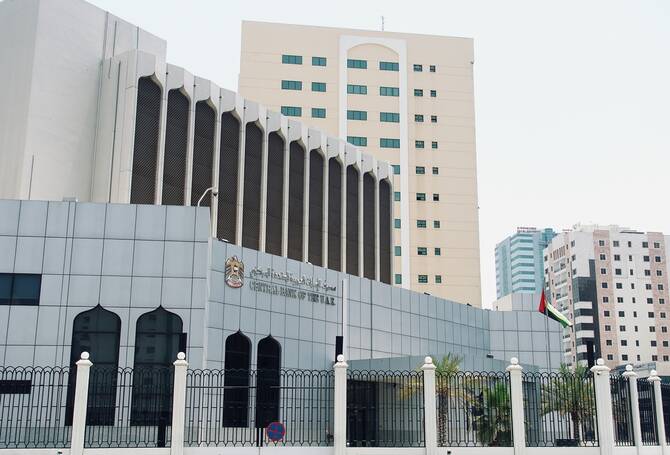

DUBAI: Shares of UAE-listed banks jumped on Wednesday after the Central Bank of the UAE announced measures to support their liquidity as the Iran crisis hits Gulf economies.
The package detailed by the CBUAE in a statement dated March 17 includes enhanced access to reserve balances of up to 30 percent of the cash reserve requirement and term liquidity facilities in both UAE dirhams and US dollars.
Abu Dhabi Commercial Bank chief economist Monica Malik said the measures echoed the central bank’s response to the COVID-19 pandemic.
“Again, we see this package aimed at ensuring that banks have sufficient liquidity and that credit continues to flow to the real economy. We see the package as supporting macro stability and broader economic confidence,” she said.
Dubai’s Emirates NBD and Abu Dhabi Islamic Bank jumped over 9 percent on Wednesday morning before paring gains, while ADCB rose as much as 6.6 percent.
First Abu Dhabi Bank, the UAE’s biggest bank by assets, closed down 3.6 percent. FAB is perceived as a defensive pick compared to its peers, said Naresh Bilandani, Jefferies head of CEEMEA equity research, noting the stock remains Jefferies’ preferred UAE exposure.
Stocks of banks based in the UAE have suffered double-digit losses since the US-Israeli war on Iran began on Feb. 28.
The conflict, which shows no signs of de-escalation, has thrown global energy markets and transport networks into chaos and has quickly become regional, with multiple attacks by Iran on Dubai and other countries across the Gulf.
Some lenders have temporarily closed branches in the country.
The UAE’s financial system “has demonstrated resilience during the current extraordinary circumstances affecting the global and regional markets without any material impact on the banking sector’s health and payment systems,” the CBUAE said in its statement.
“We think this news should be positive for sentiment near term as it provides temporary liquidity and capital relief for the banks in what is a difficult period,” Goldman Sachs analysts said in a note.
‘No material stress’ yet
Other measures in the package approved on Tuesday include stopgap relief in liquidity and stable funding ratios and the temporary release of the countercyclical capital buffer and capital conservation buffer — regulatory requirements that prescribe banks to hold extra capital in periods of high credit growth, which can be deployed during downturns.
Goldman Sachs said the temporary lifting of CCyB and CCB could boost capital buffers by up to 3 percentage points, giving lenders flexibility to keep writing loans and potentially absorb potential losses should asset quality deteriorate.
Banks across the Gulf have benefited in recent years from rising demand for credit as governments invest to diversify their economies away from oil.
While the measures introduced on Tuesday are larger than the similar COVID-era package, “asset quality pressures could still emerge should the conflict persist and its economic effects deepen,” Goldman Sachs said.
Gulf banks could face domestic deposit outflows of $307 billion if the Middle East conflict deepens, S&P Global Ratings said in a report on Monday. The ratings agency said, however, that it had seen no evidence of major outflows of foreign or local funding from banks.
The CBUAE said in Tuesday’s statement that the overall stock of liquidity held by UAE banks at the regulator, combined with their net eligible assets for central bank operations, had reached close to $250 billion, of which banks’ reserve balances exceed $109 billion.
According to the most recent daily liquidity metrics, no material stress has emerged and the measures “are still preventive in nature and rather meant to offer reassurance to the edgy market sentiment,” Jefferies wrote in a note, adding that the measures create liquidity access of up to $58.3 billion for UAE banks.
The CBUAE and other Gulf central banks could make further announcements after the US Federal Reserve gives its latest interest-rate decision later on Wednesday. The Fed meets as the war drives oil prices — a major engine of inflation — above $100 a barrel for the first time in years.
Gulf Cooperation Council countries generally follow the Fed’s lead on interest rates as most regional currencies are pegged to the US dollar. Only the Kuwaiti dinar is pegged to a basket of currencies, which includes the US dollar.