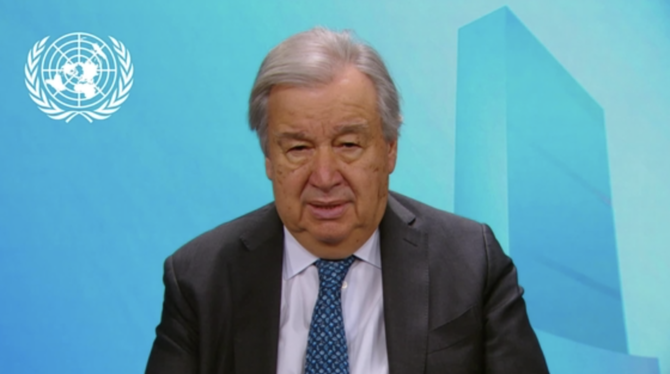

NEW YORK CITY: UN Secretary-General Antonio Guterres warned on Monday of a “rising tide of anti-Muslim bigotry and hate” around the world, as he urged governments, technology companies and individuals to take stronger action to combat discrimination and protect human rights.
Speaking during a high-level event at the UN in New York marking International Day to Combat Islamophobia, he said nearly 2 billion Muslims worldwide continue to face exclusion, discrimination and violence, online and offline.
“We are facing a rising tide of anti-Muslim bigotry and hate,” Guterres said. “For far too many Muslims, daily life can be shaped by exclusion.”
Bias can take overt forms, such as institutional discrimination, socioeconomic effects, immigration restrictions and profiling, but can also appear in more subtle ways, including opportunities that are quietly denied and suspicions that go unchallenged, the UN chief added.
“These everyday experiences rarely make the headlines or statistics,” he said. “But over time, they shape lives, erode trust and send a clear message about who is seen as belonging and who is not.”
Anti-Muslim rhetoric, misinformation and hate speech are amplifying prejudice, particularly when repeated by authority figures, Guterres warned.
“When discriminatory narratives are echoed by those in positions of authority, prejudice becomes normalized,” he said. “When stereotypes are left unchallenged, they harden into policy.”
The consequences include harassment, intimidation, vandalism and attacks that target both individuals and mosques, he continued.
“This is an assault on Muslims, and it is an assault on the values that underpin peaceful, inclusive societies everywhere.”
Guterres called on governments to ensure laws and security measures protect people while respecting human rights, rather than stigmatizing entire communities.
Technology companies must also do more to address hate speech, he said, adding: “Online spaces should bring people together, not drive them apart.”
Last year, Guterres appointed the head of the UN Alliance of Civilizations as the UN’s Special Envoy to Combat Islamophobia, in an effort to strengthen coordination and enhance partnerships to tackle discrimination.
The UN General Assembly established International Day to Combat Islamophobia in 2022 after Pakistan introduced a resolution on behalf of the Organization of Islamic Cooperation.
The measure, co-sponsored by dozens of states, including Saudi Arabia, and adopted by consensus, designated March 15 for the annual observance. The date was chosen as it marks the anniversary of the 2019 Christchurch mosque attacks in New Zealand in which a gunman killed 51 worshippers, an assault that drew global condemnation and renewed calls for action against anti-Muslim hate.
Saudi Arabia and other members of the OIC argued at the time that the designation of a Day to Combat Islamophobia would help raise global awareness of discrimination against Muslims and encourage international action to promote tolerance and religious coexistence.
The resolution urged countries, international organizations, civil society and the private sector to work together to promote tolerance, peaceful coexistence and respect for religious diversity.
This year’s event took place as Muslims this week prepare for the end of the holy month of Ramadan, a time of year Guterres described as devoted to solidarity and compassion.
“As Ramadan draws to a close, Muslims around the world reaffirm values that also form the foundation of the UN Charter: empathy for the vulnerable, generosity toward neighbors, and responsibility toward the wider community,” he said.
“On this International Day to Combat Islamophobia, let us recommit to the equality, human rights, and dignity of every person, everywhere. Let us reject the narratives of fear and exclusion.”