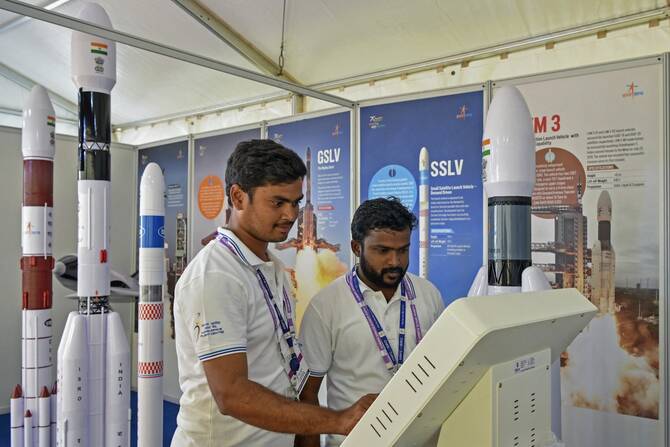
NEW DELHI: India’s space agency is expanding student participation in programs developing satellites and payloads, as the government tries to increase the contribution of young researchers to the country’s growing space ecosystem.
Initiatives to modernize and liberalize India’s space sector have been underway for the past few years.
The Indian Space Policy‑2023, launched by the Indian Space Research Organisation and the government in April 2023, lays out a framework for public‑private cooperation.
The policy is also designed to strengthen space education in the country, Science and Technology Minister Jitendra Singh told parliamentarians last week, as he outlined the government’s plans to involve students in space missions.
“The government has earmarked around 10 crore rupees (12.255 million rupees, $1.08 million) annually for student-focused educational outreach activities related to space science and technology,” he said, as quoted in a statement by the Department of Space.
“To further expand academic participation, Space Technology Incubation Centres have been established across different regions of the country. These centers facilitate collaborative research between universities and ISRO scientists and help students develop indigenous space technologies under expert mentorship.”
Since 2024, the Indian National Space Promotion and the Authorization Center has been organizing student competitions in designing model rockets and CanSats — small satellites the size of a soda can, which mimic real satellite operations after descent via parachutes.
IN-SPACe has so far authorized 17 such student-designed satellites and payloads.
“Eleven have already been successfully launched,” Singh said. “IN-SPACe is also nurturing the next generation of space entrepreneurs through several initiatives, including mentorship from domain experts, pre-incubation entrepreneurship support programs, and co-working facilities at IN-SPACe Technical Centres.”
The private sector’s engagement has been crucial in India’s plans to increase its current 2 percent share in the $450 billion global space economy to nearly 8 percent by 2033.
In 2025, it had more than 300 active startups operating in rocket launches, satellites, Earth observation, satellite communications, propulsion, electronics, space monitoring, and data analytics, according to Indian Space Association data.
The association’s director general, Lt. Gen. AK Bhatt (retd.), told Arab News on Sunday that expanding student involvement in space-related activities was a “timely” move.
“Encouraging students to design satellites, build payloads and gain exposure to real mission experiments will significantly strengthen innovation capacity at the grassroots level,” he said.
“Such early engagement nurtures a scientific temperament, builds future-ready skills, and creates a strong talent pipeline for both research and industry. Empowering young minds today will be central to sustaining India’s long-term ambitions in the global space economy.”
Over the past few years, India has several times made history in the industry.
In August 2023, ISRO’s Chandrayaan-3 moon rover landed on the lunar surface, making India the first country to land near the lunar south pole and the fourth to land on the moon — after the US, the Soviet Union, and China.
A month later, ISRO launched Aditya-L1 in 2023 — the country’s first solar observation mission, and the world’s second after the US Parker Solar Probe in 2021.
In January 2025, India became the fourth country to perform space docking — connecting two spacecraft in orbit. In June, Shubhanshu Shukla flew to the International Space Station, becoming the second Indian national in space, after Rakesh Sharma in 1984.
A month later, ISRO, in collaboration with NASA, launched a joint observation satellite to provide high-resolution radar imagery of the Earth, and in December deployed the BlueBird Block 2 — the heaviest payload ever launched from Indian soil.


![]()

India expands student participation in space missions, satellite design
Short Url
https://arab.news/z87pn
India expands student participation in space missions, satellite design
- Indian Space Research Organisation has launched 11 student-made satellites, minister says
- Government earmarks $1 million for space science educational outreach among students


Latest updates


© 2026 SAUDI RESEARCH & PUBLISHING COMPANY, All Rights Reserved And subject to Terms of Use Agreement.