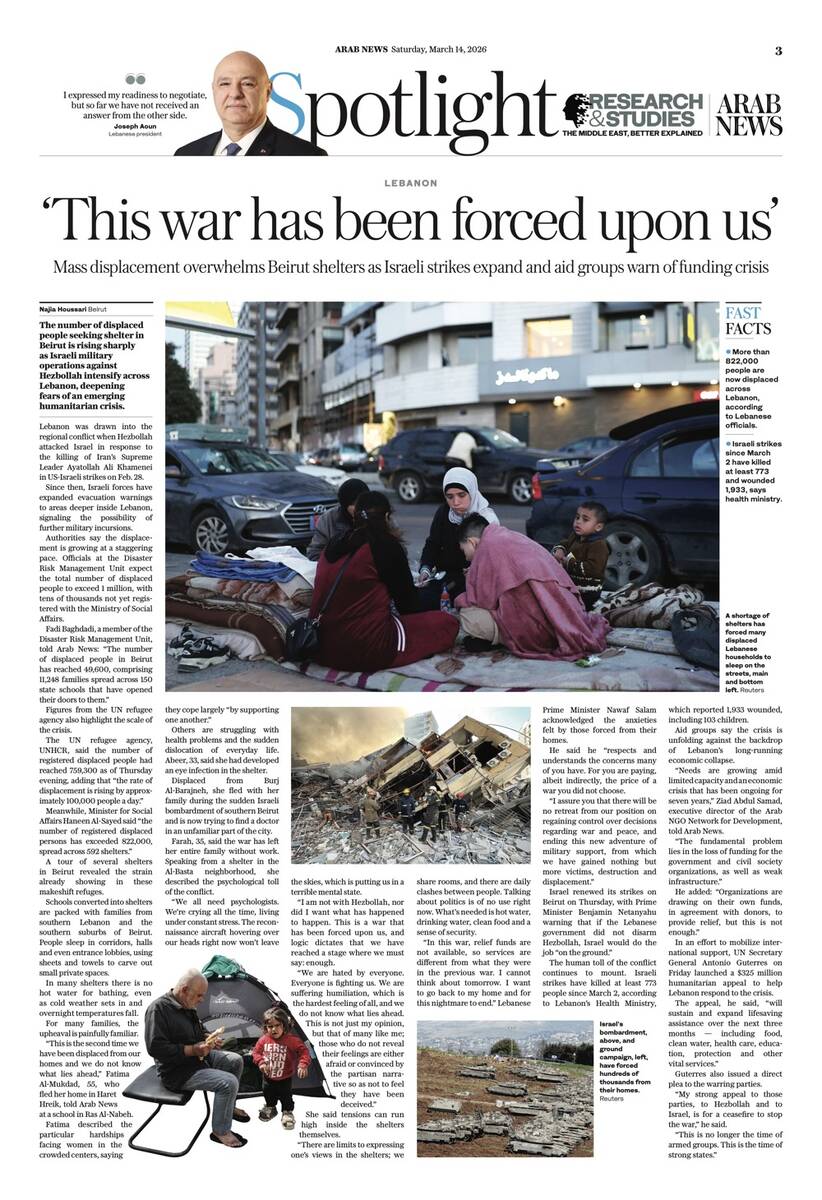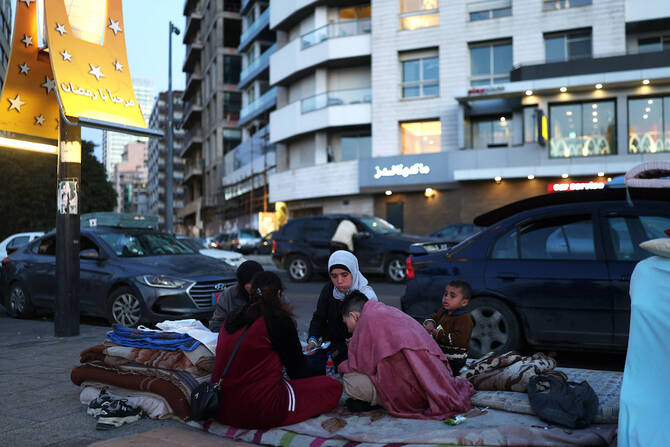

BEIRUT: The number of displaced people seeking shelter across Beirut is rising sharply as Israeli military operations against Hezbollah intensify across Lebanon, deepening fears of an emerging humanitarian crisis.
Lebanon was drawn into the regional conflict last week when Hezbollah attacked Israel in response to the killing of Iran’s Supreme Leader Ayatollah Ali Khamenei in US-Israeli strikes on Feb. 28.
Since then, Israeli forces have expanded evacuation warnings to areas deeper inside Lebanon, signaling the possibility of further military incursions.
Authorities say the displacement is growing at a staggering pace. Officials at the Disaster Risk Management Unit expect the total number of displaced people to exceed one million, with tens of thousands not yet registered with the Ministry of Social Affairs.
Fadi Baghdadi, a member of the Disaster Risk Management Unit, told Arab News: “The number of displaced people in Beirut has reached 49,600, comprising 11,248 families spread across 150 state schools that have opened their doors to them.”
Figures from the UN refugee agency also highlight the scale of the crisis.

A displaced man rests next to tents along a roadside by the sea, following an escalation between Hezbollah and Israel amid the US-Israeli conflict with Iran, in Beirut, on March 12, 2026. (Reuters)
The UN refugee agency, UNHCR, said the number of registered displaced people had reached 759,300 as of Thursday evening, adding that “the rate of displacement is rising by approximately 100,000 people a day.”
Meanwhile, Minister for Social Affairs Haneen Al-Sayed said “the number of registered displaced persons has exceeded 822,000, spread across 592 shelters.”
UNHCR warned that the situation in Lebanon is heading toward “a humanitarian disaster that is worsening as aerial bombardment continues and the number of families forced to leave their homes increases.”
A tour of several shelters in Beirut revealed the strain already showing in these makeshift refuges.
Schools converted into shelters are packed with families from southern Lebanon and the southern suburbs of Beirut. People sleep in corridors, halls and even entrance lobbies, using sheets and towels to carve out small private spaces.
Facilities are rudimentary. In many shelters there is no hot water for bathing, even as cold weather sets in and overnight temperatures are expected to fall to freezing.
For many families, the upheaval is painfully familiar.
“This is the second time we have been displaced from our homes and we do not know what lies ahead,” Fatima Al-Mukdad, 55, who joined her brothers and their families after shelling intensified around her home in Haret Hreik, told Arab News at a school in Ras Al-Nabeh.
Fatima described the particular hardships facing women in the crowded centers, saying they cope largely “by supporting one another,” while describing their lives as “miserable, despite the availability of food, but there are other needs.”

For many families in Lebanon, the upheaval currently being experienced amid the conflict is painfully familiar. (Reuters)
Others are struggling with health problems and the sudden dislocation of everyday life.
Abeer, 33, said she had developed an eye infection after catching a virus in the shelter.
Displaced from Burj Al-Barajneh, she fled her home in her pajamas with her family during the sudden Israeli bombardment of southern Beirut and is now trying to find a doctor in an unfamiliar part of the city.
Farah, 35, whose company has halted operations after closing its branch in the southern suburbs of Beirut, said the war has left her entire family without work. Speaking from a shelter in the Al-Basta neighborhood, she described the psychological toll of the conflict.
“We all need psychologists. We’re crying all the time, living under constant stress. The reconnaissance aircraft hovering over our heads right now won’t leave the skies, which is putting us in a terrible mental state.
“I am not with Hezbollah, nor did I want what has happened to happen. This is a war that has been forced upon us, and logic dictates that we have reached a stage where we must say: enough.
“We are hated by everyone. Everyone is fighting us. We are suffering humiliation, which is the hardest feeling of all, and we do not know what lies ahead. This is not just my opinion, but that of many like me; those who do not reveal their feelings are either afraid or convinced by the partisan narrative so as not to feel they have been deceived.”
She said tensions can run high inside the shelters themselves.
“There are limits to expressing one’s views in the shelters; we share rooms, and there are daily clashes between people. Talking about politics is of no use right now. What’s needed is hot water, drinking water, clean food and a sense of security.
“In this war, relief funds are not available, so services are different from what they were in the previous war. I cannot think about tomorrow. I want to go back to my home and for this nightmare to end.”

Flames rise from an Israeli airstrike in Dahiyeh, Beirut's southern suburbs, Wednesday, March 11, 2026. (AP)
Some shelters have also seen individuals identifying themselves as members of Hezbollah monitoring who enters and questioning the identities of displaced families.
Lebanese Prime Minister Nawaf Salam acknowledged the anxieties felt by those forced from their homes.
He said he “respects and understands the concerns many of you have. For you are paying, albeit indirectly, the price of a war you did not choose.
“I assure you that there will be no retreat from our position on regaining control over decisions regarding war and peace, and ending this new adventure of military support, from which we have gained nothing but more victims, destruction and displacement.”
Israel renewed its strikes on Beirut on Thursday, with Prime Minister Benjamin Netanyahu warning that if the Lebanese government did not disarm Hezbollah, Israel would do the job “on the ground.”
“You are playing with fire,” Netanyahu said in comments directed at Lebanese authorities.
Referring to the Lebanese government’s stated commitment to disarm the Iran-backed group, Netanyahu added: “If you do not do so, it is clear that we will.”
The human toll of the conflict continues to mount. Israeli strikes have killed at least 773 people since March 2, according to Lebanon’s health ministry, which reported 1,933 wounded, including 103 children.

An Israeli flag flies above Israeli military vehicles on the Israeli side of the Israel-Lebanon border, following an escalation between Hezbollah and Israel amid the US-Israeli conflict with Iran, in northern Israel, on March 8, 2026. (Reuters)
Children make up a large share of the displaced. UNICEF estimates that 285,600 children have been forced from their homes and warned of “the risk of further displacement as a result of continuing air strikes on southern Lebanon, Beirut, and the Bekaa.”
The agency also pointed to the disruption caused by sudden evacuation orders, noting that some areas recently hosting displaced families — including Haret Saida and Tyre — have themselves been ordered to evacuate, triggering secondary displacement.
At least 570 internally displaced people and many residents were forced to leave immediately, with some families sleeping in the open due to a lack of available accommodation.
Across the country, 344 public schools have been converted into shelters, according to the Ministry of Education. With occupancy rates already at 92 percent, the move has disrupted schooling for more than 72,000 pupils in morning classes and 39,000 more in the evening.
Aid groups say the crisis is unfolding against the backdrop of Lebanon’s long-running economic collapse.
“Needs are growing amid limited capacity and an economic crisis that has been ongoing for seven years,” Ziad Abdul Samad, executive director of the Arab NGO Network for Development, told Arab News.
“The fundamental problem lies in the loss of funding for the government and civil society organizations, as well as weak infrastructure.”
He added: “Organizations are drawing on their own funds, in agreement with donors, to provide relief, but this is not enough.
“The main problem is also that there is no enthusiasm among organizations to work again to help people, given that less than a year and a half has passed since they provided relief following a previous war.”
Many displaced families are reluctant to move far from their homes, even when shelters elsewhere are available.

Workers unload aid supplies as the first aid shipment from the European Union and UNICEF arrives at Beirut-Rafic Hariri International Airport on March 10, 2026. (Reuters)
“They are staying on the streets and refusing to go to shelters outside Beirut and Mount Lebanon, because they want to remain close to their homes in the southern suburbs of Beirut,” Abdul Samad said.
“There is a general feeling of alienation and that they have been left to their own devices.”
He said the government was doing what it could within limited resources, and that the humanitarian air and sea bridge opened between Lebanon and international partners was a positive step, but warned that the scale of needs remained overwhelming.
In an effort to mobilize international support, UN Secretary General Antonio Guterres on Friday launched a $325 million humanitarian appeal to help Lebanon respond to the crisis.
“I am pleased to join all of you today as we launch a Flash Humanitarian Appeal of $325 million to support the people of Lebanon,” Guterres said during a conference attended by representatives of UN agencies and donor countries at the Lebanese prime minister’s office.
The appeal, he said, “will sustain and expand life-saving assistance over the next three months — including food, clean water, health care, education, protection and other vital services.”
Guterres also issued a direct plea to the warring parties.
“My strong appeal to those parties, to Hezbollah and to Israel, is for a ceasefire to stop the war,” he said.
“This is no longer the time of armed groups. This is the time of strong states.”