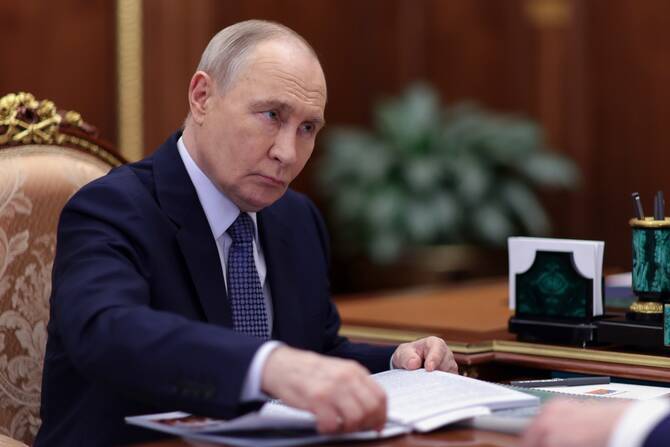
MOSCOW: President Vladimir Putin discussed measures to protect Russia’s critical infrastructure with his Security Council, the Kremlin said on Friday, after intensified Ukrainian attacks that hit a major military plant among other targets.
Putin asked Deputy Prime Minister Alexander Novak, Transport Minister Vitaly Savelyev and Construction Minister Irek Faizullin to report on the proposed measures in his opening remarks, with the rest of the meeting not made public.
Ukraine said on March 10 that it had used British Storm Shadow missiles to hit a factory that produced semiconductor devices and integrated micro chips for missiles in the city of Bryansk, just over 100 km (60 miles) from Ukraine’s border.
After the attack, which killed six people, some Russian war bloggers expressed bewilderment that such a crucial site for meeting Russia’s battlefield needs had not been evacuated during four years of war and was operating within reach of Ukrainian missiles.
On February 25, Ukrainian drones hit a chemical plant owned by fertilizer producer Akron in the town of Dorogobuzh, knocking off about 5 percent of Russia’s fertilizer output just before the supply crunch caused by US-Israeli attacks on Iran.
Russia’s defense ministry said on Thursday that Ukraine had attempted to attack a pumping station operated by gas giant Gazprom that exports natural gas via the TurkStream subsea pipeline to European customers, but that the attack was foiled.
On March 2, Sheskharis, a major oil terminal on Russia’s Black Sea coast, suspended loadings following a Ukrainian drone attack that injured five, damaged 20 buildings and set a fuel terminal on fire.
Amid the stepped-up attacks, Russia has slowed down or turned off mobile Internet in Moscow and some other major cities as part of what the Kremlin described as security measures.
Although such outages have become common across Russia during the war in Ukraine, Moscow has not previously experienced them on such a scale since the war started, with millions of people losing access to popular services such as maps or taxi hailing applications.


![]()

Putin questions crucial infrastructure protection amid intensified Ukrainian attacks
Short Url
https://arab.news/r8fxw
Putin questions crucial infrastructure protection amid intensified Ukrainian attacks
- Ukraine said on March 10 that it had used British Storm Shadow missiles to hit a factory that produced semiconductor devices
- On February 25, Ukrainian drones hit a chemical plant owned by fertilizer producer Akron


Latest updates





© 2026 SAUDI RESEARCH & PUBLISHING COMPANY, All Rights Reserved And subject to Terms of Use Agreement.