

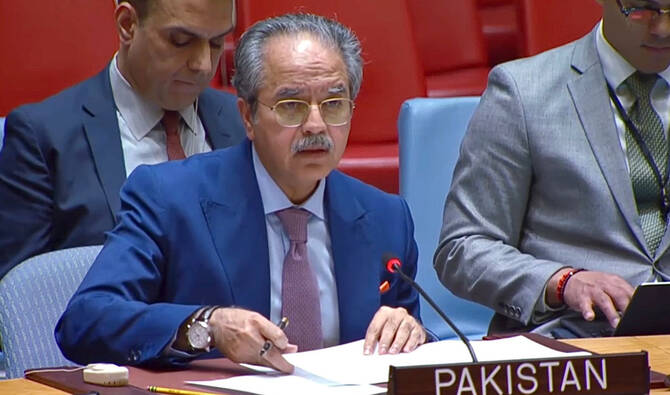

ISLAMABAD: Pakistan told the United Nations on Monday it would take all measures required to protect its citizens from militant attacks emanating from Afghanistan as tensions between the neighboring countries intensify, with Islamabad accusing Kabul of harboring armed groups and the Afghan Taliban denying the allegation.
Pakistan’s UN ambassador, Asim Iftikhar Ahmad, laid out Islamabad’s position during a debate at the UN Security Council on the situation in Afghanistan, warning that cross-border militancy posed a serious threat to regional security.
The remarks came after clashes between Pakistani and Afghan forces erupted last month when Afghan forces attacked Pakistani military positions along their shared border in retaliation for earlier Pakistani airstrikes that Islamabad said targeted militant camps inside Afghanistan.
“Pakistan will take all necessary defensive measures for the protection of its citizens, territory and sovereignty,” Ahmad told the council. “Our counterterrorism operations will continue for as long as it takes to degrade the combat capabilities of terrorist groups and support infrastructure.”
Ahmad said Afghanistan had become “a sanctuary” for militant groups including the Tehreek-e-Taliban Pakistan (TTP), the Baloch Liberation
Army and its Majeed Brigade, Daesh, Al-Qaeda and the East Turkestan Islamic Movement.
He warned that militancy emanating from Afghanistan was destabilizing the region and could threaten wider international security if left unchecked.
Ahmad told the council that Pakistan had witnessed a surge in attacks since the Taliban returned to power in Afghanistan in 2021, saying thousands of Pakistanis had been killed in militant violence over the years and that more than 175 people had died in attacks last month alone, including three suicide bombings.
He also accused elements within the Taliban administration of complicity with militant networks and said Pakistan had seized sophisticated military equipment left behind by foreign forces in Afghanistan during its counter-terrorism operations.
While the UN Assistance Mission in Afghanistan (UNAMA) has reported civilian casualties in cross-border fighting, the Pakistani diplomat questioned the mission’s ability to independently verify such incidents.
He said UNAMA’s capacity to accurately assess border clashes and civilian casualty reports was limited because access to areas outside Kabul remained tightly controlled by the Taliban.
Ahmad also criticized Taliban governance inside Afghanistan, saying restrictions on women and girls and worsening economic conditions were harming the Afghan population.
Despite the tensions, he said Pakistan had repeatedly pursued diplomatic engagement with Kabul and had supported regional mediation efforts involving Qatar, Türkiye and Saudi Arabia.
“As an immediate neighbor bound by geography, with deep-rooted ties, cultural linkages and fraternal bonds, no country desires peace and stability in Afghanistan more than Pakistan,” he said, adding it had also suffered from the consequences of decades of conflict and instability in Afghanistan more than any other state.
“Pakistan’s demand from Afghanistan has always been singular and clear: verifiable and non-reversible action against terrorists,” he added.
“This demand remains unmet to date.”
During the council meeting, Pakistan’s envoy also exchanged sharp remarks with representatives of Afghanistan and India, accusing Kabul of ignoring cross-border militant attacks and alleging that New Delhi had supported groups targeting Pakistan from Afghan territory.
India has rejected similar accusations in the past.


