

Nuclear power summit to open in France

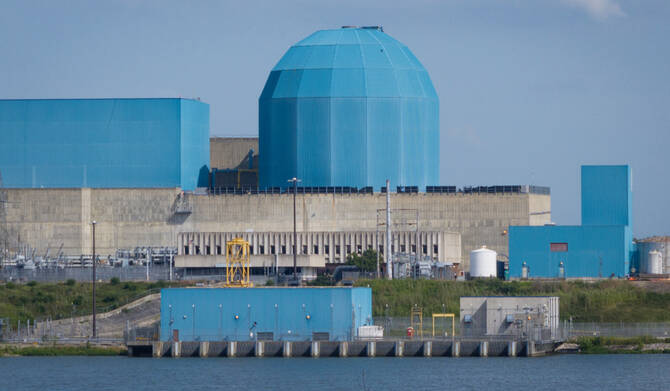
Constellation's Clinton Clean Energy Centerís single nuclear reactor power plant is shown on July 24, 2025 in Clinton, Illinois. (AFP)
Short Url
Updated 10 March 2026
Follow

Nuclear power summit to open in France

  • The United States and China will be present, but Russia, another key nuclear power, will be missing because of its invasion of Ukraine

PARIS, France: A summit aiming to boost the use of civilian nuclear power opens in Paris on Tuesday, as the US-Israeli conflict against Iran highlights the dangers of reliance on fossil fuels.
Representatives from about 40 countries and international organizations are expected at the meeting to be opened by President Emmanuel Macron.
The United States and China will be present, but Russia, another key nuclear power, will be missing because of its invasion of Ukraine.
Nuclear energy fell into crisis after the Fukushima disaster in Japan in 2011, which reinforced fears highlighted by the 1986 Chernobyl disaster.
But interest has been reignited by the growing international focus on energy sovereignty and the search for clean energies to counter global warming.
Nuclear power accounts for about nine percent of electricity produced in the world, and there are some 440 reactors in about 30 countries, according to the World Nuclear Association.
The UN’s International Atomic Energy Agency (IAEA), a co-sponsor of the conference with the International Energy Agency (IEA), has said that nuclear power generation could double by 2050.
It says that China is building 29 reactors to add to its 57 already in operation.
IAEA chief Rafael Grossi said Monday that about 40 countries had started building or were interested in building reactors.
IEA chief Fatih Birol said it was particularly in the interest of European countries to strengthen their energy sovereignty by producing more renewable sources — including solar and wind — and “making a strong comeback for the nuclear power.”


North Korean leader Kim watches cruise missile tests with his daughter

A strategic cruise missile test launch conducted on the destroyer Choe Hyon at an undisclosed location in North Korea. (AFP)
Updated 11 March 2026
Follow

North Korean leader Kim watches cruise missile tests with his daughter

  • KCNA said the missiles hit target islands off North Korea’s west coast

SEOUL, South Korea: North Korean leader Kim Jong Un and his teenage daughter observed tests of strategic cruise missiles fired from a warship, state media reported Wednesday, as North Korea threatened responses to US-South Korean military drills.
Images sent by the Korean Central News Agency showed the two in a conference room looking at a screen showing weapons being fired from the Choe Hyon, a year-old naval destroyer.
Kim Jong Un watched the missiles launches via video on Tuesday and underscored the need to maintain “a powerful and reliable nuclear war deterrent,” KCNA reported in a dispatch that did not mention his daughter.
The girl, reportedly named Kim Ju Ae and about 13, has accompanied her father at numerous prominent events including military parades and weapons launches since late 2022. South Korea’s spy agency assessed last month Kim Jong Un was close to designating her as his heir.
KCNA said the missiles hit target islands off North Korea’s west coast. It quoted Kim Jong Un as saying the launches were meant to demonstrate the navy’s strategic offensive posture and get troops familiarized with weapons firings.
Kim Jong Un observed similar cruise missile launches from the Choe Hyon in person last week, but his daughter was not seen at that appearance.
Tuesday’s missile firings came after the start of the springtime US-South Korean military drills that North Korea views as an invasion rehearsal.
On Tuesday, Kim Jong Un’s sister and senior official, Kim Yo Jong, warned the drills reveal again the US and South Korea’s “inveterate repugnancy toward” North Korea. She said North Korea will “convince the enemies of our war deterrence.”
The 11-day Freedom Shield drill that began Monday is largely a computer-simulated command post exercise and will be accompanied by a field training program. North Korea often reacts to the two sets of training with its own weapons tests.
