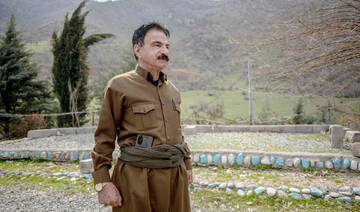
PENJWEN: From their hideouts in the Iraqi mountains near Iran, leftist Kurdish rebels say they are ready to fight Iran, but hope for an uprising before they intervene, with or without US support.
After saying that he would be “all for” a Kurdish offensive on Iran, US President Donald Trump appeared to backtrack Saturday, saying he did not want such an attack.
Senior commander Roken Nerada of the Party of Free Life of Kurdistan, or PJAK, said: “If there is an attack on the Kurdish people ... then with every means ... we are ready to resist as we always have.”
“I think we can achieve our rights without the help of the US or any other country,” said Nerada, 39, who joined the rebels 17 years ago.
HIGHLIGHTS
• Iran has designated Kurdish rebels as terrorists, and many have previously fought its security forces in areas along the border.
• Just before the war, PJAK joined a coalition of Kurdish rebel parties seeking to overthrow the Iranian government and secure self-determination.
Like other Iranian Kurdish rebel groups, PJAK has bases in the mountains of Iraq’s northern autonomous Kurdistan region, but it also maintains hideouts in majority-Kurdish areas inside Iran.
Iran has designated Kurdish rebels as terrorist organizations, and many have previously fought its security forces in Kurdish-majority areas along the border.
But in recent years, under political pressure mostly from their Iraqi hosts, they have largely refrained from armed activity — raising questions about their current capacity to lead an armed offensive against Iran.
Since the Middle East war began late last month with a wave of US-Israeli strikes on Iran, Tehran has repeatedly struck Kurdish militants’ positions in Iraq, accusing them of serving Western or Israeli interests.
Just before the war, and after anti-government protests in Iran, PJAK joined a coalition of Kurdish rebel parties seeking to overthrow the Iranian government and secure self-determination.
“We are ready to fight, especially after what they did 50 days ago,” PJAK fighter Shwan said, referring to the crackdown on the protests in Iran that left thousands dead.
Amid reports that rebels might collaborate with the US, Tehran threatened to target “all facilities” in Iraq’s Kurdistan if Kurdish militants cross the border.
But on Saturday, Trump said “we’re not looking to the Kurds going in.”
“We don’t want to make the war any more complex than it already is,” he added.
Amir Karimi, another commander in PJAK, said last week that the “Americans are already in the area, and we have had a dialogue.”
It was “a political exchange ... to get to know each other,” Karimi said, adding that “a ground attack is not on the table at this stage.”
“From a strategic and tactical point of view, we believe it wouldn’t be a good idea,” he added, warning that Iranian forces have reinforced the borders.
“The Kurds will need guarantees to secure a democratic Iran,” he said.