

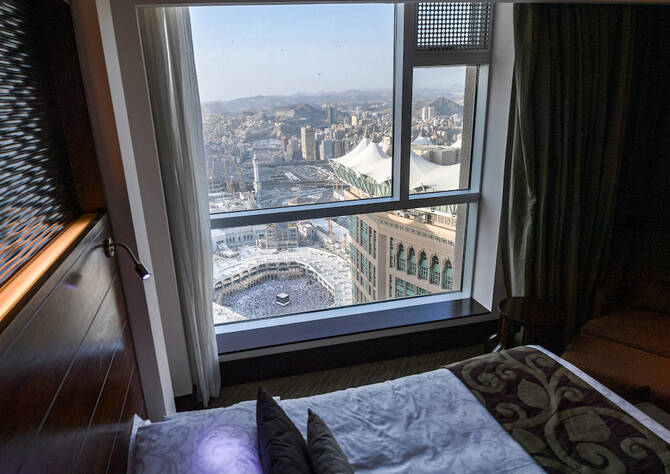

MAKKAH: Hotel demand in Makkah during the final 10 days of Ramadan, traditionally the busiest period of the year, has softened this season as international pilgrims cancel bookings due to regional tensions impact on the aviation industry, causing lower prices as more flights get cancelled or rerouted, or as passengers prefer to delay their plans.
The shift has opened opportunities for Saudi citizens and residents as well as visitors from non effected areas and routes, who can now secure rooms near the Grand Mosque at prices rarely seen during Ramadan’s final nights.
Hotels that normally sell out months in advance are now accepting last-minute reservations.
With fewer international pilgrims arriving, some properties have lowered prices, creating unexpected savings for locals and allowing them to experience the holy nights near the Grand Mosque, Islam’s holiest site.
Makkah resident Kamel Ibrahim told Arab News that domestic pilgrims are benefiting from the shift.
“Those seeking hotel rooms in the central area of Makkah and Madinah should contact hotels directly rather than booking through applications,” he said.
“Some properties are offering discounts of up to 50 percent compared with typical Ramadan prices because thousands of reservations from abroad have been canceled.”
Arab News tested this by checking prices on the travel platform Wego. A one-night stay at a hotel in Makkah was listed at SR1,138 (about $303).
When the hotel was contacted directly, the same room was offered for SR1,032 (about $275).
The difference highlights how travelers already in the Kingdom can make savings by booking directly rather than through international platforms.
Travel data from Wego shows average nightly rates for hotels near the Haram can still reach about $400 (SR1,500), depending on proximity to the mosque and room views.
Sara Siyamek, front office supervisor of Tilal Jabal Al-Kaabah Hotel said occupancy near the Grand Mosque is lower than in previous years.
“Hotels in Makkah, particularly those surrounding the Grand Mosque, have been affected by the current situation in the Gulf region, which has directly impacted bookings during the last 10 days of Ramadan,” she told Arab News.
“According to indicators circulating in the accommodation sector, occupancy rates have declined by approximately 30 percent compared with previous years, even though the last 10 days of Ramadan typically see full occupancy.”
The decline in international arrivals has been linked to travel disruptions affecting several countries who send pilgrims to Saudi Arabia.
Wejdan Bugis is a mutawwif (someone appointed by the Ministry of Hajj to act as a guide for pilgrims) in Makkah who inherited the profession from her father and grandfather who traditionally guided pilgrims from East Asia.
Bugis told Arab News that flight disruptions are the main reason fewer pilgrims are arriving during the final days of Ramadan.
“Most pilgrims come from outside Makkah, and the main issue now is travel,” she said. “If flights are operating, people will come.
“But many travelers from Gulf countries cannot arrive unless they are already inside Saudi Arabia.”
Bugis said airport operations have been disrupted across the region. “When I arrived in Dammam, airport staff said international flights had been suspended and operations were limited, which has put pressure on Jeddah airport.
“Dammam airport is now very empty because many flights have stopped, and the number of people coming to Makkah is much lower,” she said.
Officials in Indonesia have urged pilgrims to delay departures, citing escalating tensions in the Middle East and flight cancellations affecting travel routes to Saudi Arabia, according to Antara News.
Reports also indicate that about 1,600 pilgrims from Malaysia were stranded in Saudi Arabia after flights were canceled due to regional airspace disruptions, according to The Star.
Maldives Islamic Minister Dr. Mohamed Shaheem Ali Saeed said authorities are working to assist about 150 Maldivian pilgrims who were unable to travel for Umrah during the final 10 days of Ramadan after flights from transit points were canceled, according to Edition.mv.
Despite the disruptions, some hotels in the city continue to maintain steady occupancy, especially from routes or areas unaffected by the tensions and given that Jeddah Airport, the main airport connecting the Holy City of Makkah, is located far away from Iran and has been operating with full capacity and uninterrupted since the beginning of the conflict.
“Despite current tensions in parts of the region and the flight cancellations we are seeing, the flow of pilgrims to Makkah for Umrah continues,” Talat Hafiz, an economist and financial analyst, told Arab News.
“For Muslims around the world, performing Umrah — especially at this time of year — remains a deeply important spiritual journey.
“Aviation authorities and airlines are adjusting routes to ensure safety, and safe aviation corridors remain available in the region, including through Saudi Arabia’s airspace.
“As a result, pilgrims are still able to reach the Kingdom, and the hospitality sector in Makkah continues to see strong demand.”
Abdulmughni Al-Twyri, a Makkah hotel consultant, said many pilgrims from Turkey, Pakistan, Uzbekistan and Tajikistan are already in the city, because they tend to stay for longer periods.
“Most of the guests in the hotels I consult for are Turks, Uzbeks and Egyptians,” he said.
He said that visitors from Gulf countries represent only a small share of pilgrims. “Less than 5 percent of the pilgrims come from Gulf countries,” he said.
Al-Twyri noted that hotels in areas such as Al-Aziziyah and Kudai continue to enjoy steady occupancy.
Pilgrims from Gulf countries typically stay in hotels close to the Grand Mosque, often in higher-end properties, and usually visit for short stays of one or two days.
In contrast, visitors from countries such as Turkey and Uzbekistan tend to stay in Makkah for longer periods, helping sustain occupancy in mid-range hotels.
Industry figures say the domestic market is helping to stabilize demand even as international travel fluctuates.
Ahmed Al-Maghrabi, former hotel director at Swissotel Al-Maqam Makkah, said the local market plays an important role.
“In my personal opinion, the local market will not be significantly affected,” he told Arab News. “International travel may fluctuate depending on the region, but the Kingdom remains a safe destination and Makkah continues to attract visitors.”
Analysts say the shift reflects temporary changes in travel patterns rather than a long-term slowdown in religious tourism.
“The desire of visitors from inside the Kingdom and abroad to stay in Makkah during Ramadan, particularly during the last 10 days, remains extremely strong,” said Hatem Al-Masoudi, a journalism and media specialist.


