

1,965 Israeli violations recorded against Palestinians in February

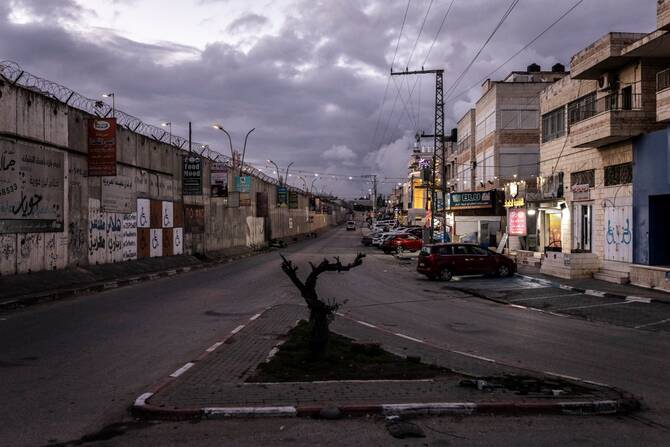
This picture shows a view of the Israeli-built controversial separation barrier in Al-Ram, in the occupied West Bank, Feb. 24, 2026. (AFP)
Short Url
Updated 04 March 2026
Follow

1,965 Israeli violations recorded against Palestinians in February

  • Head of Wall and Settlement Resistance Commission condemns attacks as a continuation of ‘terror’ against Palestinians
  • Violations included assaults, uprooting trees, burning fields and preventing olive pickers from accessing their lands

LONDON: Israeli forces and settlers carried out 1,965 attacks across Palestinian towns in the occupied West Bank in February, according to a report by the Palestinian Authority.

Muayyad Shaaban, head of the Wall and Settlement Resistance Commission, condemned the attacks as a continuation of the “terror” against the Palestinian people, their land and property.

The commission documented 1,454 attacks by Israeli forces and 511 by settlers, most of which were concentrated in the governorates of Hebron with 421 attacks, followed by Nablus with 340, Ramallah and Al-Bireh with 320, and East Jerusalem with 210 attacks.

Violations have included direct beatings of Palestinians, uprooting trees, burning fields, and preventing olive pickers from accessing their lands.

Israeli forces have seized land and demolished homes and agricultural facilities under the pretext of “security,” which has enabled settlers to expand their settlements, according to Wafa news agency.

Shaaban said: “What is taking place represents an organized methodology aimed at emptying the land of its owners and imposing an integrated racist colonial system.”

Israeli settlers have poisoned and uprooted a total of 1,314 trees, including 1,054 olive trees, in the areas of Ramallah, Bethlehem, Hebron, Nablus and Tulkarm. The olive groves have been a lifeline for Palestinians in the West Bank, with an estimated 80,000 to 100,000 families relying on the olive harvest for their livelihoods, according to the UN Human Rights Council.

In February, Israeli forces demolished 122 structures belonging to Palestinians, including 56 inhabited homes, nine uninhabited homes, 34 agricultural facilities and 18 sources of livelihood. More than one-third of these demolitions took place in Jerusalem, totaling 46 structures.


GCC ambassadors hold discussions with Japan’s ruling party regarding Iran

Updated 8 sec ago
Follow

GCC ambassadors hold discussions with Japan’s ruling party regarding Iran

  • KONO Taro, head of the LDP’s international relations, participated in the high-level discussions alongside other senior officials
  • Dr. Ghazi Faisal Binzagr, Saudi Arabia’s ambassador to Japan, described the meeting as a timely opportunity to exchange views on the evolving regional situation

TOKYO: Gulf Cooperation Council (GCC) ambassadors met on Tuesday with leaders of Japan’s ruling Liberal Democratic Party (LDP) to explore deeper collaboration across multiple fields and tackle pressing issues related to Iran.

KONO Taro, head of the party’s international relations, participated in the high-level discussions alongside other senior officials.

Dr. Ghazi Faisal Binzagr, Saudi Arabia’s ambassador to Japan, described the meeting as a timely opportunity to exchange views on the evolving regional situation.

Ambassador Binzagr emphasized that during periods of heightened tension, open dialogue with trusted partners like Japan is essential. He noted that diplomacy and clear communication are vital for defusing conflict and maintaining regional stability.

Saudi Ambassador Binzagr further noted that the Gulf countries and Japan share a longstanding history of cooperation founded on mutual trust and common objectives of stability and prosperity. He stated, “In times such as these, it is precisely these enduring partnerships that allow constructive dialogue to prevail, and that help ensure that wisdom and restraint guide the path toward peace and stability in our region."

Kono underscored the strong bonds and active cooperation between Japan and the GCC, noting that Japan views its ties with the GCC as a strategic partnership.