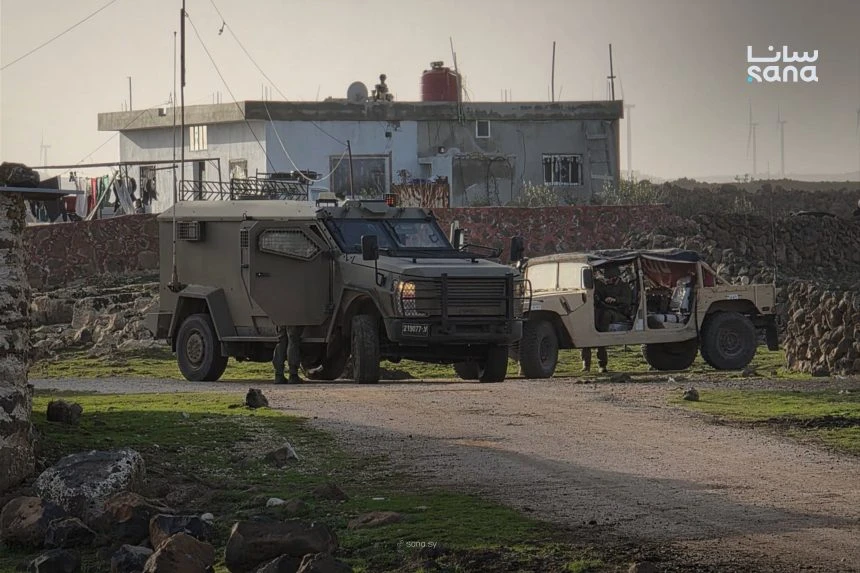
Israeli forces set up checkpoint, arrest residents inside southern Syria

Israeli forces arrested six individuals from the villages of Ain Al-Abd, Kodna, and Al-Asbah in the southern Quneitra countryside. (SANA)
Short Url
Updated 04 March 2026
Follow

Israeli forces set up checkpoint, arrest residents inside southern Syria

  • An Israeli force comprising 7 military vehicles entered Wadi Al-Raqad and established a checkpoint on the Al-Raqad bridge
  • The Syrian government has repeatedly condemned Israeli incursions into its territory, including raids, arrests, and land razing in the south

LONDON: Israeli forces conducted an incursion into the Wadi Al-Raqad area in the Daraa countryside and arrested six residents from villages in Quneitra, southern Syrian Arab Republic.

On Wednesday, an Israeli force comprising seven military vehicles entered Wadi Al-Raqad and set up a checkpoint on the Al-Raqad bridge. Additionally, six other vehicles were stationed at the Tell Abu Al-Ghithar gate, as reported by the Syrian Arab News Agency.

Israeli forces arrested six individuals from the villages of Ain Al-Abd, Kodna, and Al-Asbah in the southern Quneitra countryside, and conducted another incursion into the village of Saida Al-Golan in the area.

The Syrian government has repeatedly condemned Israeli incursions into its territory, including raids, arrests, and land razing in the south, saying that they violate the 1974 Disengagement Agreement.

Syria stresses that the presence of Israeli forces on its territory is “illegitimate” and that all Israeli measures in the region are “null and void and have no legal effect” under international law, the SANA added.
The art of war: fears for masterpieces on loan to Louvre Abu Dhabi

Updated 8 sec ago
Follow

The art of war: fears for masterpieces on loan to Louvre Abu Dhabi

  • UAE paid more than €1 billion to borrow priceless works, but experts in France want them back

PARIS: The Middle East war has raised fears for the safety of priceless masterpieces on loan from France to the Louvre Abu Dhabi, the museum’s only foreign branch.
The Abu Dhabi museum, which opened in 2017, has so far escaped damage from nearly 1,800 Iranian drone and missile strikes launched since the conflict erupted on Feb. 28.
However, concerns are mounting in France. “The works must be removed,” said Didier Selles, who helped broker the original agreement between France and the UAE.
French journal La Tribune de l’Art echoed that alarm. “The Louvre’s works in Abu Dhabi must be secured!” it said.
France’s culture ministry said French authorities were “in close and regular contact with the authorities of the UAE to ensure the protection of the works loaned by France.”
Under the agreement with the UAE, France agreed to provide expertise, lend works of art and organize exhibitions, in return for €1 billion, including €400 million for licensing the use of the Louvre name. The deal was extended in 2021 to 2047 for an additional €165 million.
Works on loan include paintings by Rembrandt and Chardin, Classical statues of Isis, Roman sarcophagi and Islamic masterpieces: such as the Pyxis of Al-Mughira.

A Louvre Abu Dhabi source said the museum was designed to protect collections from both security threats and natural disasters.