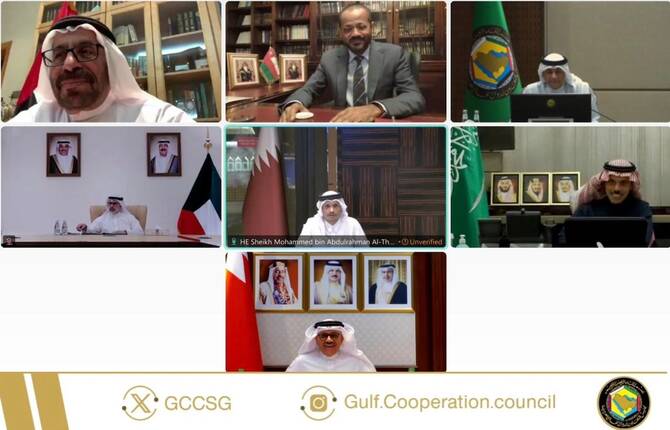
GCC Foreign Ministers affirm the right of its states to respond to any aggression

The Ministerial Council of the Gulf Cooperation Council held its 50th extraordinary meeting via video conference on Sunday, March 1, 2026. (GCC)
Short Url
Updated 02 March 2026
Follow

GCC Foreign Ministers affirm the right of its states to respond to any aggression

  • An emergency virtual meeting led by Bahrain to discuss recent Iranian attacks

MANAMA: The Ministerial Council of the Gulf Cooperation Council (GCC) held its 50th extraordinary meeting via video conference on Sunday, March 1, 2026, chaired by Dr. Abdullatif bin Rashid Al Zayani, Minister of Foreign Affairs of the Kingdom of Bahrain and current Chairman of the GCC Ministerial Council.

The meeting discussed Iranian missile and drone attacks on the United Arab Emirates, Kingdom of Bahrain, Kingdom of Saudi Arabia, Sultanate of Oman, State of Qatar, and State of Kuwait, which began on Saturday, February 28, 2026.

The Council expressed its rejection and strongest condemnation of these heinous Iranian attacks targeting GCC countries, as well as the Hashemite Kingdom of Jordan, in a serious violation of these countries' sovereignty, good neighborly principles, and a clear breach of international law and the UN Charter, regardless of pretexts and justifications. Targeting civilians and civilian objects constitutes a serious violation of international humanitarian law.

The Council expressed complete solidarity among GCC countries, standing united against these attacks, emphasizing that the security of its states is indivisible, and any aggression against a member state is a direct attack on all GCC countries, in accordance with the GCC Charter and Joint Defense Agreement. The Council affirmed the GCC countries' legal right to respond, in accordance with Article 51 of the UN Charter, which guarantees the right to self-defense individually and collectively in case of aggression, and to take all measures to preserve their sovereignty, security, and stability.

The Ministerial Council emphasized that in light of this unjustified Iranian aggression against GCC countries, they will take all necessary measures to defend their security, stability, and protect their territories, citizens, and residents, including the option to respond to the aggression.

Despite numerous diplomatic efforts by GCC countries to avoid escalation and their confirmation that their territories will not be used to launch any attack on the Islamic Republic of Iran, Iran continued to carry out military operations against GCC countries, targeting many civilian and residential facilities.

The Ministerial Council stressed the need for an immediate halt to these attacks to restore security, peace, and stability in the region, emphasizing the importance of preserving air, sea, and waterway security in the region, the safety of supply chains, and ensuring the stability of global energy markets. The stability of the Gulf region is not only a regional issue but a fundamental pillar for global economic stability and maritime navigation.

The Ministerial Council called on the international community to strongly condemn these attacks and urged the Security Council to assume its responsibilities by taking an immediate and firm stance to prevent these violations that endanger the lives of inhabitants and prevent their recurrence, due to their serious implications for regional and international peace.


Lebanese government imposes immediate ban on Hezbollah’s military activities

Updated 02 March 2026
Follow

Lebanese government imposes immediate ban on Hezbollah’s military activities


BERUIT: Lebanon's government said Hezbollah’s overnight attack against Israel were “illegal” and imposed an immediate ban on the group’s military activities, while also demanding its hand over its weapons.

Lebanese Prime Minister Nawaf Salam said only the state could decide whether to go to war and called on the Lebanese military to prevent the firing of projectiles and detain anyone involved.

The move comes after Iran-backed Hezbollah launched rockets at Israel, provoking retaliatory Israeli strikes. The government convened for five hours and 15 minutes in an early morning meeting on Monday before reaching its decision.

The Lebanese cabinet meeting, chaired by President Joseph Aoun, started at 8am with ministers discussing the repercussions Hezbollah's launching of missiles from southern Lebanon into Israel and the Israeli attacks on Lebanon.

Sources initially told Arab News that ministers were “pushing for a decisive response to Hezbollah’s recklessness, regardless of the consequences.”

Lebanese MP Melhem Khalaf said the priority was to “shelter people that are evacuating their homes in relatively safe places. What happened at dawn on Monday has taken us from one stage to another, and we don't know where they've taken us.”

As US-Israeli attacks on Iran continued, Hezbollah said it fired missiles from Lebanon into Israel early Monday in response to the killing of Iranian Supreme Leader Ali Khamenei and “repeated Israeli aggressions.”

There were no reports of injuries or damage, and Israel said it had intercepted one projectile, while several fell in open areas.

Israel retaliated with strikes on Lebanon, killing at least 31 people and wounding 149 others, according to Lebanon's Health Ministry. Around two thirds of the dead were in the south of the country.

Lebanon’s government said it was holding an emergency meeting after Hezbollah’s attack triggered the Israeli airstrikes.

Iran has been firing missiles at Israel and Arab states in a counter-offensive since the joint America-Israeli attack Saturday that killed Khamenei and other top Iranian officials. The war has quickly expanded to proxy forces, including Hezbollah firing out of Lebanon.

MP Bilal Abdullah told Arab News: “All the appeals issued by officials in Lebanon not to embroil us in this destructive war seem to have been in vain. We were supposed to protect Lebanon.

“Whoever launched the missiles and drones from Lebanon has slaughtered Lebanon. Displacing people is a major tragedy. We are in the winter season, and the cold is severe.”