‘Justice for the dead’: Protests mark Greece’s worst train disaster

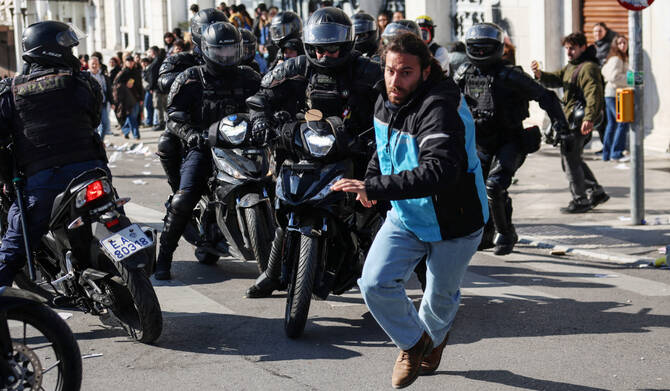
A man runs from motorised police, which tries to disperse protesters, during a rally to mark the third anniversary of a deadly train crash which killed 57 people in Athens, Greece, February 28, 2026. 9REUTERS)
Short Url
Updated 28 February 2026
Follow

‘Justice for the dead’: Protests mark Greece’s worst train disaster

  • Tragedy claimed 57 lives in 2023 and rattled the govt of Prime Minister Kyriakos Mitsotakis
  • We are here because, three years after the Tempe disaster, we still don’t know exactly what happened, justice has not yet been served and those responsible are still walking free

ATHENS: Tens of thousands of people across Greece demonstrated Saturday in solidarity with victims of the country’s worst train tragedy, which claimed 57 lives in 2023 and rattled the government of Prime Minister Kyriakos Mitsotakis.

More than a hundred gatherings are being held in Greece and abroad to demand justice for the victims, most of whom were young students returning from a three-day carnival weekend.
“We are here because, three years after the Tempe disaster, we still don’t know exactly what happened, justice has not yet been served and those responsible are still walking free,” Lydia Pagkali, a 28-year-old woman protesting in Athens, said.

SPEEDREAD

Nearly 40 people will go on trial on March 23, including railway executives and the station master on duty that night. They risk prison sentences of up to 20 years.

“Even today we don’t feel safe taking the train or the metro,” she added.
The crash on Feb. 28, 2023 took place when a passenger locomotive carrying some 350 people from Athens to Thessaloniki hit a freight train in the dead of the night.
The two trains had run on the same track for more than 10 minutes without triggering any alarm, laying bare the parlous state of the Greek railway network’s security fail-safes — despite EU grants for their modernization.
“We are protesting against a government, a state that has proven it does not take us into account,” 21-year-old student Yiannis Angelidis said in Thessaloniki.
“We demand that everyone responsible be punished, no matter how high up they are,” he said.
The head of an association of relatives of the victims, Pavlos Aslanidis, said the families demanded “justice for the dead.”
“We will allow nothing to be forgotten,” Aslanidis told a crowd of at least 20,000 people in Athens’s Syntagma Square, accusing the government and justice officials of attempting to “bury” the truth and “insulting” the victims’ families by repeatedly turning down requests to exhume the dead for tests. “Murderers,” the crowd shouted back.
Many relatives believe their loved ones were not killed by the collision, but by an ensuing fire that could have been averted if the passenger train had better insulation.
With a long-awaited trial into the disaster looming in March, unanswered questions remain about the accident and the ensuing investigation, which victims’ relatives argue was deficient and left state officials largely untouched.
“Responsibility for the tragedy must be assigned in a strict yet impartial manner in the trial that is beginning,” Prime Minister Kyriakos Mitsotakis said in a statement on Saturday.
In the hours after the tragedy, he had been strongly criticized after stating that “everything indicates” that the collision was “due, unfortunately, mainly to a tragic human error.”
More than 300,000 people rallied to mark last year’s anniversary, one of the biggest demonstrations the country has seen since the decade-long financial crisis which began in late 2009.
This year will see demonstrations in more than 70 towns and cities across Greece.
Unions have kicked off a series of strikes, and there will be no trains or ferry services on Saturday, while stores in the capital Athens have been urged to close.
European Chief Prosecutor Laura Kovesi last year noted that the accident could have been avoided if an EU-funded railway signaling project had been completed on time.
The victims’ families have also protested that valuable clues were lost when the crash site was bulldozed soon after the accident, sparking allegations that the government was literally trying to bury the evidence.
Despite the disaster, Mitsotakis comfortably won reelection just months later, and went on to defeat two votes of no-confidence on the issue.
But anger continues to simmer, increasing support for smaller opposition parties, including one headed by a leading lawyer for the accident victims. The mother of another victim, Maria Karystianou, has announced plans for a new party.
“We don’t just want to remain a protest movement. We really want to see some things change in the country,” Karystianou said in an interview this week.
Nearly 40 people will go on trial on March 23, including railway executives and the station master on duty that night. They risk prison sentences of up to 20 years.
Two former ministers, including the ex-transport minister, were also referred to justice by parliament, but face only misdemeanor charges at present.


US intel did not suggest a preemptive strike from Iran before US-Israeli attacks, AP sources say

Updated 02 March 2026
Follow

US intel did not suggest a preemptive strike from Iran before US-Israeli attacks, AP sources say

  • The official said a variety of factors created a golden opportunity to take out much of Iran’s leadership

WASHINGTON: Trump administration officials told congressional staff in private briefings Sunday that US intelligence did not suggest Iran was preparing to launch a preemptive strike against the US, three people familiar with the briefings said.
The administration officials instead acknowledged there was a more general threat in the region from Iran’s missiles and proxy forces, two of the people said. The third person, however, said the administration emphasized that Iran’s missiles and proxy forces posed an imminent threat to US personnel and allies in the region.
The officials did not provide any clarity about what would happen next in Iran after the joint US-Israeli operation, the two people said. All three people insisted on anonymity to discuss details that have not been made public.
The information conveyed to the congressional staff contrasts with the message from President Donald Trump. “Our objective is to defend the American people by eliminating imminent threats from the Iranian regime. A vicious group of very hard, terrible people,” he said in a video message after launching strikes on Iran.
Senior Trump administration officials, who like others were not authorized to comment publicly and spoke on condition of anonymity, had told reporters Saturday that there were indicators that the Iranians could launch a preemptive attack.
The White House and Pentagon did not immediately reply to requests for comment on Sunday night. Details of the briefing were first reported by Politico.
On Tuesday, Secretary of State Marco Rubio, Defense Secretary Pete Hegseth, CIA Director John Ratcliffe and Gen. Dan Caine, chairman of the Joint Chiefs of Staff, will brief the full membership of Congress on the US military operation against Iran, the White House said Sunday. Rubio also was slated to brief Hill leadership Monday, the same day Hegseth and Caine are planning a press conference about the operation.
Three strikes, three locations, within a single minute
The military operation came after authorities from Israel and the US spent weeks tracking the movements of senior Iranian leaders, including Supreme Leader Ayatollah Ali Khamenei, and shared information that allowed the strikes to be carried out in a surprise daylight attack, according to an Israeli military official and another person familiar with the operation.
The eventual barrage of US-Israeli attacks on Iran came so quickly that they were nearly simultaneous — with three strikes in three locations hitting within a single minute — killing Khamenei and some 40 senior figures, including the head of the paramilitary Revolutionary Guard and the country’s defense minister, the Israeli military official said Sunday.
The official said a variety of factors created a golden opportunity to take out much of Iran’s leadership, like weeks of training and monitoring the movements of senior figures as well as intelligence in real-time before the attack began that key targets were gathered together.
Striking by day also gave an additional element of surprise, said the official, who said so many major, rapid-fire strikes were critical to keep key officials from fleeing after the first strike. The official said Israel closely cooperated with its US counterparts and had used a similar tactic at the beginning of last June’s war — which resulted in the killing of several senior Iranian figures.
The official also noted Khamenei having posted defiant tweets taunting President Donald Trump in the days before the attack.
The details about the strikes came as the conflict entered its second day, with Trump saying in a video message Sunday that he expected it would continue until “all of our objectives are achieved.” He did not spell out what those objectives were.
The Republican president also said the US military and its partners hit hundreds of targets in Iran, including Revolutionary Guard facilities, Iranian air defense systems and nine warships, “all in a matter of literally minutes.”
CIA had long tracked top Iranian leaders
Before the attacks, the CIA had for months tracked the movements of senior Iranian leaders, including Khamenei.
The intelligence was shared with Israeli officials, and the timing of the strikes was adjusted in part because of that information about the Iranian leaders’ location, according to the person familiar with the planning.
The intelligence-sharing between US and Israel reflects the preparation that went into the strikes, which threw the future of the Islamic Republic into uncertainty and raised the risk of escalating regional conflict.
The US regularly shares intelligence with allies including Israel. Those partnerships, and the accuracy of the intelligence they yield, is often critical not only to the success of a military operation but also to the public’s support for it.
Virginia Sen. Mark Warner, the senior Democrat on the committee, told The Associated Press that, historically, “our working relationship with the Mossad and Israel is really strong.” Mossad is the Israeli spy agency.
Warner said he has serious concerns about the justification for the strikes, Trump’s long-term plans for the conflict and the risks that US service members will face. The military announced Sunday that three American troops had been killed in the Iran operation.
“No tears will be shed over their leadership being eliminated, but always the question is: OK, what next?” Warner said.
Iran has signaled it’s open to talks with the US
A senior White House official said Iran’s “new potential leadership” has suggested it is open to talks with the United States. That official, who spoke on condition of anonymity to discuss internal administration deliberations, said Trump has indicated he’s “eventually” willing to talk but that for now the military operation “continues unabated.”
The official did not say who the potential new Iranian leaders are or how they made their alleged willingness to talk known. Separately, Trump told The Atlantic that he planned to speak with Iran’s new leadership.
“They want to talk, and I have agreed to talk, so I will be talking to them,” he said Sunday, declining comment on the timing.