

Pakistan business group presses for corporate tax rationalization in IMF talks

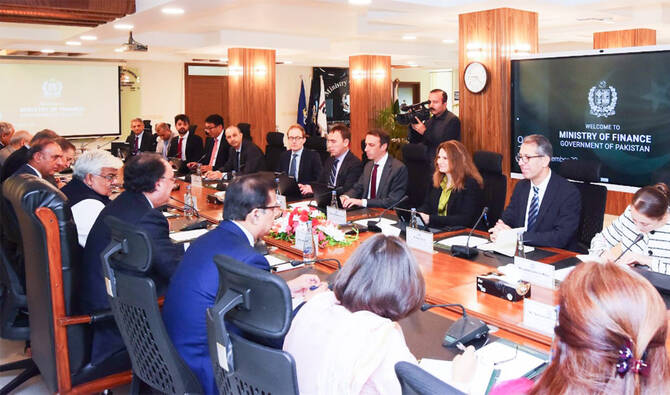
Pakistan’s finance minister Muhammad Aurangzeb (fourth in left row) holds a meeting with the visiting IMF delegation in Islamabad, Pakistan, on September 29, 2025. (Finance Ministry/File)
Short Url
Updated 28 February 2026
Follow

Pakistan business group presses for corporate tax rationalization in IMF talks

  • Pakistan Business Council calls for abolition of super tax, phased corporate rate cut to 25%
  • PM Sharif has said government is considering reduction in direct taxes in upcoming budget

KARACHI: Pakistan’s business policy advocacy group urged the government to rationalize corporate tax rates during talks with an International Monetary Fund (IMF) delegation on Saturday, arguing such a step would be critical to shifting the economy from stabilization to export-led growth.

The Pakistan Business Council (PBC), which represents many of the country’s largest private-sector companies, said the current tax structure places a disproportionate burden on documented and compliant enterprises.

The engagement follows the arrival of an IMF staff mission in Pakistan earlier this week to begin review talks that will determine the release of the next tranche under the country’s $7 billion Extended Fund Facility (EFF) and the $1.4 billion Resilience and Sustainability Facility (RSF).

The team is expected to start formal negotiations next week, discussions seen as critical to sustaining Pakistan’s fragile economic recovery and maintaining external financing stability.

“Stabilization has provided breathing space,” PBC Chairperson Dr. Zeelaf Munir said according to a statement after the meeting with the IMF delegation headed by mission chief Iva Petrova. “The priority now is institutionalizing growth.”

“A competitive and equitable tax framework, predictable energy pricing and policy consistency are essential to expand exports, attract investment and generate employment at scale,” she continued. “The private sector stands ready to deploy capital where reform signals remain clear and credible.”

In its presentation to the Fund team, the PBC called for the abolition of the super tax, an additional levy imposed in recent years on high-earning companies and individuals to shore up revenues, in all its forms. It also demanded a phased reduction of the corporate tax rate to 25%, and rationalization of advance and withholding tax regimes that businesses say function as de facto minimum taxes.

The PBC urged the broadening of the tax base through stronger enforcement to bring untaxed sectors into the net, rather than increasing the burden on existing taxpayers.

Prime Minister Shehbaz Sharif said earlier this week on Wednesday the government was considering reducing direct taxes in the upcoming federal budget to support businesses, while maintaining that indirect taxes collected from consumers must be properly deposited into the national exchequer.

The IMF review discussions with the Pakistani authorities are expected to focus on fiscal consolidation, monetary policy, structural reforms and climate-related benchmarks tied to the RSF program, as Islamabad seeks to secure continued external financing and strengthen macroeconomic stability.

Pakistan’s president defends ongoing strikes in Afghanistan, urges Kabul to dismantle militants

Updated 02 March 2026
Follow

Pakistan’s president defends ongoing strikes in Afghanistan, urges Kabul to dismantle militants

  • Afghanistan on Thursday launched attacks in retaliation for Pakistani airstrikes the previous Sunday
  • Pakistan’s military says it is only targeting Afghan military installations to avoid civilian casualties

ISLAMABAD: Pakistan’s president on Monday defended his country’s ongoing military strikes in neighboring Afghanistan, saying Islamabad tried all forms of diplomacy before targeting militants operating from Afghan territory, and called on the Taliban government in Kabul to disarm groups responsible for attacks in Pakistan.

Pakistan earlier said it is in “open war” with Afghanistan, alarming the international community. The border area remains a stronghold for militant organizations including Al-Qaeda and the Daesh (Islamic State) group.

“(The Afghan Taliban) must choose to dismantle the terror groups that survive on conflict and its war economy,” Asif Ali Zardari said during a speech to lawmakers, adding that “no state accepts serial attacks on its soil.”

Afghanistan on Thursday launched attacks in retaliation for Pakistani airstrikes the previous Sunday. Since then, Pakistan has carried out operations along the border, with Information Minister Attaullah Tarar claiming the killing of 435 Afghan forces and the capture of 31 Afghan positions.

Kabul has denied such claims.

In Afghanistan, the deputy government spokesman Hamdullah Fitrat said Pakistan’s military fired mortar shells at a refugee camp in eastern Kunar province, killing three children and injuring three others.

Afghanistan’s defense ministry said Afghan forces carried out strikes targeting a Pakistani military facility near Paktia province, causing “substantial losses and heavy casualties.”

Pakistan’s military did not respond to questions. It has said Pakistan is only targeting Afghan military installations to avoid civilian casualties.

Pakistan has witnessed a surge of violence in recent months and blames it on the outlawed Pakistani Taliban, known as Tehreek-e-Taliban Pakistan or TTP. It operates both inside Pakistan and from Afghan territory.
Islamabad accuses Afghanistan’s Taliban government of providing safe havens for the TTP, which Kabul denies.

The latest cross-border fighting ended a ceasefire brokered by Qatar and Turkiye in October. The two sides failed to reach a permanent agreement during talks in Istanbul.

Zardari reiterated Pakistan’s call for talks, saying, “We have never walked away from dialogue.”

The Pakistani leader again accused Afghanistan of acting as a proxy for India by sheltering militant groups.

“Stop being used by another country as a battlefield for their ambitions,” he said.

Zardari cited a recent report from the United Nations Security Council’s monitoring team that described the presence of militant groups in Afghanistan as an extra-regional threat.