

Trump administration cannot ‘terrorize’ Minnesota’s refugees with arrests, US judge rules

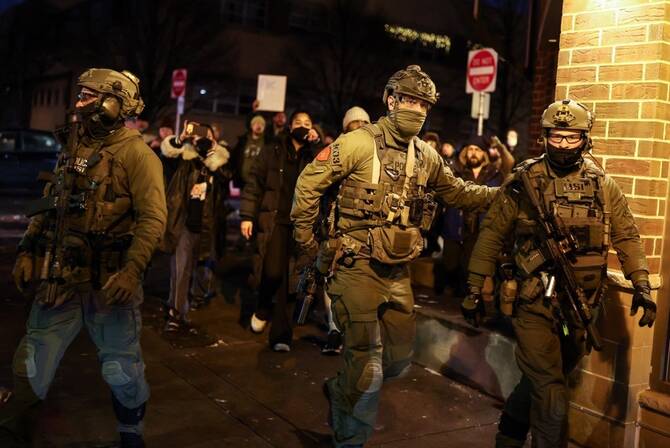
Refugees from Africa, Asia and ⁠Latin America sued in a class-action lawsuit, arguing Trump’s ‌administration was wrongly asserting that immigration law gave ‌US Immigration and Customs Enforcement the power to arrest ​any refugee who had not ‌been granted a green card after a year in the United States. (AFP/File)
Short Url
Updated 28 February 2026
Follow

Trump administration cannot ‘terrorize’ Minnesota’s refugees with arrests, US judge rules

  • Judge blocks arrests of refugees in Minnesota
  • Operation PARRIS aimed ‌to reexamine refugee cases, focusing on Minnesota

A federal judge on Friday said he would not allow President Donald Trump’s administration ​to “terrorize” Minnesota’s 5,600 refugees by arresting and detaining them under a new policy that “turns the refugees’ American Dream into a dystopian nightmare.”

US District Judge John Tunheim in Minneapolis made that statement as he issued a preliminary injunction that extended an earlier, temporary order that blocked the administration from arresting or detaining refugees on the basis that they had yet to obtain lawful permanent resident status, or green cards.

The administration had sought to do so ‌under a policy ‌adopted as part of “Operation PARRIS,” a program announced ​in ‌January ⁠that the ​US Department ⁠of Homeland Security billed as “a sweeping initiative” to reexamine thousands of refugee cases.

DHS at the time said the initial focus of the initiative would be the roughly 5,600 refugees who had yet to be given green cards in Minnesota, the site of a recent immigration enforcement surge operation and benefits fraud scandal.

DHS did not respond to a request for comment.

Refugees from Africa, Asia and ⁠Latin America sued in a class-action lawsuit, arguing Trump’s ‌administration was wrongly asserting that immigration law gave ‌US Immigration and Customs Enforcement the power to arrest ​any refugee who had not ‌been granted a green card after a year in the United States.

Tunheim, ‌who was appointed by Democratic President Bill Clinton, agreed, saying the administration’s policy lacked authorization from Congress, raised constitutional concerns and upended the promise of the Refugee Act of 1980 that refugees could “be given a chance at a new beginning in safety.”

He noted ‌that by law, the refugees could not obtain green cards until a year had passed. Yet he said ⁠the administration was claiming ⁠the power to arrest them upon the 366th day of being lawfully admitted.
“The Court will not allow federal authorities to use a new and erroneous statutory interpretation to terrorize refugees who immigrated to this country under the promise that they would be welcomed and allowed to live in peace, far from the persecution they fled,” Tunheim wrote.

He ruled shortly after a group of refugees filed a similar but broader lawsuit in federal court in Massachusetts seeking to challenge the policy’s enforcement nationwide.

Kimberly Grano, a lawyer for the Minnesota plaintiffs at the International Refugee Assistance Project, in a statement hailed the ​ruling, saying the “refugees can now live ​their lives without fear that their own government will snatch them off the street and imprison them far from their loved ones.”


US intel did not suggest a preemptive strike from Iran before US-Israeli attacks, AP sources say

Updated 02 March 2026
Follow

US intel did not suggest a preemptive strike from Iran before US-Israeli attacks, AP sources say

  • The official said a variety of factors created a golden opportunity to take out much of Iran’s leadership

WASHINGTON: Trump administration officials told congressional staff in private briefings Sunday that US intelligence did not suggest Iran was preparing to launch a preemptive strike against the US, three people familiar with the briefings said.
The administration officials instead acknowledged there was a more general threat in the region from Iran’s missiles and proxy forces, two of the people said. The third person, however, said the administration emphasized that Iran’s missiles and proxy forces posed an imminent threat to US personnel and allies in the region.
The officials did not provide any clarity about what would happen next in Iran after the joint US-Israeli operation, the two people said. All three people insisted on anonymity to discuss details that have not been made public.
The information conveyed to the congressional staff contrasts with the message from President Donald Trump. “Our objective is to defend the American people by eliminating imminent threats from the Iranian regime. A vicious group of very hard, terrible people,” he said in a video message after launching strikes on Iran.
Senior Trump administration officials, who like others were not authorized to comment publicly and spoke on condition of anonymity, had told reporters Saturday that there were indicators that the Iranians could launch a preemptive attack.
The White House and Pentagon did not immediately reply to requests for comment on Sunday night. Details of the briefing were first reported by Politico.
On Tuesday, Secretary of State Marco Rubio, Defense Secretary Pete Hegseth, CIA Director John Ratcliffe and Gen. Dan Caine, chairman of the Joint Chiefs of Staff, will brief the full membership of Congress on the US military operation against Iran, the White House said Sunday. Rubio also was slated to brief Hill leadership Monday, the same day Hegseth and Caine are planning a press conference about the operation.
Three strikes, three locations, within a single minute
The military operation came after authorities from Israel and the US spent weeks tracking the movements of senior Iranian leaders, including Supreme Leader Ayatollah Ali Khamenei, and shared information that allowed the strikes to be carried out in a surprise daylight attack, according to an Israeli military official and another person familiar with the operation.
The eventual barrage of US-Israeli attacks on Iran came so quickly that they were nearly simultaneous — with three strikes in three locations hitting within a single minute — killing Khamenei and some 40 senior figures, including the head of the paramilitary Revolutionary Guard and the country’s defense minister, the Israeli military official said Sunday.
The official said a variety of factors created a golden opportunity to take out much of Iran’s leadership, like weeks of training and monitoring the movements of senior figures as well as intelligence in real-time before the attack began that key targets were gathered together.
Striking by day also gave an additional element of surprise, said the official, who said so many major, rapid-fire strikes were critical to keep key officials from fleeing after the first strike. The official said Israel closely cooperated with its US counterparts and had used a similar tactic at the beginning of last June’s war — which resulted in the killing of several senior Iranian figures.
The official also noted Khamenei having posted defiant tweets taunting President Donald Trump in the days before the attack.
The details about the strikes came as the conflict entered its second day, with Trump saying in a video message Sunday that he expected it would continue until “all of our objectives are achieved.” He did not spell out what those objectives were.
The Republican president also said the US military and its partners hit hundreds of targets in Iran, including Revolutionary Guard facilities, Iranian air defense systems and nine warships, “all in a matter of literally minutes.”
CIA had long tracked top Iranian leaders
Before the attacks, the CIA had for months tracked the movements of senior Iranian leaders, including Khamenei.
The intelligence was shared with Israeli officials, and the timing of the strikes was adjusted in part because of that information about the Iranian leaders’ location, according to the person familiar with the planning.
The intelligence-sharing between US and Israel reflects the preparation that went into the strikes, which threw the future of the Islamic Republic into uncertainty and raised the risk of escalating regional conflict.
The US regularly shares intelligence with allies including Israel. Those partnerships, and the accuracy of the intelligence they yield, is often critical not only to the success of a military operation but also to the public’s support for it.
Virginia Sen. Mark Warner, the senior Democrat on the committee, told The Associated Press that, historically, “our working relationship with the Mossad and Israel is really strong.” Mossad is the Israeli spy agency.
Warner said he has serious concerns about the justification for the strikes, Trump’s long-term plans for the conflict and the risks that US service members will face. The military announced Sunday that three American troops had been killed in the Iran operation.
“No tears will be shed over their leadership being eliminated, but always the question is: OK, what next?” Warner said.
Iran has signaled it’s open to talks with the US
A senior White House official said Iran’s “new potential leadership” has suggested it is open to talks with the United States. That official, who spoke on condition of anonymity to discuss internal administration deliberations, said Trump has indicated he’s “eventually” willing to talk but that for now the military operation “continues unabated.”
The official did not say who the potential new Iranian leaders are or how they made their alleged willingness to talk known. Separately, Trump told The Atlantic that he planned to speak with Iran’s new leadership.
“They want to talk, and I have agreed to talk, so I will be talking to them,” he said Sunday, declining comment on the timing.