

Pakistan says 64% of Ramadan relief package beneficiaries have received payments

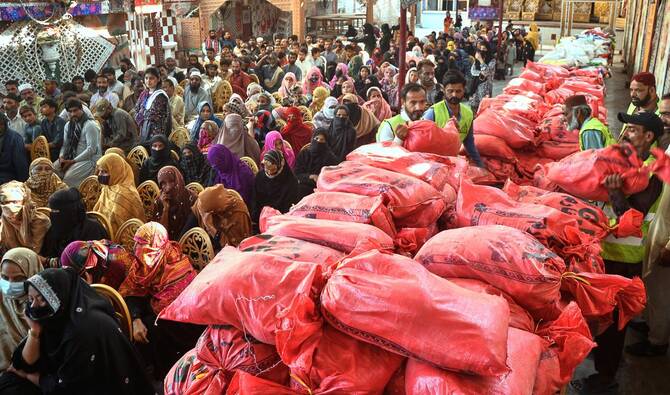
People wait for their turn to get free sack of relief aid distributed by a charity group for the Muslim's holy fasting month of Ramadan, in Hyderabad, Pakistan, Wednesday, Feb. 25, 2026. (AP)
Short Url
Updated 26 February 2026
Follow

Pakistan says 64% of Ramadan relief package beneficiaries have received payments

  • Government provides $47 each to eligible households via bank accounts, mobile wallets as part of $136 million package
  • Verification and validation process for remaining beneficiaries continuing at fast pace, officials tell PM Shehbaz Sharif 

ISLAMABAD: Pakistani officials told Prime Minister Shehbaz Sharif on Thursday that 64 percent of the beneficiaries of the government’s Rs38 billion [$136 million] Ramadan cash relief package have received payments so far, Sharif’s office said. 

The Prime Minister’s Ramadan Relief Package 2026, launched on Feb. 14, provides Rs13,000 ($47) each to eligible households through bank accounts and regulated mobile wallets, replacing the earlier utility-store subsidy model with a digital transfer system overseen by the State Bank of Pakistan.

The latest directive comes as Ramadan spending accelerates, with food purchases typically rising during the holy month, prompting the government to ensure payments reach families before household expenses increase further.

Sharif chaired a meeting to review the progress of the Ramadan Relief Package in Islamabad, the PMO said. 

“It was informed that by the 8th of Ramadan, 64 percent of beneficiaries had received their payments,” the PMO said.

“The verification and validation process for the remaining beneficiaries is continuing at a fast pace.”

Officials briefed the prime minister that this year, 12 banks and fintech companies are partnering with the government to distribute the funds.

“So far, beneficiaries have conducted 1.1 million digital transactions under the Ramadan package,” the PMO said, adding that 1.227 million automated calls have been made by the government to raise awareness among beneficiaries. 

Sharif’s office said the package is being distributed to beneficiaries across the country, including the northern Gilgit-Baltistan and Azad Jammu and Kashmir territories.

The digital transfer model for disbursement aims to move toward a targeted subsidy regime aligned with broader efforts to expand financial inclusion and reduce cash-based leakages.

Pakistan warns of strict action against hoarding petroleum products amid Iran crisis

Updated 52 min 29 sec ago
Follow

Pakistan warns of strict action against hoarding petroleum products amid Iran crisis

  • OGRA says reports indicate “certain elements” may attempt to hoard petroleum products for profiteering
  • Oil and Gas Regulatory Authority says Pakistan’s petroleum reserves stocks adequate, no need for panic buying

ISLAMABAD: Pakistan’s Oil and Gas Regulatory Authority (OGRA) warned on Thursday that the government will take strict action against anyone found illegally hoarding petroleum products for profiteering, amid fears of a shortage of energy supplies due to the ongoing conflict in the Middle East.

Pakistan fears it may face a shortage of petroleum products as Iran has halted oil and gas exports through the Strait of Hormuz amid its ongoing conflict with the US and Israel. The closure of the strategic waterway between Iran and Oman has disrupted tanker traffic through one of the world’s most important oil chokepoints, from where one-fifth of global oil shipments normally pass through.

Pakistan, which relies heavily on Middle Eastern crude with the majority of its energy imports typically transiting the strait, has formed a government committee to monitor the country’s stock of petroleum products. The committee is also reviewing supply chains, price movements and assessing broader implications for inflation, external accounts, and financial stability due to the crisis. 

“It has been emphasized that strict action will be taken against any individual or entity found involved in illegal hoarding or storage of petroleum products at unauthorized locations,” OGRA spokesperson Imran Ghaznavi said in a statement.

“Particularly at places other than duly licensed oil depots and retail outlets of Oil Marketing Companies (OMCs).”

OGRA has repeatedly urged that Pakistan’s stock of petroleum products is adequate and urged the masses not to take part in panic buying. On Wednesday, it allowed oil marketing companies to regulate supplies to their retail outlets so as to discourage hoarding.

The OGRA spokesperson said reports indicate certain elements may attempt to hoard petroleum products for profiteering, adding that provincial chief secretaries have been requested to direct deputy commissioners to conduct inspections in their jurisdictions. 

“Any premises found involved in illegal storage of petroleum products will be sealed and action will be taken in accordance with the law,” OGRA warned. 

The spokesperson said OGRA was monitoring energy supplies in Pakistan, adding that inspections are being conducted at oil depots and retail outlets to ensure smooth supply of petroleum products.

“The public is advised not to pay attention to rumors and to continue normal consumption patterns, as the petroleum supply situation in the country remains stable,” it added. 

Pakistan this week asked Saudi Arabia to help Islamabad secure crude oil supplies through the Red Sea port of Yanbu, as the Strait of Hormuz’s closure threatens its energy supply routes.

Pakistan fears higher global energy prices could lead to consumers paying more for petrol and shelling out more for groceries and other goods, at a time when many are already feeling the impacts of inflation.