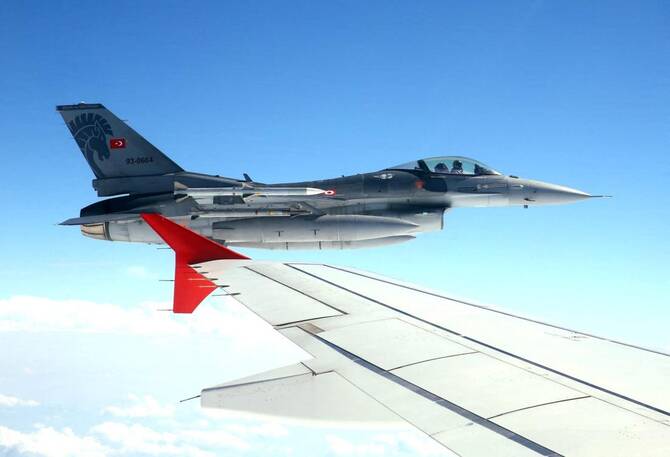
ISTANBUL: A Turkish fighter jet crashed shortly after takeoff early Wednesday, killing the pilot, state media reported, citing the defense ministry.
Radio and tracking information with the aircraft, which took off from Balikesir at 12:56 a.m. (2156 GMT Tuesday), was lost soon after departure, the ministry said according to the official Anadolu Agency.
A search and rescue operation was launched and the wreckage was located.
“Our pilot was martyred. The cause of the accident will be determined following an investigation by the crash examination team,” the ministry said, offering condolences to the pilot’s family.
In November, Turkiye suspended flights by its C-130 cargo planes after one crashed in neighboring Georgia while returning from Azerbaijan, killing all 20 people aboard.
Other F-16s, manufactured by US firm Lockheed Martin, have crashed in recent months.
In January, a Taiwanese F-16 crashed into the sea during a routine mission. Its pilot, who ejected offshore, was reported missing.
In Poland, an F-16 crashed in August while rehearsing for an air show, killing its pilot.

Turkish F-16 jet crash kills pilot: state media
Short Url
https://arab.news/5y44y
Turkish F-16 jet crash kills pilot: state media
- A search and rescue operation was launched and the wreckage was located
Iran urges US to drop ‘excessive demands’ to reach deal
- Longtime adversaries Iran and the United States held their third round of Omani-mediated nuclear talks on Thursday in Geneva
- Both Iran and Oman cited progress after the talks, with technical discussions scheduled for Monday in Vienna
TEHRAN: Iran’s Foreign Minister Abbas Araghchi said on Friday that in order to reach a deal, the United States will have to drop its “excessive demands,” after the two sides held talks in Geneva.
In a phone call with Egypt’s top diplomat Badr Abdelatty, Araghchi said “success in this path requires seriousness and realism from the other side and avoidance of any miscalculation and excessive demands.”
Araghchi did not clarify what demands he was referring to, but Washington has pointed to Iran’s ballistic missile program and has repeatedly described Tehran’s uranium enrichment capability as a red line.
US President Donald Trump said on Wednesday that Tehran had “already developed missiles that can threaten Europe and our bases overseas, and they’re working to build missiles that will soon reach the United States of America.”
Also on Wednesday, US Secretary of State Marco Rubio said Iran is “not enriching right now, but they’re trying to get to the point where they ultimately can,” adding that Tehran “refuses” to discuss its ballistic missile program and “that’s a big problem.”
Iran has repeatedly said its missile program is part of its defensive capabilities and has ruled out abandoning uranium enrichment, insisting its nuclear program is solely for peaceful purposes.
Longtime adversaries Iran and the United States held their third round of Omani-mediated nuclear talks on Thursday in Geneva, seeking to avert military escalation as Washington expands its military build-up in the region.
Both Iran and Oman cited progress after the talks, with technical discussions scheduled for Monday in Vienna ahead of a fourth round expected next week.
In a phone call with Egypt’s top diplomat Badr Abdelatty, Araghchi said “success in this path requires seriousness and realism from the other side and avoidance of any miscalculation and excessive demands.”
Araghchi did not clarify what demands he was referring to, but Washington has pointed to Iran’s ballistic missile program and has repeatedly described Tehran’s uranium enrichment capability as a red line.
US President Donald Trump said on Wednesday that Tehran had “already developed missiles that can threaten Europe and our bases overseas, and they’re working to build missiles that will soon reach the United States of America.”
Also on Wednesday, US Secretary of State Marco Rubio said Iran is “not enriching right now, but they’re trying to get to the point where they ultimately can,” adding that Tehran “refuses” to discuss its ballistic missile program and “that’s a big problem.”
Iran has repeatedly said its missile program is part of its defensive capabilities and has ruled out abandoning uranium enrichment, insisting its nuclear program is solely for peaceful purposes.
Longtime adversaries Iran and the United States held their third round of Omani-mediated nuclear talks on Thursday in Geneva, seeking to avert military escalation as Washington expands its military build-up in the region.
Both Iran and Oman cited progress after the talks, with technical discussions scheduled for Monday in Vienna ahead of a fourth round expected next week.
© 2026 SAUDI RESEARCH & PUBLISHING COMPANY, All Rights Reserved And subject to Terms of Use Agreement.