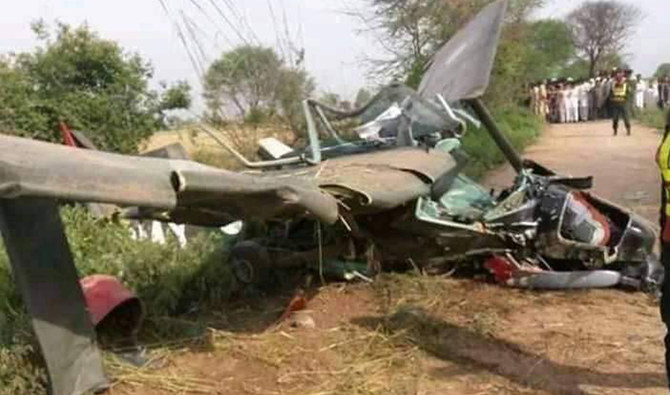
ISLAMABAD: A Pakistani fighter jet crashed during a routine training mission near the city of Gujrat in eastern Punjab province on Monday morning, killing both the instructor and the trainee pilot on board, the military said.
There were no casualties on ground, the military said, without elaborating. Such incidents occasionally happen in Pakistan; the military usually doesn't release crash findings.
The latest incident came weeks after an Air Force pilot died when his F-16 jet crashed near the capital, Islamabad, during maneuvers ahead of National Day celebrations.
In January, an FT-7 jet trainer also went down in Punjab, killing the two pilots. Last July, 19 people died when a Pakistani military aircraft crashed into a residential area on the outskirts of the garrison city of Rawalpindi, most of them in their homes.
Pakistan’s air force has been on high alert since February 2019, when neighboring India launched airstrikes inside Pakistan. New Delhi said it targeted Pakistan-based militants responsible for a suicide bombing that killed 40 Indian troops in Indian-administered Kashmir.
At the time, Pakistan retaliated and shot down two Indian military planes. One Indian pilot was captured and later released. But tensions remain high over the divided Kashmir region, which both countries claim in its entirety.

Pakistan army jet crashes, killing instructor, trainee pilot
https://arab.news/cr7hj
Pakistan army jet crashes, killing instructor, trainee pilot
- There were no casualties on ground, military says
- The latest incident came weeks after an Air Force pilot died when his F-16 jet crashed near the capital
Pakistan’s president defends ongoing strikes in Afghanistan, urges Kabul to dismantle militants
- Afghanistan on Thursday launched attacks in retaliation for Pakistani airstrikes the previous Sunday
- Pakistan’s military says it is only targeting Afghan military installations to avoid civilian casualties
ISLAMABAD: Pakistan’s president on Monday defended his country’s ongoing military strikes in neighboring Afghanistan, saying Islamabad tried all forms of diplomacy before targeting militants operating from Afghan territory, and called on the Taliban government in Kabul to disarm groups responsible for attacks in Pakistan.
Pakistan earlier said it is in “open war” with Afghanistan, alarming the international community. The border area remains a stronghold for militant organizations including Al-Qaeda and the Daesh (Islamic State) group.
“(The Afghan Taliban) must choose to dismantle the terror groups that survive on conflict and its war economy,” Asif Ali Zardari said during a speech to lawmakers, adding that “no state accepts serial attacks on its soil.”
Afghanistan on Thursday launched attacks in retaliation for Pakistani airstrikes the previous Sunday. Since then, Pakistan has carried out operations along the border, with Information Minister Attaullah Tarar claiming the killing of 435 Afghan forces and the capture of 31 Afghan positions.
Kabul has denied such claims.
In Afghanistan, the deputy government spokesman Hamdullah Fitrat said Pakistan’s military fired mortar shells at a refugee camp in eastern Kunar province, killing three children and injuring three others.
Afghanistan’s defense ministry said Afghan forces carried out strikes targeting a Pakistani military facility near Paktia province, causing “substantial losses and heavy casualties.”
Pakistan’s military did not respond to questions. It has said Pakistan is only targeting Afghan military installations to avoid civilian casualties.
Pakistan has witnessed a surge of violence in recent months and blames it on the outlawed Pakistani Taliban, known as Tehreek-e-Taliban Pakistan or TTP. It operates both inside Pakistan and from Afghan territory.
Islamabad accuses Afghanistan’s Taliban government of providing safe havens for the TTP, which Kabul denies.
The latest cross-border fighting ended a ceasefire brokered by Qatar and Turkiye in October. The two sides failed to reach a permanent agreement during talks in Istanbul.
Zardari reiterated Pakistan’s call for talks, saying, “We have never walked away from dialogue.”
The Pakistani leader again accused Afghanistan of acting as a proxy for India by sheltering militant groups.
“Stop being used by another country as a battlefield for their ambitions,” he said.
Zardari cited a recent report from the United Nations Security Council’s monitoring team that described the presence of militant groups in Afghanistan as an extra-regional threat.


