

UN alarm at escalating drone attacks, worsening humanitarian crisis in Sudan’s North Kordofan and Darfur

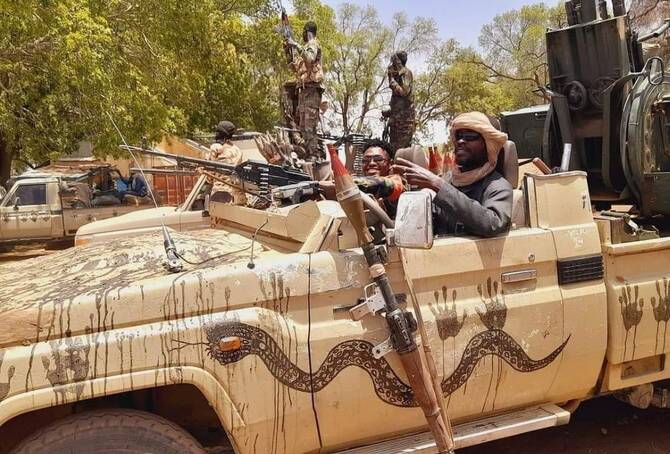
Darfur’s Joint Forces prepare to fight RSF militia in El-Fasher, Darfur. (Sudan War Monitor)
Short Url
Updated 25 February 2026
Follow

UN alarm at escalating drone attacks, worsening humanitarian crisis in Sudan’s North Kordofan and Darfur

  • El-Obeid, a strategically vital hub linking Khartoum with Darfur region, remains under siege as Rapid Support Forces seeks to consolidate control over critical corridor
  • Number of displaced people sheltering near town of Tawila has grown to 715,000 since RSF attacks on El-Fasher began to intensify last year, says UN spokesperson

NEW YORK CITY: The UN on Tuesday expressed alarm over continuing drone attacks in North Kordofan state, warning that the violence and worsening humanitarian conditions are compounding civilian suffering across Sudan.

El-Obeid, the capital of the state, has experienced a series of intense attacks by the paramilitary Rapid Support Forces, marked by frequent drone strikes targeting key infrastructure across the city.

Government and other public buildings, including the headquarters of the Legislative Council, a police facility, a telecommunications company and a hospital, have sustained significant damage. Last month, drone attacks targeted the city’s power supply and residential neighborhoods, resulting in civilian casualties, including children.

El-Obeid, a strategically vital hub linking Khartoum with Darfur region, remains under siege as the Rapid Support Forces, which has been engaged in a civil war with the Sudanese Armed Forces since April 2023, seeks to consolidate its control over this critical corridor. Since beginning of this month there have been near-daily drone assaults on the city and surrounding areas, including parts of North Kordofan State.

“We continue to be very concerned by the deteriorating humanitarian situation, notably in North Darfur state, and by reports of continuing drone attacks in North Kordofan state,” UN spokesperson Stephane Dujarric told reporters in New York.

Drone attacks targeted El-Obeid for at least three consecutive days beginning on Feb. 20. One strike hit the University of Kordofan’s campus in the city on Monday, causing significant structural damage.

In North Darfur, escalating violence in the area around the border town of Tine has forced civilians to flee into neighboring Chad, Dujarric said, and is constraining humanitarian access.

Humanitarian movements through the Adre border crossing nevertheless are continuing and UN aid officials are maintaining close contact with the governments of Chad and Sudan to ensure the safe and efficient passage of supplies and personnel, as the Adre crossing remains indispensable for humanitarian operations in Darfur, the UN said.

Elsewhere in North Darfur, the area around the town of Tawila has become one of the region’s largest and fastest-growing displacement hubs, Dujarric said. It is hosting more than 715,000 people displaced by attacks last year on El-Fasher and nearby camps. Prior to this mass influx, Tawila’s population was estimated at about 40,000. Now more than half a million displaced people are sheltering at four major sites just outside the town.

The UN’s Children’s Fund has found that more than half of the people in North Darfur are not receiving the minimum daily water requirement for survival, which is set by the World Health Organization at 7.5 liters per person per day. More than 40 percent of latrines are non-functional, more than 80 percent of families lack soap, and only 8 percent of women and girls reported having access to sufficient menstrual hygiene supplies.

Humanitarian agencies are calling for rapid funding, as well as safe and unhindered access for the delivery of aid and the scaling up water and sanitation services in Tawila to prevent further deterioration of the public health conditions there.

The UN’s 2026 Humanitarian Response Plan for Sudan is seeking $2.9 billion in funding to assist more than 20 million people nationwide.


US presses missile issue as new Iran talks to open in Geneva

Updated 11 sec ago
Follow

US presses missile issue as new Iran talks to open in Geneva

  • New round of negotiations in Geneva comes after the US carried out a massive military build-up in the region
  • The dispute between the countries mostly revolves around Iran’s nuclear program
GENEVA: The United States and Iran are set to hold indirect talks in Switzerland on Thursday aiming to strike a deal to avert fresh conflict and bring an end to weeks of threats.
The new round of negotiations in Geneva comes after the US carried out a massive military build-up in the region and President Donald Trump repeatedly threatened to strike Iran if a deal is not reached.
In his State of the Union address on Tuesday, Trump accused Iran of “pursuing sinister nuclear ambitions.”
He also claimed Tehran had “already developed missiles that can threaten Europe and our bases overseas, and they’re working to build missiles that will soon reach the United States of America.”
The Iranian foreign ministry called these claims “big lies.”
The maximum range of Iran’s missiles is 2,000 kilometers (1,200 miles) according to what Tehran has publicly disclosed. However the US Congressional Research Service estimates they top out at about 3,000 kilometers — less than a third of the distance to the continental United States.
The dispute between the countries mostly revolves around Iran’s nuclear program, which the West believes is aimed at building an atomic bomb but Tehran insists is peaceful.
However the US has also been pushing to discuss Iran’s ballistic missile program, as well as Tehran’s support for armed groups hostile toward Israel.
Secretary of State Marco Rubio warned that Iran must also negotiate on its missile program, calling Tehran’s refusal to discuss ballistic weapons “a big, big problem” on the eve of the talks.
He followed up by saying “the president wants diplomatic solutions.”
Iran has taken anything beyond the nuclear issue off the negotiating table and has demanded that the US sanctions crippling its economy be part of any agreement.
‘Neither war nor peace’
Iranian President Masoud Pezeshkian said on Wednesday he had a “favorable outlook for the negotiations” that could finally “move beyond this ‘neither war nor peace’ situation.”
Foreign Minister Abbas Araghchi, who is leading the Iranian delegation at the talks, has called them “a historic opportunity,” adding that a deal was “within reach.”
In a foreign ministry statement that followed a meeting with his Oman counterpart, Araghchi said the success of the US negotiations depend “on the seriousness of the other side and its avoidance of contradictory behavior and positions.”
The US will be represented by envoy Steve Witkoff and Jared Kushner, who is married to Trump’s daughter Ivanka.
The two countries held talks earlier this month in Oman, which is mediating the negotiations, then gathered for a second round in Geneva last week.
A previous attempt at negotiations collapsed when Israel launched surprise strikes on Iran last June, beginning a 12-day war that Washington briefly joined to bomb Iranian nuclear sites.
In January, fresh tensions between the US and Iran emerged after Tehran engaged in a bloody crackdown on widespread protests that have posed one of the greatest challenges to the Islamic republic since its inception.
Trump has threatened several times to intervene to “help” the Iranian people.
Emile Hokayem, senior fellow for Middle East security at the International Institute for Strategic Studies, said that “the region seems to expect a war at this point.”
In January, there was “a big push by a number of Middle Eastern states to convince the US not to” strike Iran.
“But there’s a lot of apprehension at this point, because the expectation is that this time” a war would be “bigger” than the one in June.
Tehran residents who spoke to AFP were divided as to whether there would be renewed conflict.
Homemaker Tayebeh noted that Trump had “said that war would be very bad for Iran.”
“There would be famine and people would suffer a lot. People are suffering now, but at least with war, our fate might be clear,” the 60-year-old said.