Serbian farmers block roads to demand higher subsidies and import ban

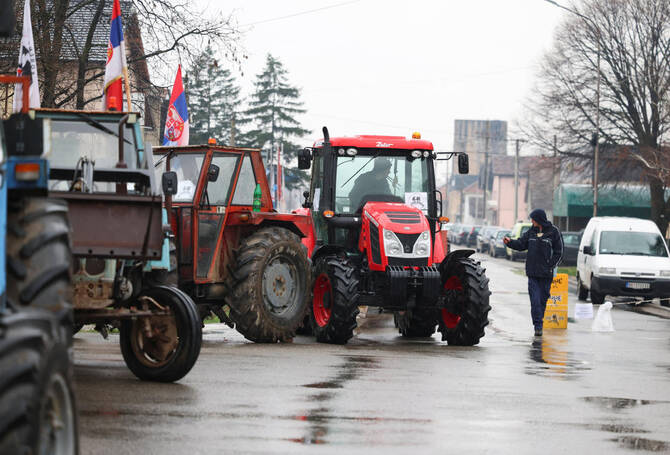
Serbian farmers block roads in Bogatic and nationwide after negotiations with the government failed to resolve disputes over milk prices, subsidies and agricultural imports, in Bogatic, Feb. 24, 2026. (Reuters)
Short Url
Updated 24 February 2026
Follow

Serbian farmers block roads to demand higher subsidies and import ban

  • The protests started in Serbia’s southwest almost two weeks ago and have spread across the country, with 42 sites targeted on Tuesday
  • “We are ready for anything ... and we will ⁠not back down ... as ⁠this is the rock bottom,” Zorbic said

BOGATIC, Serbia: Thousands of Serbian farmers blocked roads across the country with their tractors on Tuesday to demand higher subsidies and protection from cheap imported products such as milk and pork as well as faster payments for their products.
The protests started in Serbia’s southwest almost two weeks ago and have spread across the country, with 42 sites targeted on Tuesday.
In Bogatic, a small agricultural town, west of Belgrade, tractors, decorated with national flags, clogged up the main intersection. Farmers said the blockade would remain in place until their demands were met.
“We are ready for anything ... and we will ⁠not back down ... as ⁠this is the rock bottom,” Milan Zorbic, a member of a farmers’ association, said, while acknowledging that farmers like him had missed days working the fields while they were mounting the protests.
Dairy farmers say large volumes of imported milk and dairy products, mainly from the EU and the rest of ⁠the Western Balkans, are being sold at prices far below what Serbian farmers can sustainably produce, forcing producers toward collapse.
Farmers also say live pigs have sold for far below sustainable levels and that viable prices should be significantly higher to cover costs.
They are seeking higher government subsidies and temporary restrictions or tariffs on some agricultural imports to help level the playing field.
On Tuesday, Agriculture Minister Dragan Glamocic said farmers had failed to come to talks to discuss measures aimed at improving the milk market. ⁠Some retailers ⁠had pledged to increase the purchases of dairy products from farmers, he said.
The farmers’ protests coincide with ongoing nationwide anti-government protests which started in 2024, after 16 people died when a canopy collapsed at a train station. Some of the farmers’ placards also called on Serbian President Aleksandar Vucic to resign.
In 2024, agriculture accounted for 6.1 percent of Serbia’s GDP. The sector makes up 20 percent of the workforce.
Serbia is a candidate for membership of the European Union and it has committed to harmonize agricultural policies with those of the bloc, including opening of its market to EU products.


Germany’s Merz visits China AI hub hoping for business deals

Updated 4 sec ago
Follow

Germany’s Merz visits China AI hub hoping for business deals

  • German Chancellor Friedrich Merz arrived in the Chinese tech hub of Hangzhou on Thursday hoping to land new contracts a day after meeting President Xi
HANGZHOU: German Chancellor Friedrich Merz arrived in the Chinese tech hub of Hangzhou on Thursday with a large group of entrepreneurs, hoping to land new contracts a day after meeting President Xi Jinping and announcing an Airbus deal.
Merz’s first official visit to China comes as Berlin and Beijing seek to build on decades-old economic ties to weather global uncertainty sparked by US President Donald Trump’s tariff blitz and erratic foreign policies.
China, the world’s number two economy, overtook the United States last year to become Germany’s biggest trade partner. At the same time, Berlin regards the Communist Party-run state as a systemic rival to the West.
The German leader is accompanied in China by a large delegation of business leaders, including executives of auto giants Volkswagen, BMW and Mercedes.
Merz visited a Mercedes plant in Beijing on Thursday morning, where he was shown a demonstration of self-driving vehicles.
He then traveled to Hangzhou, where he is set to visit the sites of Germany’s Siemens Energy and Chinese humanoid robot-maker Unitree.
The eastern city is home to several other major Chinese tech companies like AI unicorn DeepSeek and e-commerce giant Alibaba.
European business leaders, who broadly complain China is flooding the EU market with cheap goods, have urged Merz to keep a cavernous trade imbalance at the top of his agenda.
Germany’s trade deficit with China hit a record 89 billion euros ($105 billion) last year.
- ‘New levels’ -
Following talks with Xi and top Chinese leaders in the capital on Wednesday, Merz said that China had agreed to purchase up to 120 Airbus aircraft, adding that it “demonstrates how worthwhile such trips can be.”
Other contracts were in the pipeline, Merz added.
The two leaders stressed their commitment to developing closer strategic relations, with Xi telling Merz he was willing to take relations to “new levels.”
Merz said he had also touched on the sensitive topic of Taiwan, the self-ruled island China claims as its territory and which it has not ruled out the use of force to annex.
Any “reunification” must be done peacefully, Merz said.
He also discussed the Ukraine war with Xi, who, according to Chinese state news agency Xinhua, said diplomacy was “key to the issue.”
Merz is the latest in a string of Western leaders to court Beijing recently.
He follows Britain’s Keir Starmer, France’s Emmanuel Macron and Canada’s Mark Carney, as they recoil from the mercurial policies of Trump, who is also expected to visit from March 31.