

Pakistani charity ramps up Gaza aid during Ramadan, delivering 10,000 iftar meals daily

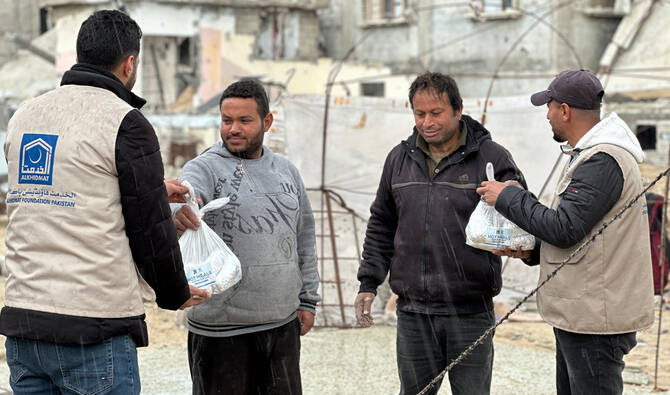
In this undated picture, volunteers of the Al Khidmat Foundation are seen distributing ration among the displaced people in Gaza. (Al Khidmat Foundation)
Short Url
Updated 24 February 2026
Follow

Pakistani charity ramps up Gaza aid during Ramadan, delivering 10,000 iftar meals daily

  • Al-Khidmat has sent 40 aid shipments to Gaza since Oct. 2023 war began
  • Foundation commits $30 million, plans hospital and school projects

ISLAMABAD: Pakistan’s Al-Khidmat Foundation (AKF) has expanded delivery of daily meals, water supplies and emergency relief to families in Gaza during the holy month of Ramadan, a senior official said this week, as Palestinians observe the fasting month under severe humanitarian strain following more than two years of war.

The two-year conflict, which began in October 2023, has killed more than 72,000 Palestinians and injured over 171,000 others, according to Palestinian health authorities. Vast areas of Gaza have been destroyed, leaving residents dependent on humanitarian assistance despite an October 2025 ceasefire between Israel and Hamas.

Since the war began, AKF has dispatched 40 aid shipments to Gaza, funded by public donations in Pakistan and delivered under the patronage of the government and the National Disaster Management Authority (NDMA).

“Daily, we are giving 20,000 liters of water to the people who have to break their fast,” AKF President Arshad Malik told Arab News in an interview on Monday. “Second, every day there are families who are getting 10,000 meals for iftar in Gaza.”

Malik said the organization has prioritized food staples tailored to local needs during Ramadan.

“In Ramadan, what we have prioritized is… food like it is oil, it’s hummus, it’s dates, it’s flour,” he said. “It is from people of Pakistan for the people of Gaza.”

Al-Khidmat, one of Pakistan’s largest humanitarian charities, is registered in several countries including the UK, US and Norway, and maintains offices in Japan, Italy and Turkiye. Since October 2023, it has delivered aid through chartered aircraft and sea shipments, coordinating cross-border logistics via Jordan and relying on local teams inside Gaza.

“First of all, we have employed our own people like boots on the ground. So there are people who are there, whom we are paying,” Malik said, explaining that designated camps are used to distribute daily iftar meals.

Each shipment is tracked through an identification number, he added.

“They track [shipments] and they follow that which camp has received those items and which camp has not been able to receive it so far,” Malik said.

Malik acknowledged that delivering aid into Gaza has involved complex logistical and security challenges.

“It was a challenge for us, it was a challenge for Government of Pakistan,” he said, noting that consignments required coordination with regional humanitarian organizations and clearance procedures before entering Gaza. “The logistics charges or the trawler charges were huge.”

However, he said processes have gradually streamlined, enabling faster distribution during Ramadan. Public donations in Pakistan have also increased during the fasting month, allowing the organization to expand its relief efforts.

“Since Oct. 2023, we committed $30 million and till date, we have been able to spend $23 million,” Malik said.

The foundation says it aims to spend Rs6 billion ($21.5 million) on Gaza relief during Ramadan alone.

Beyond emergency assistance, AKF is supporting Palestinian students studying in Pakistan and planning longer-term rehabilitation initiatives.

“One hospital close to Gaza border would be built, operated by Al-Khidmat Foundation Pakistan,” Malik said, adding that proposals also include building a hospital and a school inside Gaza.

Pakistan does not have diplomatic relations with Israel and maintains a policy of non-recognition, rooted in its support for an independent Palestinian state with Al-Quds Al-Sharif as its capital.


Pakistan says responding to Afghan ‘offensive operations’ after border fire as tensions escalate

Updated 56 min 19 sec ago
Follow

Pakistan says responding to Afghan ‘offensive operations’ after border fire as tensions escalate

  • Afghan Taliban spokesperson says “large-scale offensive operations” launched against Pakistani military bases
  • Pakistan says Afghan forces opened “unprovoked” fire across multiple sectors along shared border

ISLAMABAD: Afghanistan’s Taliban authorities said on Thursday they had launched “large-scale offensive operations” against Pakistani military bases and installations, prompting Pakistan to say its forces were responding to what it described as unprovoked fire along the shared border.

The escalation follows Islamabad’s weekend airstrikes targeting what it said were Tehreek-e-Taliban Pakistan (TTP) and Daesh militant camps inside Afghanistan in response to a wave of recent bombings and attacks in Pakistan. Islamabad said the strikes killed over 100 militants, while Kabul said dozens of civilians were killed and condemned the attacks as a violation of its sovereignty.

In a post on social media platform X, Afghan government spokesperson Zabihullah Mujahid said Afghanistan had launched “large-scale offensive operations” in response to repeated violations by the Pakistani military.


Pakistan’s Ministry of Information said Afghan forces had initiated hostilities along multiple points of the frontier.

“Afghan Taliban regime unprovoked action along the Pakistan–Afghanistan border given an immediate, and effective response,” the ministry said in a statement.

The statement said Pakistani forces were targeting Taliban positions in the Chitral, Khyber, Mohmand, Kurram and Bajaur sectors, claiming heavy Afghan casualties and the destruction of multiple posts and equipment. It added that Pakistan would take all necessary measures to safeguard its territorial integrity and the security of its citizens.


Separately, security officials said Pakistani forces had carried out counterattacks in several border sectors.

“Pakistan’s security forces are giving a befitting reply to the unprovoked Afghan aggression with full force,” a security official said, declining to be named. 

“The Pakistani security forces’ counter-attack destroyed Taliban’s hideouts and the Khawarij fled,” they added, referring to TTP militants. 

The claims from both sides could not be independently verified.

Cross-border violence has intensified in recent weeks, with Pakistan blaming a surge in suicide bombings and militant attacks on militants it says are based in Afghanistan. Kabul denies providing safe havens to anti-Pakistan militant groups.

The clashes mark the third major escalation between the neighbors in less than a year. Similar Pakistani strikes last year triggered weeklong clashes before Qatar, Türkiye and other regional actors mediated a ceasefire in October.

The 2,600-kilometer (1,600-mile) frontier, a key trade and transit corridor linking Pakistan to landlocked Afghanistan and onward to Central Asia, has faced repeated closures amid tensions, disrupting commerce and humanitarian movement. Trade between the two nations has remained closed since October 2025.