

Pakistan extends airspace ban on Indian aircraft until Mar. 23

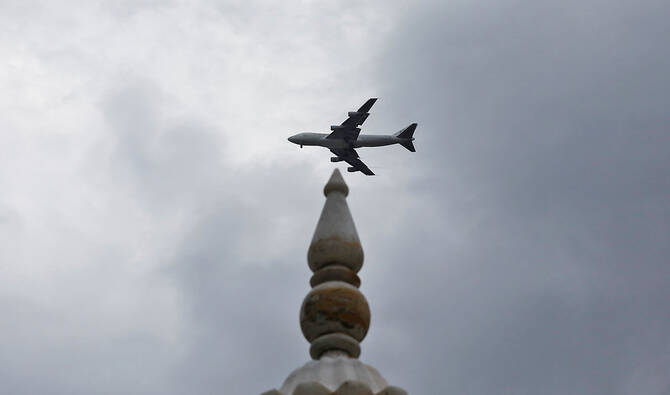
A plane flies past a monumemt in Karachi, Pakistan on July 17, 2022. (REUTERS/File)
Short Url
Updated 20 February 2026
Follow

Pakistan extends airspace ban on Indian aircraft until Mar. 23

  • This marks the ninth extension of the ban, first imposed in April after heightened tensions over an attack in Indian-administered Kashmir
  • Restriction has forced Indian airlines to reroute their flights that resulted in increased fuel consumption, travel times and operating costs

ISLAMABAD: Pakistan has extended a ban on Indian-registered aircraft from using its airspace until late March, the Pakistan Airports Authority (PAA) said on Friday, prolonging restrictions that have disrupted flight routes for Indian airlines.

Pakistan first imposed the restriction on Apr. 23 last year as part of a series of tit-for-tat measures announced by both countries days after an attack in Indian-administered Kashmir. New Delhi blamed the attack that killed 26 tourists on Pakistan, Islamabad denied it.

Tensions had quickly escalated between the neighbors after India targeted several sites in Pakistan and Azad Kashmir, triggering four-day-long missile, drone and artillery exchanges before a the United States brokered a ceasefire took on May 10, 2025.

"Pakistan’s airspace will remain closed to all Indian military and civil registered aircraft until Mar. 23," the PAA said in a statement.

This marks the ninth extension of the ban that has forced Indian airlines to reroute international flights, increasing fuel consumption, travel times and operating costs.

Air India, which operates numerous flights to Europe and North America, is lobbying the Indian government to convince China to let it use a sensitive military airspace zone in Xinjiang to shorten routes as the financial toll from the ban on Indian carriers flying over Pakistan mounts, according to Reuters.




Pakistan says defense pact with Saudi Arabia elevated brotherly ties to ‘new heights’

Updated 6 sec ago
Follow

Pakistan says defense pact with Saudi Arabia elevated brotherly ties to ‘new heights’

  • Pakistan, Saudi Arabia signed strategic defense pact last year pledging aggression against one will be treated as attack on both
  • Deputy PM Ishaq Dar says enduring bonds with Islamic and Arab nations form vital pillar of Pakistan’s foreign policy 

ISLAMABAD: Deputy Prime Minister Ishaq Dar said on Wednesday that Pakistan’s defense pact with Saudi Arabia elevated its brotherly ties with the Kingdom to “new heights,” stressing that close ties with Arab and Islamic nations form a key pillar of Islamabad’s foreign policy. 

Pakistan and Saudi Arabia signed a Strategic Mutual Defense Agreement on Sept. 17 last year, pledging that aggression against one country would be treated as an attack on both, enhancing joint deterrence and formalizing decades of military and security cooperation.

Both nations agreed in October 2025 to launch an economic cooperation framework to strengthen trade and investment ties. 

“In the Middle East, our landmark Strategic Mutual Defense Agreement with Saudi Arabia has elevated our brotherly ties to new heights,” Dar said while speaking at the Pakistan Governance Forum 2026 event in Islamabad. 

The Pakistani deputy prime minister was speaking on the topic “Navigating International Relations Amidst Changing Geo-Politics.”

Dar noted that Pakistan has reinforced partnerships with other Middle Eastern nations such as the UAE, Qatar, Jordan, Oman, Egypt and Bahrain. He said these partnerships have yielded “concrete agreements” in investment, agriculture, infrastructure, and energy sectors. 

“Our enduring bonds with Islamic and Arab nations form a vital pillar of our foreign policy, and we will continue to expand our partnerships across Asia, Latin America, and Africa,” he said. 

Dar pointed out that the presidents of Kazakhstan, Uzbekistan and Kyrgyzstan have undertaken visits to Pakistan in recent months, reflecting Central Asian nations’ desire to boost cooperation with Islamabad.

On South Asia, the Pakistani deputy PM said Pakistan has successfully transformed its fraternal ties with Bangladesh into “a substantive partnership.”

“Similarly, the trilateral mechanism involving China, Pakistan, and Bangladesh has been launched with a view to expanding and deepening regional cooperation and synergy,” the Pakistani minister said. 

He said Islamabad has strengthened its “all-weather” partnership with China via the second phase of the multi-billion-dollar China-Pakistan Economic Corridor agreement and “unwavering support” from both sides for each other’s core interests. 

Dar said Pakistan had also reinvigorated its partnership with the US, advancing cooperation in trade, technology, investment, and regional stability. 

“This calibrated approach has enhanced our ability to navigate complexity with skill and confidence, ensuring that our national interests are served without compromising our core foreign policy principles,” he said.
