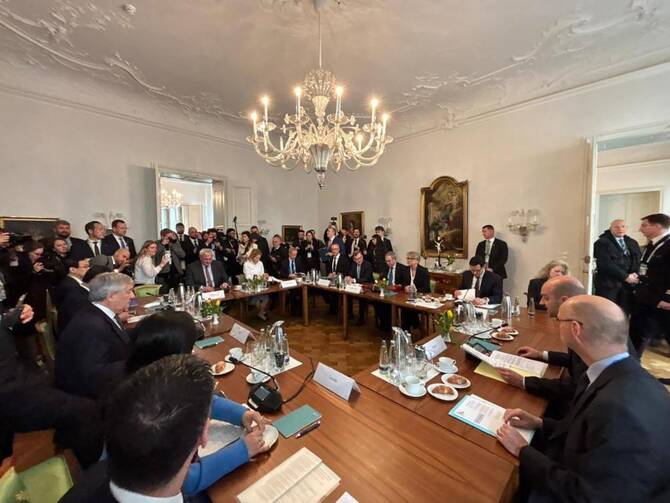
GENEVA: Russian and Ukrainian negotiators will meet Tuesday in Geneva for fresh US-brokered talks seeking to end the four-year war, hours after both sides launched a fresh wave of long-range strikes.
US President Donald Trump is seeking to position himself as peacemaker of the conflict unleashed when Russia invaded Ukraine in February 2022, but previous rounds of talks mediated by the White House have yielded no breakthroughs.
Before the meetings began Ukraine accused Russia of undermining peace efforts by launching 29 missiles and 396 drones in attacks that authorities said killed one, wounded others and cut power to tens of thousands.
“The extent to which Russia disregards peace efforts: a massive missile and drone strike against Ukraine right before the next round of talks in Geneva,” Foreign Minister Andriy Sybiga wrote on social media.
He repeated Ukraine’s call for allies to exert greater pressure on Russia to negotiate in good faith by applying more sanctions on Moscow.
The talks, which the Kremlin said will be held behind closed doors and with no media present, come after two earlier rounds held this year in Abu Dhabi.
“Ukraine better come to the table, fast,” Trump told reporters ahead of the negotiations.
Ukrainian President Volodymyr Zelensky said his team had already arrived in Geneva on Monday, while a source with the Russian delegation confirmed Tuesday that their team had touched down in the Swiss city in the early hours.
Russia meanwhile claimed to have repelled more than 150 Ukrainian drones mainly over southern regions and Crimean peninsula, occupied by the Kremlin in 2014.
Officials said an oil depot in southern Russia caught fire.
Sticking points
The war has spiralled into Europe’s deadliest conflict since World War II, with hundreds of thousands killed, millions forced to flee their homes in Ukraine and much of the eastern and southern part of the country scarred by war.
Russia occupies around one-fifth of Ukraine — including the Crimean peninsula it seized in 2014 — and areas that Moscow-backed separatists had taken prior to the 2022 invasion.
It wants Ukrainian troops to withdraw from swathes of heavily fortified and strategic territory as part of any peace deal.
Kyiv has rejected this deeply unpopular demand, which would be politically and militarily fraught, and has instead demanded robust security guarantees from the west before agreeing to any proposals with Russia.
Russia’s better-resourced army has been making steady gains across the sprawling front line in the eastern and southern Ukraine in recent months.
But Ukrainian forces have recently made significant battlefield gains, recapturing 201 square kilometers (78 square miles) last week, according to an AFP analysis of data from the Institute for the Study of War.
The counterattacks likely leveraged Russian forces’ lack of access to Starlink, which has disrupted communications, the ISW said.
The territorial gain is concentrated mainly around 80 kilometers east of the city of Zaporizhzhia, a region that Moscow claims is part of Russia, and where its troops have made significant progress since last summer.
The centrally located region hosts Europe’s largest nuclear power plant, which Russia currently controls — another sticking point in negotiations.
For the talks in Geneva, the Kremlin has reinstated nationalist hawk and former culture minister Vladimir Medinsky as its lead negotiator.
“This time, we plan to discuss a broader set of issues, focusing on key ones related to the territories and other demands,” a spokesperson for President Vladimir Putin told reporters, including AFP, explaining the personnel change.
Kyiv’s team will be led by national security chief Rustem Umerov, while the White House is expected to dispatch Special Envoy Steve Witkoff and Trump’s son-in-law Jared Kushner.


![]()

Moscow, Kyiv meet for US-brokered talks after fresh attacks
Short Url
https://arab.news/2nr89
Moscow, Kyiv meet for US-brokered talks after fresh attacks
- Foreign Minister Andriy Sybiga repeated Ukraine’s call for allies to exert greater pressure on Russia to negotiate in good faith by applying more sanctions on Moscow


Latest updates


© 2026 SAUDI RESEARCH & PUBLISHING COMPANY, All Rights Reserved And subject to Terms of Use Agreement.