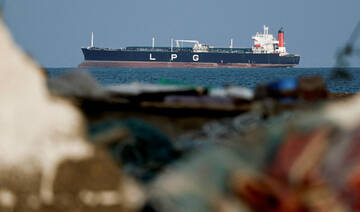
TEHRAN: Iran closed parts of the strategic Strait of Hormuz for “safety” measures during military drills by its Revolutionary Guards, state media reported on Tuesday.
State TV reported earlier that “parts of the Strait of Hormuz will be closed in order to respect the principles of safety and navigation."
This is the first time that Iran has closed parts of the strait since the US began threatening Iran with military action. Earlier, state TV announced that Iran had launched missiles into the Strait of Hormuz.
The announcement comes as Iran is participating in nuclear negotiations with the US in Geneva, Switzerland.
Iran fires missiles into Strait of Hormuz in drill
The semi-official Tasnim news agency, which is close to the paramilitary Revolutionary Guard, said missiles launched inside Iran and along its coast had struck their targets in the Strait of Hormuz.
Iran had announced that the Revolutionary Guard started a drill early Monday morning in the Strait of Hormuz, the Arabian Gulf and the Gulf of Oman, which are crucial international shipping routes.
It is the second time in recent weeks that Iran has held a live fire drill in the Strait of Hormuz.
Iran’s Supreme Leader Ayatollah Ali Khamenei stepped up his warnings to the US over its buildup of military forces in the Middle East. “Of course a warship is a dangerous apparatus, but more dangerous than the warship is the weapon that can sink the warship into the depths of the sea,” Khamanei said, Iranian state TV reported.
He also warned the US that “forcing the result of talks in advance is a wrong and foolish job.”
Drill comes as US increases military presence
Last week, Trump said the USS Gerald R. Ford, the world’s largest aircraft carrier, was being sent from the Caribbean Sea to the Mideast to join other warships and military assets the US has built up in the region.
The Ford, whose new deployment was first reported by The New York Times, will join the USS Abraham Lincoln and its accompanying guided-missile destroyers, which have been in the region for over two weeks. US forces already have shot down an Iranian drone that approached the Lincoln on the same day last week that Iran tried to stop a US-flagged ship in the Strait of Hormuz.
Gulf Arab nations have warned any attack could spiral into another regional conflict in a Mideast still reeling from the Israel-Hamas war in the Gaza Strip.
The Trump administration is seeking a deal to limit Iran’s nuclear program and ensure it does not develop nuclear weapons. Iran says it is not pursuing weapons and has so far resisted demands that it halt uranium enrichment or hand over its supply of uranium.
The US and Iran were in the middle of months of meetings when Israel’s launch of a 12-day war against Iran back in June instantly halted the talks. The US bombed Iranian nuclear sites during that war, likely destroying many of the centrifuges that spun uranium to near weapons-grade purity. Israel’s attacks decimated Iran’s air defenses and targeted its ballistic missile arsenal as well.
Iran has insisted its nuclear program is for peaceful purposes. Before the June war, Iran had been enriching uranium up to 60 percent purity, a short, technical step away from weapons-grade levels.
Iran marks 40 days since deadliest part of protest crackdowns
Iran is marking 40 days, the traditional Muslim mourning period, since one of the deadliest days in the crackdown on protests that swept the country last month. Activists say at least 7,015 people have been killed, many in a bloody crackdown overnight between Jan. 8 and 9.
The US-based Human Rights Activists News Agency, which offered the latest figures, has been accurate in counting deaths during previous rounds of unrest in Iran and relies on a network of activists in the country to verify deaths.
The Associated Press has been unable to independently assess the death toll, given authorities have disrupted Internet access and international calls in Iran.
Iran’s state news agency said the government would hold a memorial marking 40 days at the Grand Mosalla mosque in Tehran, and blamed the demonstrations on “violent actions by armed groups allegedly directed by foreign intelligence agencies.”


Iran closes parts of Hormuz Strait for ‘safety’ measures during drill: state media

https://arab.news/8uhbt
Iran closes parts of Hormuz Strait for ‘safety’ measures during drill: state media

- It is the first time Iran has closed parts of the strait since the US began threatening the country with military action


Bahrain arrests four for spying for Iran’s IRGC as Gulf attacks intensify
- Investigators said the suspects were found to have sent pictures and coordinates of vital locations in Bahrain to the IRGC via encrypted software
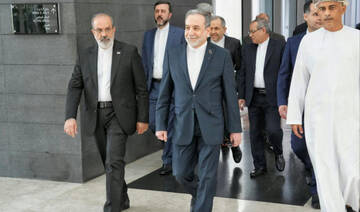
MANAMA: Bahrain has detained four citizens suspected of spying for Iran’s Islamic Revolutionary Guard Corps (IRGC), as Tehran’s retaliatory strikes on Gulf states show no signs of letting up.
Bahrain’s General Directorate of Criminal Investigation and Forensic Science identified the four detainees as Murtadha Hussain Awal, 25; Ahmed Isa Al Haiki, 34; Sarah Abdulnabi Marhoon, 36; and Elias Salman Mirza, 22. A fifth suspect, Ali Mohammed Hassan Al Shaikh, 25, remains at large abroad.
Investigators said Murtadha Hussain and his cohorts, acting on IRGC instructions, used high-resolution equipment to photograph and record coordinates of vital locations in Bahrain, transmitting the data to the IRGC via encrypted software.
The arrests come as Iran escalates attacks across the Gulf. Bahrain’s Interior Ministry issued an advisory urging residents in Hidd, Arad, Qalali and Samaheej to stay indoors and seal windows against smoke from fires sparked by Iranian strikes. Fuel tanks at a facility in Muharraq Governorate, northeast of Manama, were among the targets. Oman’s Port of Salalah also battled blazes at fuel storage tanks following separate Iranian drone strikes.
Elsewhere in the region, two Iranian drones struck near Dubai International Airport, wounding four people, though flights continued uninterrupted. A fire broke out at a luxury apartment tower in Dubai Creek Harbour after another drone hit — extinguished by Thursday morning.
Iran also targeted commercial ships and struck what officials described as the world’s busiest international airport on Wednesday, as US and Israeli strikes continued to pound Tehran.
A war now 12 days old — and costly
The conflict began on February 28, when US and Israeli forces launched coordinated strikes on Iran. Tehran has since retaliated by targeting Gulf states, US and Israeli assets, and critical energy infrastructure.
Iran has declared a blockade on energy shipments through the Strait of Hormuz, a vital chokepoint for global oil and gas flows, sending commodity prices surging and rattling international markets.
The Pentagon told Congress this week that the first week of war cost the United States $11.3 billion — including $5 billion in munitions in the conflict’s opening weekend alone.
The UN Security Council on Wednesday voted to approve a resolution demanding a halt to Iran’s attacks on its Gulf neighbors. Bahrain’s UN Ambassador Jamal Alrowaiei welcomed the move.
“The international community is resolute in rejecting these Iranian attacks against sovereign countries that are threatening the stability of the peoples, especially in a region of strategic importance to global economy, energy security and global trade,” he said.
Despite the resolution, there were no immediate signs the conflict was easing.
(With AP)