Thousands rally in support of Nepal’s former king and call for monarchy’s return

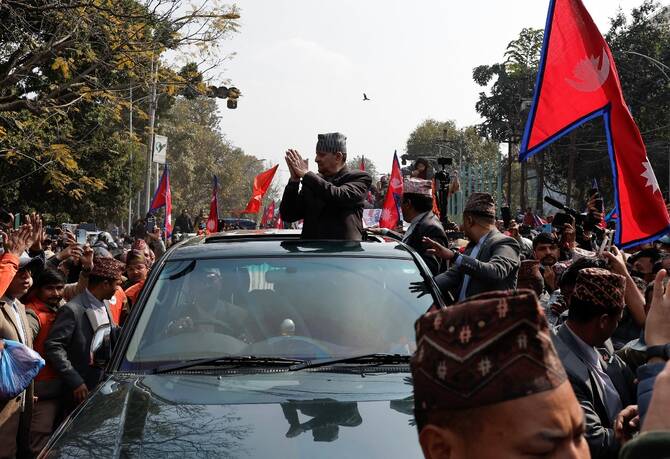
Former King of Nepal Gyanendra Bir Bikram Shah Dev is welcomed by the pro-monarchy supporters outside the Tribhuvan International Airport in Kathmandu, Nepal. (Reuters)
Short Url
Updated 13 February 2026
Follow

Thousands rally in support of Nepal’s former king and call for monarchy’s return

  • An estimated 10,000 supporters turned out for a similar rally last year at the airport
  • The show of support for the monarchy comes ahead of crucial parliament elections next month

Katmandu: Thousands of supporters of Nepal’s former king gathered outside Katmandu airport Friday to greet him and demand the restoration of abolished monarchy in the Himalayan nation.
Gyanendra Shah waved to the cheering crowd from the sunroof of his car as hundreds of police officers in riot gear struggled to control the supporters crowding the main entrance at Tribhuvan International Airport.
“Bring back the king. We love our king more than our own selves. Restore constitutional monarchy,” the crowd chanted.
More supporters lined the route from the airport to the former king’s private residence. The crowds were peaceful and no arrests were made.
The former king was returning from a trip to eastern Nepal.
Massive street protests in 2006 forced Gyanendra to give up his authoritarian rule, and two years later the parliament voted to abolish the monarchy as Gyanendra left the Royal Palace to live the life of a commoner.
An estimated 10,000 supporters turned out for a similar rally last year at the airport. Another pro-royal rally last year had turned violent leaving two dead and many injured.
Gyanendra has not commented on the calls for the return of monarchy. Despite growing support for the former king, Gyanendra has slim chances of immediately returning to power as the support is not as significant as that for other political parties opposing the idea.
The show of support for the monarchy comes ahead of crucial parliament elections next month. Pro-Gyanendra groups, which won about 5 percent of seats in the last election, are hoping to win seats.


Hungary to release 1.8 million barrels of crude oil from strategic reserves

Updated 5 sec ago
Follow

Hungary to release 1.8 million barrels of crude oil from strategic reserves

  • Croatia’s JANAF pipeline operator, however, said there was no need for Budapest to tap its reserves
  • Hungary and Slovakia have been trying to secure supply since flows were halted on January 27

BUDAPEST: Hungary’s government will release about 1.8 million barrels of crude oil from its strategic reserves after a drone attack on the Druzhba pipeline late last month stopped oil flow, according to a government decree published late on Thursday.
Croatia’s JANAF pipeline operator, however, said there was no need for Budapest to tap its reserves after Hungary’s oil company MOL said on Friday JANAF must allow transit of Russian seaborne oil to Hungary and Slovakia during the Druzhba outage.
“At this ⁠moment, a significant ⁠quantity of non-Russian crude oil is being transported via JANAF’s pipeline for MOL Group, while three additional tankers carrying non-Russian oil, also for MOL Group, are on their way to the Omisalj Terminal,” JANAF said in a statement.
“There was no need to tap into (their) reserves since oil transport via the JANAF pipeline toward MOL’s refineries is being carried out continuously and without ⁠delays.”
Hungary and Slovakia, which have the only remaining refineries in the EU using Russian oil through Druzhba, have been trying to secure supply since flows were halted on January 27 following what Ukraine said was a Russian drone attack that damaged pipeline infrastructure.
Both countries have blamed Ukraine for the delay in restarting the flows for political reasons.

SCRAMBLE FOR CRUDE SUPPLIES
MOL is entitled to priority access to released crude oil reserves, and it will have access to the freed reserves until April 15 and has to return them by August 24, the Hungarian government decree said.
At the end of January, ⁠Hungary had ⁠enough crude oil and petroleum product reserves to cover 96 days, according to data on the Hungarian Hydrocarbon Stockpiling Association’s website.
As the two countries scramble to ensure supplies, MOL ordered tankers delivering Saudi, Norwegian, Kazakh, Libyan and Russian oil to supply its Hungarian and Slovak refineries and halted diesel deliveries to Ukraine earlier this week.
MOL said that first shipments were expected to arrive at the port of Omisalj in Croatia in early March. After that, it will take a further 5-12 days for the crude oil to reach its refineries.
The Slovak government has also declared an oil emergency situation and has pledged to release 1.825 million barrels of oil following a request from Slovakia’s Slovnaft refinery, which is owned by MOL.