

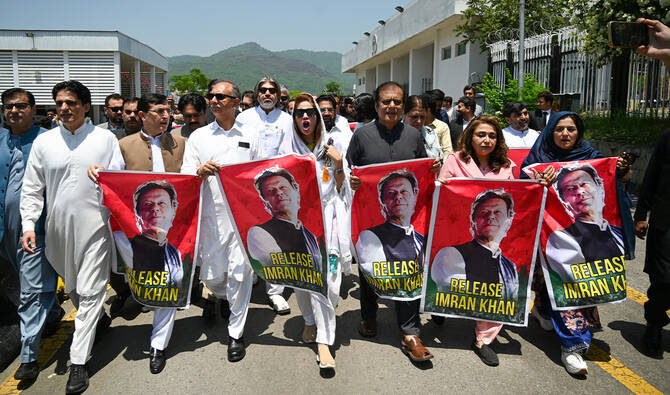

ISLAMABAD: Pakistan’s opposition alliance has announced a sit-in outside the Parliament House in Islamabad today, Friday, over jailed former prime minister Imran Khan’s deteriorating eye condition, following a rare prison visit by a Supreme Court-appointed lawyer this week.
Barrister Salman Safdar, who was appointed ‘amicus curiae,’ or ‘friend of the court,’ visited Khan at Rawalpindi’s Adiala jail on Feb. 10 and filed a detailed report on his living conditions and health, which was made public on Thursday.
The report stated that in view of the seriousness of Khan’s ocular condition, “it is imperative that the seriousness of the condition be independently ascertained without delay.” There was no immediate response from prison authorities on the findings.
The Tehreek-e-Tahafuz-e-Ayin-e-Pakistan opposition alliance late Thursday demanded that Khan be transferred to Al-Shifa Hospital and announced a sit-in outside parliament until the former prime minister is allowed treatment in the presence of his personal physicians.
“The sit-in will be held tomorrow,” Mahmood Khan Achakzai, the head of the opposition alliance, told reporters in Islamabad, adding that they will lay down all demands at the sit-in. “If, God forbids, something happens, then the government will be responsible for that.”
Speaking to reporters in Islamabad, Parliamentary Affairs Minister Tariq Fazal Chaudhry denied claims the ex-premier had an eye issue since Oct. last year, noting that Khan was visited by his sister on Dec. 2 but she did not mention the medical issue.
The ex-premier was examined by a medical board on Dec. 9 and complained of the eye issue on Jan. 16, the minister said, reassuring that the government would arrange for his treatment by best specialists and compile a medical report into the examination.
“Medical report will be compiled again, the chief justice of the Supreme Court is himself monitoring this case,” he said. “Wherever it will be requested, Imran Khan’s eye will be examined.”
Chaudhry vowed the government would not leave room for any negligence in this regard.
“This is a sensitive issue, doing politics, making comments, twisting facts about it, I believe this would be injustice,” he said. “If there would be any negligence on our part, we will admit it... This is a medical issue and God willing, we will resolve it the way medical issues are resolved on priority.”
Khan, 73, has been in custody since August 2023 in connection with multiple cases that he and his party describe as politically motivated. The government denies the allegation.
Concerns about Khan’s health resurfaced in recent weeks after authorities confirmed he had been briefly taken from prison to a hospital in Islamabad for an eye procedure. The government said at the time his condition was stable, while Khan’s family and his Pakistan Tehreek-e-Insaf (PTI) political party complained they had not been informed in advance and alleged he was being denied timely and independent medical access.
The issue was then taken up by the Supreme Court earlier this week, which tasked Safdar, who has represented Khan in the past, with visiting the ex-premier and submitting a written report.
According to a medical condition report from the Pakistan Institute of Medical Sciences (PIMS), dated Feb. 6, 2026 and referenced in Safdar’s court filing, Khan was diagnosed with “right central retinal vein occlusion” after reporting reduced vision in his right eye.
The report states that he underwent anti-VEGF intravitreal injection treatment at PIMS and was discharged with follow-up advice.
However, in his interaction with Safdar, Khan said he had experienced “rapid and substantial loss of vision over the preceding three months” and claimed his complaints had not been addressed promptly while in custody. He further stated that despite treatment, he had been left with “only 15 percent vision in his right eye.”
Safdar’s report notes that the former premier appeared “visibly perturbed and deeply distressed by the loss of vision and the absence of timely and specialized medical intervention.” The amicus also recommended that the Supreme Court consider directing involvement of Khan’s personal physicians or other specialists of his choice, warning that “any further delay poses a serious risk to the Petitioner’s well-being.”
Beyond medical concerns, the report addressed Khan’s confinement conditions, noting that he expressed “satisfaction regarding his safety and security within the cell-block,” as well as contentment with basic amenities and food provisions.
Information Minister Attaullah Tarar earlier rejected claims of mistreatment of Khan at the prison, saying the “narrative being propagated to international media” by Khan’s family had “fallen flat on its face.”
He said the prison report on Khan’s daily routine and diet had removed any ambiguity and maintained that all facilities were available to the former premier, who he said enjoyed privileges “more than any other prisoner.” His X post did not address the allegations on Khan’s health issues.


