Saudi Arabia explores vaccine manufacturing partnerships in Belgium

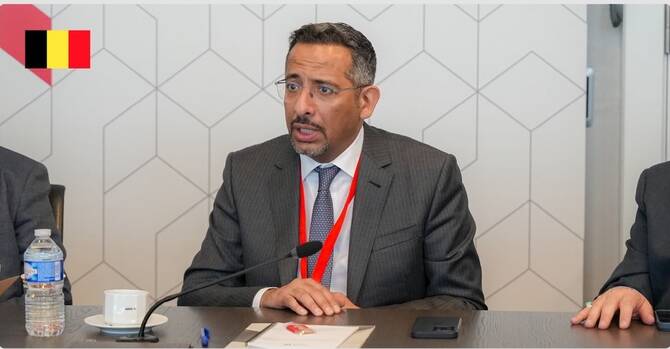
Saudi Industry and Mineral Resources Minister Bandar Alkhorayef met senior executives from Pfizer during an official visit to Belgium. Supplied
Short Url
Updated 12 February 2026
Follow

Saudi Arabia explores vaccine manufacturing partnerships in Belgium

RIYADH: Medical device and vaccine manufacturing is set to receive a boost after Saudi Arabia held partnership talks with Pfizer and Agfa HealthCare to localize advanced pharmaceutical technologies. 

Saudi Industry and Mineral Resources Minister Bandar Alkhorayef met senior executives from Pfizer during an official visit to Belgium to explore cooperation in pharmaceutical manufacturing and opportunities to localize vaccine and medicine production in the Kingdom, according to a government statement. 

The initiative aligns with the objectives of the Kingdom’s national industrial strategy and Saudi Vision 2030. 

“The meeting discussed aspects of joint cooperation, exchange of expertise, and the transfer of advanced technologies in the manufacturing of vaccines and biopharmaceuticals to the Kingdom, strengthening integration in pharmaceutical supply chains, in addition to developing joint investments in high-quality projects that support the Kingdom’s pharmaceutical security objectives,” the release stated. 

As part of the visit, Alkhorayef toured Pfizer’s manufacturing facilities in Brussels, where he was briefed on the company’s operations and key investments in the pharmaceutical and vaccine sector.  

Company officials outlined Pfizer’s global role in vaccine and biopharmaceutical production and expressed interest in transferring similar technologies to the proposed facility in Saudi Arabia. 

In a separate meeting, the minister held talks with the chief executive of Agfa HealthCare to discuss cooperation in the manufacturing of medical devices and advanced industrial solutions.  

He visited the company’s industrial facilities and reviewed its efforts in developing medical imaging solutions, digital health data management systems, and advanced radiology technologies, in addition to its capabilities in producing specialized chemicals and green hydrogen membranes. 

The meetings and site visits were conducted as part of Alkhorayef’s official trip to Belgium, aimed at strengthening economic partnerships and attracting high-quality investments while facilitating the transfer of advanced technologies in pharmaceutical and medical industries.  

The push reflects Saudi Arabia’s broader strategy to build domestic capacity in critical industries following supply disruptions seen during the COVID-19 pandemic, when many countries moved to reduce reliance on imported medicines and medical equipment.  

The Kingdom has since identified pharmaceuticals and biotechnology as priority sectors under its National Industrial Strategy, with the goal of creating a regional production hub serving Middle East and African markets. 


Up to $600m in additional tariffs on Saudi exports to the US

Updated 12 sec ago
Follow

Up to $600m in additional tariffs on Saudi exports to the US

RIYADH: Gulf exports have become targets of US President Donald Trump’s tariffs, which he raised from 10 percent to 15 percent on all countries.

The increase comes after the US Supreme Court ruled that the legal basis Trump had used to impose earlier tariffs was unlawful.

Previously, Gulf countries were among the few that had not raised their tariffs above 10 percent, while many other countries, most notably China, had already been subject to higher tariffs. However, with this latest increase, the Gulf states will be among those affected.

According to the financial analysis unit of Al-Eqtisadiah newspaper, Gulf exports to the US in 2024 amounted to about $26.2 billion, with Saudi Arabia accounting for roughly half of that, at $12.7 billion. These exports are subject to potential additional tariffs of SR637 million ($169 million).

It is likely that tariffs on Saudi exports will grow from $1.3 billion annually to $1.9 billion, a rise of 50 percent, following Trump’s recent increase.

Customs duties on Gulf exports will also increase, from $2.6 billion annually to $3.9 billion.

In 2024, Gulf exports are distributed as follows: $7.5 billion from the UAE, $1.8 billion from Qatar, and $1.6 billion from Kuwait, as well as $1.3 billion from Oman, and finally, $1.2 billion from Bahrain.

Gulf trade with the US in 2024 reached approximately $86 billion, comprised of $26.2 billion in exports and approximately $60 billion in imports, resulting in a Gulf trade deficit of $33.5 billion.

Trump responds to Supreme Court ruling

US President Donald Trump raised the global tariffs from 10 percent to 15 percent in response to the US Supreme Court ruling that his previous tariff implementation mechanism was unlawful.

Trump said in a post on his Truth Social account today: “As President of the US, I will, effective immediately, raise the global tariffs imposed on countries that have been taking advantage of the US for decades with impunity (until I took over!) to the legally permitted and tested level of 15 percent.”

Hours after the Supreme Court ruling on Feb. 20, Trump imposed a 10 percent global tariff on foreign goods, a move aimed at maintaining his trade agenda.

Trump had expressed his displeasure with the Supreme Court’s decision to overturn the tariffs imposed by his administration, asserting that the ruling would not restrict him. He vowed to impose tariffs far exceeding those struck down by the court, indicating that he had stronger alternatives to tariffs, raising questions about his future trade strategy.

The US Supreme Court struck down Trump’s sweeping global tariffs, undermining his signature economic policy and inflicting his biggest legal defeat since returning to the White House.

By a six-three vote, the court ruled that Trump exceeded his authority by invoking the federal emergency powers law to impose his reciprocal tariffs worldwide, in addition to targeted import duties that the administration claims are intended to combat fentanyl smuggling.