
RIYADH: Saudi Arabia is investing in artificial intelligence to drive growth in the mining sector, according to the Kingdom’s minister of industry and mineral resources.
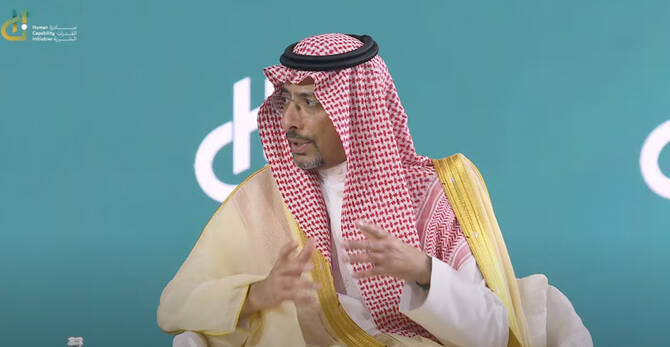
Speaking in a fireside chat titled “Human Potential – The Critical Foundation of Industrial Transformation” on the first day of the Human Capability Initiative 2025 taking place in Riyadh on April 13-14, Bandar Alkhorayef explained that this focus is significant given that mining is often viewed as a traditional industry where innovation has lagged.
This falls in line with Saudi Arabia’s goal to increase the mining industry’s gross domestic product contribution from $17 billion to $75 billion by 2035.
It also aligns well with the nation’s efforts to establish mining as the third pillar of its industrial economy.
During the session, Alkhorayef said: “When we launched our Future Mineral Form three years ago, actually in this center, we had a small zone that we called tech zone where we invited different innovators from around the world to showcase some of their ideas. It was amazing to see how small ideas can actually be accommodated in the mining sector from up to upstream in mines, for example, where we can see more safer mines, more productive and more energy efficient mines, and so on.”
He added: “So, in industry, it’s the same thing. We believe that Saudi Arabia has a great advantage in terms of our energy efficiency. Also, AI needs a lot of energy, as you can imagine, and we are spending a lot of money to create the infrastructure to build AI, to build data centers, to allow also the investors to come at the same time.”
The minister went on to highlight significant regulatory efforts — from cybersecurity to broader frameworks — that enable artificial intelligence to operate safely and under strong governance.
“We have a program that we launched two years ago in the ministry called the Future Factories Program where we incentivize industry investors to tap into new technologies, robotics, or AI,” Alkhorayef said.
He added: “When we look at the industry and mining coupled with the human capital development program, the RDI, the Research, Development and Innovation Program, it creates an ecosystem where talent-based human capital is developed, where we are creating opportunities for the young in the form of jobs but also creating opportunities in the form of actual investment or building the next interpreters.”
Regarding the Human Capital Development Program, the minister emphasized that it is a key national asset. He noted that the ministry is working to ensure strong coordination between the program and the industrial and mining sectors, as it addresses the broader needs of the nation.
“Today’s world is moving so fast, and it is very hard for sectors on their own to be responsible for the agility in a cost-cutting element of the economy, which is education and training and skilling and reskilling. So, I think that it’s a great asset for us because it allows us to focus on our own plans where we are at the same time very confident that there is a great effort with great coordination for the sector to have the right talent in place for us to achieve our targets,” Alkhorayef said.
The two-day event unites government entities, the private sector, and nonprofit organizations to foster collaboration and drive innovation.
Organized by the Human Capability Development Program — a part of the Vision 2030 realization initiatives — in partnership with the Ministry of Education, the conference is expected to explore breakthrough learning models and strategies for future workforce readiness.
HCI 2025 will host over 100-panel discussions across four main stages, focusing on key future trends in developing human potential. It will explore innovative methods to empower individuals and communities while fostering stronger public-private sector collaboration to create sustainable and impactful solutions for the future.