

Pakistan overhauls rooftop solar policy, cuts rates for excess power sold to grid

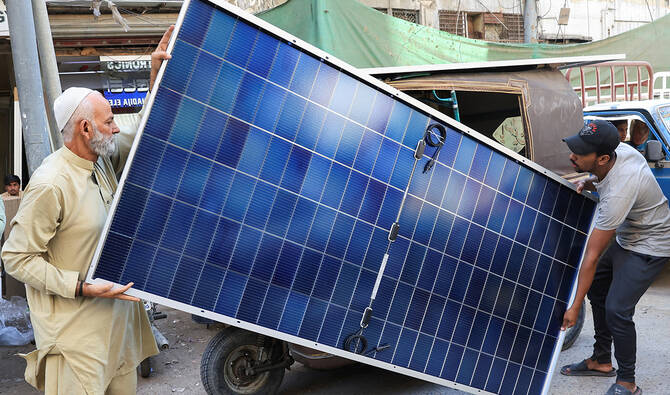
Men load solar panels on a rickshaw (tuk tuk) at a market, in Karachi, Pakistan March 26, 2025. (Reuters/File)
Short Url
Updated 10 February 2026
Follow

Pakistan overhauls rooftop solar policy, cuts rates for excess power sold to grid

  • Policy change comes amid rapid rooftop solar uptake and mounting energy sector losses
  • Lower rates for excess solar power shift benefits toward utilities, away from households

ISLAMABAD: Pakistan has sharply reduced the rate at which households and businesses are paid for excess electricity generated from rooftop solar systems, a move that lowers returns for consumers but is expected to ease financial pressure on state-run power utilities, according to new regulations notified this week.

The change shifts Pakistan from a net metering regime, under which solar users offset their electricity bills at the same rate they pay for grid power, to a net billing framework that separates buying and selling prices. Consumers will continue to pay full tariffs for electricity drawn from the grid while receiving a lower, market-linked rate for excess power they export.

Under new regulations notified by the National Electric Power Regulatory Authority (NEPRA) on Feb. 9, 2026, consumers exporting surplus electricity to the grid will no longer be compensated at retail tariffs.

“The power purchase price for electricity supplied by a prosumer to the distribution company shall be the national average energy purchase price,” the regulator said in the notification.

Pakistan has seen an unprecedented boom in rooftop solar over the past three years as households and businesses turned to private generation to escape record electricity prices, frequent outages and inflation-driven energy costs. 

Solar power grew from 4 percent of the energy mix in 2021 to over 14 percent–25 percent in 2024-2025, official figures show. Driven by skyrocketing grid tariffs, Pakistan became one of the world’s top new solar adopters, importing roughly 22 gigawatts (GW) of solar panels in 2024 alone. Industry data shows tens of thousands of new solar connections have been added annually, significantly reducing demand from the grid during daylight hours.

Power distribution companies, however, have warned that net metering was eroding revenues, worsening losses and shifting costs onto non-solar consumers, a growing concern in a sector already weighed down by billions of dollars in circular debt.

The revised framework seeks to rebalance incentives while still allowing consumers to generate their own electricity, officials say.

The new regulations apply to distributed generation systems using solar, wind or biogas technology with installed capacity of up to one megawatt. Installed capacity may not exceed a consumer’s sanctioned load, and utilities may restrict new connections if injections exceed 80 percent of a local transformer’s rated capacity.

Projects above 250 kilowatts will require technical studies before approval. All new agreements will be signed for five years and renewed under the updated rules.

Existing net-metered consumers will remain on their current contracts until expiry, after which they will transition to the new billing system.

NEPRA said the policy aims to balance renewable energy adoption with grid stability and financial sustainability as Pakistan tries to reform a power sector marked by chronic losses, rising subsidies and persistent fiscal pressure.


Pakistan stocks fall amid Afghanistan tensions, recover from intraday lows

Updated 4 sec ago
Follow

Pakistan stocks fall amid Afghanistan tensions, recover from intraday lows

  • Index drops as much as 3,081 points before paring losses after no retaliation reported from Kabul
  • Banking and energy stocks drag benchmark lower as regional tensions weigh on investor sentiment 

ISLAMABAD: Pakistan’s benchmark KSE-100 index fell on Friday amid escalating tensions with Afghanistan as Pakistan bombed government targets in Kabul and Kandahar where the Afghan Taliban leadership is based, triggering early selling pressure before the market recovered from sharp intraday losses.

The strikes marked a significant escalation in cross-border tensions between Islamabad and Kabul, raising concerns about potential retaliation and broader regional instability. The development comes at a time when relations between the two sides have been strained for months over security issues along the border and militant attacks in Pakistan that it blames on Afghan-based groups. Kabul denies it harbors such outfits. 

Heightened geopolitical risk tends to weigh on investor sentiment, particularly in emerging markets, as uncertainty over security and diplomatic fallout can prompt risk-off positioning and capital outflows. Traders said investors reacted swiftly to the headlines, pricing in the possibility of further escalation.

“KSE 100 Index opened on a negative note and declined to make an intraday low of -3,081 points (down by -1.82 percent), this negativity can be accredited to regional tension with Afghanistan, where Pakistan targeted key military installation of Afghanistan Taliban regime in Kabul,” brokerage house Topline Securities said in its market review.

The index dropped as much as 3,081 points, or 1.82 percent, during the session before recovering part of the losses after no retaliatory strikes were reported.

It settled at 168,062 points, down 0.49 percent on the day.

Losses were led by United Bank Limited, Fauji Fertilizer Company, Oil and Gas Development Company, Pakistan Petroleum Limited and MCB Bank Limited, which together shaved 658 points off the index.

National Bank of Pakistan, MCB Bank, Pakistan Petroleum Limited, Bank of Punjab and Bank Alfalah led trading by value.

Traded volume and value for the day stood at 533 million shares and 25.5 billion respectively.

Separately, a brokerage house said Pakistan’s headline inflation is likely to rise to around 7.4 percent in February ahead of the State Bank of Pakistan’s March 9 monetary policy meeting.

“Headline inflation is estimated at ~7.4 percent for Feb’26, compared to ~1.5 percent in SPLY and ~5.8 percent in preceding month,” Insight Research said. “The increase in mainly driven by low base effect.”